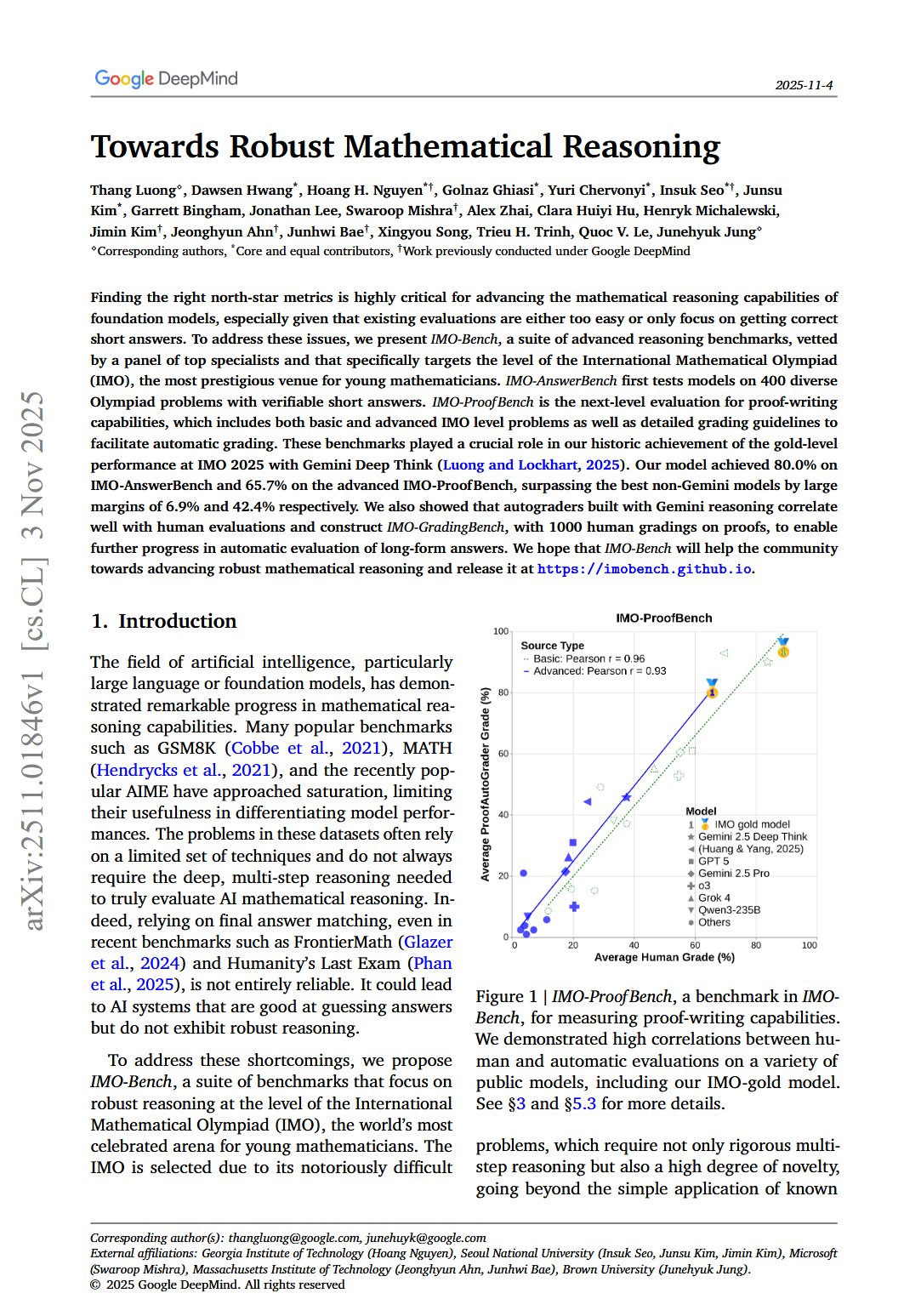
1. Towards Robust Mathematical Reasoning Google DeepMind introduces IMO-Bench, a comprehensive suite of benchmarks vetted by IMO medalists targeting International Mathematical Olympiad-level reasoning.
MACHINE LEARNING
-
Top AI Research Papers: Agents, LLMs, and Mathematical Exploration
By
–
Top AI Papers of the Week (Nov 3 – 9): – Tool-to-Agent Retrieval
– Context Engineering 2.0
– Mathematical Exploration at Scale
– Petri Dish Neural Cellular Automata
– Enhancing Long-Term Memory in LLMs
– Diffusion LMs are Super Data Learners
– Towards Robust Mathematical -

How Agentic AI Works: Data, Reasoning, and Autonomous Action
By
–
How does Agentic AI work? Collects data (APIs, sensors, logs, queries) Reasons & plans with memory + context Executes actions, learns from feedback Produces autonomous, adaptive responses AI that doesn’t just respond — it acts.
#AgenticAI #AI #Automation -

AI-Trader: Five AI Models Compete Autonomously in Market Trading
By
–
AI-Trader enables five distinct AI models, each employing unique investment strategies, to compete autonomously in the same market and determine which can generate the highest profits in NASDAQ 100 or SSE 50 trading! 9k stars already! AI-Trader: Can AI Beat the Market?
-
Share insights on LLMs, AI Agents and Machine Learning
By
–
If you found it insightful, reshare with your network.
— Akshay 🚀 (@akshay_pachaar) 9 novembre 2025
Find me → @akshay_pachaar✔️
For more insights and tutorials on LLMs, AI Agents, and Machine Learning!https://t.co/iYLe5uKmVfIf you found it insightful, reshare with your network. Find me → @akshay_pachaar For more insights and tutorials on LLMs, AI Agents, and Machine Learning!
-

PhysToolBench: Testing MLLMs’ Physical Tool Understanding
By
–
Can AI truly understand tools like humans do? Researchers introduce PhysToolBench, the first benchmark testing MLLMs’ grasp of physical tools—from recognizing and explaining how they work to creatively inventing new ones when none are available. Tests on 32 leading models show
-

DLER Method Cuts AI Output Length by 70% While Improving Accuracy
By
–
Can shorter answers be smarter? Researchers say yes.
— 机器之心 JIQIZHIXIN (@jiqizhixin) 9 novembre 2025
New method DLER pairs simple truncation with better RL tricks to cut output length by >70% while improving accuracy over prior baselines, such as batch reward normalization, higher clipping, dynamic sampling.
It also scales… pic.twitter.com/75UXfQ0a6KCan shorter answers be smarter? Researchers say yes. New method DLER pairs simple truncation with better RL tricks to cut output length by >70% while improving accuracy over prior baselines, such as batch reward normalization, higher clipping, dynamic sampling. It also scales
-
Fine-tuning Your Own LLM vs Sydney Sweeney
By
–
sydney sweeny is great but have you tried fine tuning your own llm
-
Neural Operators for AI and Science at PyTorch Conference
By
–
It was a pleasure to be back at @PyTorch conference and talk about Neural Operators as a foundation for AI+Science. Check out our open-source library in PyTorch
-
FFT and Winograd algorithms for neural network acceleration
By
–
Are you guys using fft, winograd, etc nowadays to speed it up?