
It’s done. All chapters of Build A Reasoning Model (From Scratch) are now available in early access. The book is currently in production and should be out in the next months, including full-color print and syntax highlighting. There’s also a preorder up on Amazon.
MACHINE LEARNING
-
HexRunner Achieves Stable 30 MPH Locomotion Through Speed Design
By
–
Designing for Speed: How HexRunner Achieved Stable 30 MPH Locomotion
— Ronald van Loon (@Ronald_vanLoon) 29 mars 2026
by @lukas_m_ziegler#EmergingTech #Engineering #ArtificialIntelligence #Innovation #Technology pic.twitter.com/W2jAL0BpmWDesigning for Speed: How HexRunner Achieved Stable 30 MPH Locomotion
by @lukas_m_ziegler #EmergingTech #Engineering #ArtificialIntelligence #Innovation #Technology -
AI-Generated Research Published in Nature: Peer Review Implications
By
–
AI Scientist published in Nature is a big deal. I'm curious how the review process handled the fact that the research was AI-generated, that's a fascinating meta question.
-

Crediting Alec for LLM pretraining oversimplifies research history
By
–
Alec is a once in a generational researcher, but saying that he invented pretraining is not only a bit of stretch, but it's also a disrespect to other people's work. Flowers ☾ (@flowersslop) Every LLM from any lab today traces back to this guy, who was the only person at OpenAI pushing for pretraining transformer language models. He built GPT-1. After that did others see the potential. He invented it, and almost none of the so called AI experts even know his name. — https://nitter.net/flowersslop/status/2037892926785634720#m
→ View original post on X — @jeremyphoward, 2026-03-29 12:21 UTC
-
RL Post-training Efficiency: 4x Fewer Rollouts for Coding
By
–
4x fewer rollout turns for competitive accuracy is a big deal for making RL post-training practical. Curious to see if this generalizes beyond coding tasks.
-
Model Improvements Reduce Need for Complex Workflows
By
–
That was last year’s workflow, not doing that much anymore, models got better.
-

Training vs Context: How to Actually Give AI Your Company Data
By
–
If you paste your company data into ChatGPT, you did NOT just train it. ❌ I keep getting different versions of this same question: → Can I inject knowledge directly into the model? → Does adding data through RAG actually change how the model thinks? Let's understand the answer with the example of a small company that sells climbing gear. 🧗 They have a return policy, a product catalog, and internal guidelines. They want AI to handle customer questions. If they paste their return policy into ChatGPT – did they train the model? No. They gave it temporary context. The model's brain didn't change at all. If they build a RAG system that retrieves relevant documents when a question comes in – did they train the model? Still no. They built an external bookshelf the model can read from. But the model itself is exactly the same. If they fine-tune the model on their climbing gear data – now they actually changed the brain. But even then, they didn't insert a clean fact into a specific location. The knowledge gets distributed across millions of parameters. There's no single neuron labeled "climbing shoe return policy." 🧠 So what should they actually do? If the goal is for the model to know a specific fact, don't retrain it. Give it through context or external memory. It's cheaper and more controllable. Save fine-tuning for changing behavior like tone, style, reasoning patterns, not for injecting knowledge. I covered all of this and more in a video: → How embeddings work (without the math) → What the latent space actually is → Why reasoning models aren't fundamentally different → When to choose prompting vs RAG vs fine-tuning The mental model I want you to keep: 👉 Parameters = the brain 👉 Training = changes the brain 👉 Embeddings = coordinates for searching meaning 👉 RAG = a bookshelf the brain reads from 👉 Latent space = the internal geometry created by the brain Full video 👇
-
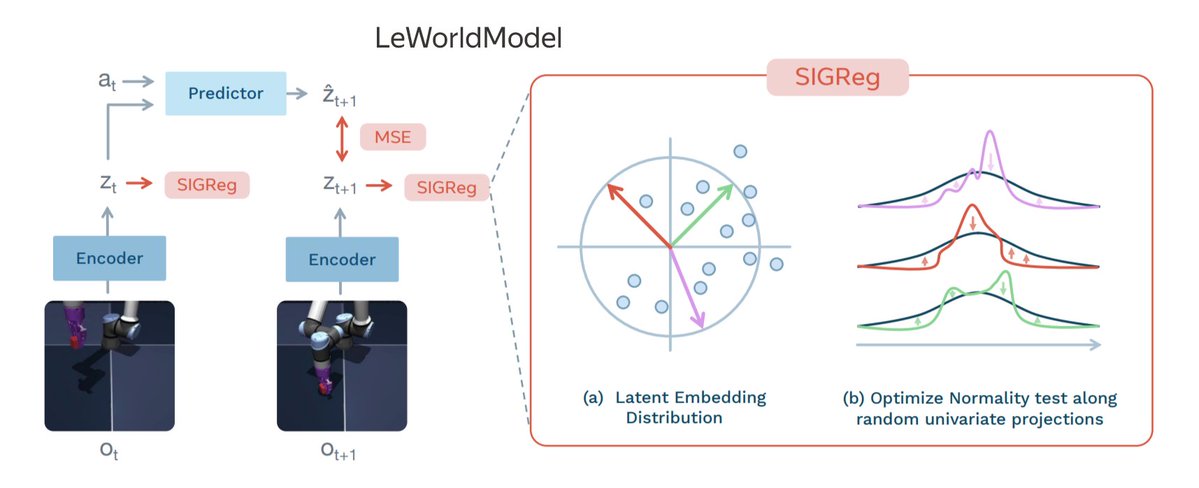
14 most important and influential types of JEPA in AI
By
–
14 most important and influential types of JEPA ▪️ JEPA / H-JEPA
▪️ I-JEPA
▪️ MC-JEPA
▪️ V-JEPA
▪️ Audio-JEPA
▪️ Point-JEPA
▪️ 3D-JEPA
▪️ ACT-JEPA
▪️ V-JEPA 2
▪️ LeJEPA
▪️ Causal-JEPA
▪️ V-JEPA 2.1
▪️ LeWorldModel
▪️ ThinkJEPA Save the list and check this out to explore these JEPA milestones as a map of AI progress: turingpost.com/p/jepamap [Translated from EN to English]→ View original post on X — @debashis_dutta, 2026-03-29 11:51 UTC
-
KV Cache Optimization and DDR5 Memory Pricing Misconception
By
–
The claim mixes up memory types: KV cache optimization (like TurboQuant) reduces GPU VRAM usage during inference, not system memory like DDR5 RAM. DDR5 prices are driven by broader semiconductor supply-demand cycles, so there’s no direct link between KV cache compression and
-

Google Open-Sources TimesFM: Foundation Model for Time Series Forecasting
By
–
Google open-sourced a time series foundation model. it works with any data without training. unlike traditional models, no dataset-specific training needed. TimesFM forecasts out of the box. trained on 100B real-world time-points across traffic, weather & demand forecasting.
→ View original post on X — @debashis_dutta, 2026-03-29 09:30 UTC