Three beginner-friendly analytics projects you can finish in an afternoon with Databricks Free Edition • Analyze a simulated environment using AI/BI Dashboards and AI_Query()
• Explore sample trends and generate predictions with AI_Forecast()
• Load open data with Python and
MACHINE LEARNING
-
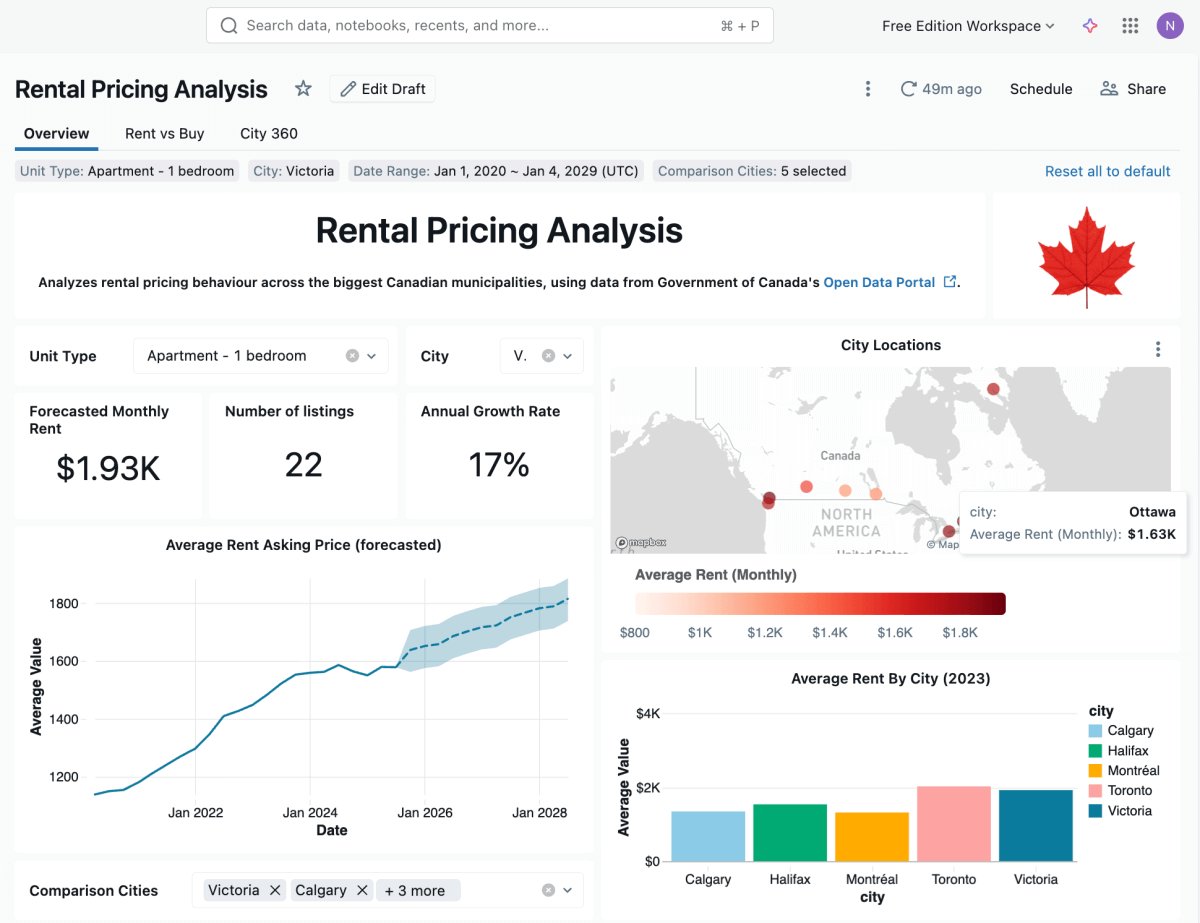
Beginner Analytics Projects with Databricks Free Edition
By
–
-

Self-Organizing LLM Agents Outperform Predefined Role Hierarchies
By
–
NEW papers on self-organizing LLM Agents. Assign an agent a role, and it'll follow instructions. Let agents figure out roles themselves, and they'll outperform your design. New research tested this across 25,000 tasks with up to 256 agents. The work shows that self-organizing LLM agents spontaneously develop specialized roles without any predefined hierarchy. A sequential coordination protocol outperformed centralized approaches by 14%, agents generated over 5,000 unique roles organically, and open-source models reached 95% of closed-source quality at significantly lower cost. Most multi-agent frameworks today start by defining roles: planner, coder, reviewer, critic. This paper provides large-scale evidence that the opposite approach works better. Give agents a mission, a protocol, and a capable model. The agents will figure out the rest. Paper: arxiv.org/abs/2603.28990 Learn to build effective AI agents in our academy: academy.dair.ai/
-
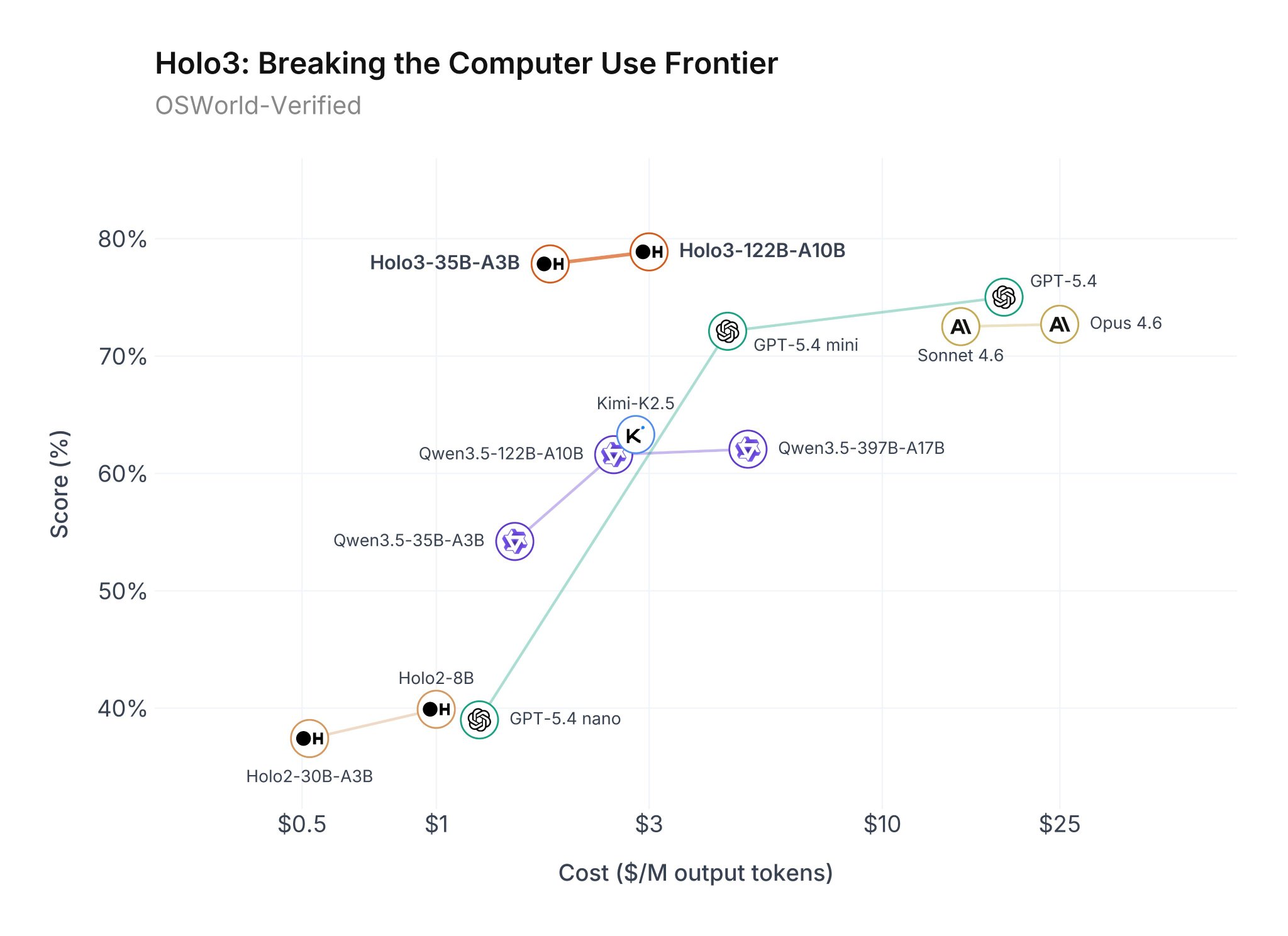
Achieving 78.9% on OS-world, Outperforming GPT-5.4 at Lower Cost
By
–
Ngl, reaching 78,9% on OS-world and outperforming even GPT-5.4 at 1/10 cost is a big deal
-

MemFactory: Unified Framework for Trainable Agent Memory Systems
By
–
// Unified Inference and Training Framework for Agent Memory // Most memory-augmented agents are built with duct tape—one system for storage, another for retrieval, a third for training. New research introduces a unified framework that treats agent memory as a first-class, trainable component. MemFactory provides modular, plug-and-play memory components with native GRPO integration for fine-tuning memory management policies through RL. It supports Memory-R1, RMM, and MemAgent paradigms in one framework, with up to 14.8% relative gains over baselines. Why does it matter? As agents move from single-turn tools to persistent assistants, memory becomes the bottleneck. MemFactory gives researchers standardized infrastructure to build, train, and evaluate memory-driven agents without reinventing plumbing for every new approach. Paper: arxiv.org/abs/2603.29493 Learn to build effective AI agents in our academy: academy.dair.ai/
-
Code-as-Policy Framework for Robot Perception and Control
By
–
Very excited about the prospect of Code-as-Policy (CaP) for Robotics!
— Ken Goldberg (@Ken_Goldberg) 1 avril 2026
Esp with recent rapid advances in agentic coding. CaP has potential to quickly combine VLA models with GOFE primitives into interpretable code, observe experiments, and iterate. Initial results are promising: https://t.co/Z60Q1TwbNkVery excited about the prospect of Code-as-Policy (CaP) for Robotics! Esp with recent rapid advances in agentic coding. CaP has potential to quickly combine VLA models with GOFE primitives into interpretable code, observe experiments, and iterate. Initial results are promising: Max Fu (@letian_fu) Robotics: coding agents’ next frontier. So how good are they? We introduce CaP-X: an open-source framework and benchmark for coding agents, where they write code for robot perception and control, execute it on sim and real robots, observe the outcomes, and iteratively improve code reliability. From @NVIDIA @Berkeley_AI @CMU_Robotics @StanfordAILab capgym.github.io 🧵 — https://nitter.net/letian_fu/status/2039342130565357956#m
→ View original post on X — @ken_goldberg, 2026-04-01 14:25 UTC
-
Neural Network Generates Real-Time Multiplayer Game Engine
By
–
Via @sallyeaves https://t.co/HO8WaYuX01
— nomoreslaves (@nomoreslaves) 1 avril 2026Via @sallyeaves Gordon Wetzstein (@GordonWetzstein) We built a real-time multiplayer game generated entirely by a neural network—and now you can actually play it. In collaboration with @modal, we just launched the live demo for MultiGen, our diffusion-based multiplayer game engine. Grab some friends and try it here 👇 — https://nitter.net/GordonWetzstein/status/2038987059835306043#m
→ View original post on X — @sallyeaves, 2026-04-01 14:01 UTC
-
Deep Generative Model for Cell ATACseq and RNAseq Profiling
By
–
A Deep Generative Model for Profiling of cell ATACseq and RNAseq. #BigData #Analytics #DataScience #AI #MachineLearning #IoT #IIoT #Python #RStats #TensorFlow #JavaScript #ReactJS #Serverless #DataScientist #Linux #Programming #Coding #100DaysofCode https://
geni.us/Gen-RNASeq -
SIGReg and LeWM Experiments: Challenges with Value Function Generalization
By
–
Adding a little bit of SIGReg to prefinal activations did coerce them into independent Gaussian, but it hurt generalization on value functions. Training a full LeWM ahead of time also resulted in worse value function estimation. I’m not giving up yet, but my first few attempts
-

Tri-System Theory: AI’s Impact on Human Reasoning and Cognitive Autonomy
By
–
Thinking—Fast, Slow, and Artificial: How AI is Reshaping Human Reasoning and the Rise of Cognitive Surrender papers.ssrn.com/sol3/papers.… ✍️Steven D. Shaw & Gideon Nave via @SSRN @Wharton 👉 "We introduce Tri-System Theory, extending dual-process accounts of reasoning by positing System 3: artificial cognition that operates outside the brain" 👉 "System 3 can supplement or supplant internal processes, introducing novel cognitive pathways" 👉 "Across studies, participants with higher trust in AI and lower need for cognition and fluid intelligence showed greater surrender to System 3" 💡 "Tri-System Theory thus characterizes a triadic cognitive ecology, revealing how System 3 reframes human reasoning and may reshape autonomy and accountability in the age of AI" @Corix_JC @ahier @sim010101 @maponi @sallyeaves @CEO_AISOMA @dinisguarda @JagersbergKnut @FernandaKellner @PVynckier @EstelaMandela @sulefati7 @ChuckDBrooks @SusanHayes_ @theomitsa @TarakRindani @FrRonconi @Nicochan33 @JoannMoretti @Khulood_Almani @TheAIObserverX @pchamard @mikeflache @TysonLester @smaksked @amalmerzouk @Analytics_699 @MaryRich78 @NathaliaLeHen @sminaev2015 @WillyRayNick @RLDI_Lamy
→ View original post on X — @sallyeaves, 2026-04-01 13:52 UTC
-

Simple Battle-Tested Algorithms Outperform AI Systems
By
–
Simple, Battle-Tested Algorithms Still Outperform #AI buff.ly/UejRET3 @Hackernoon by Jose Crespo PhD Cc @jblefevre60 @Fabriziobustama @HaroldSinnott @gezgintrk @sallyeaves @SpirosMargaris @efipm
→ View original post on X — @sallyeaves, 2026-04-01 13:30 UTC