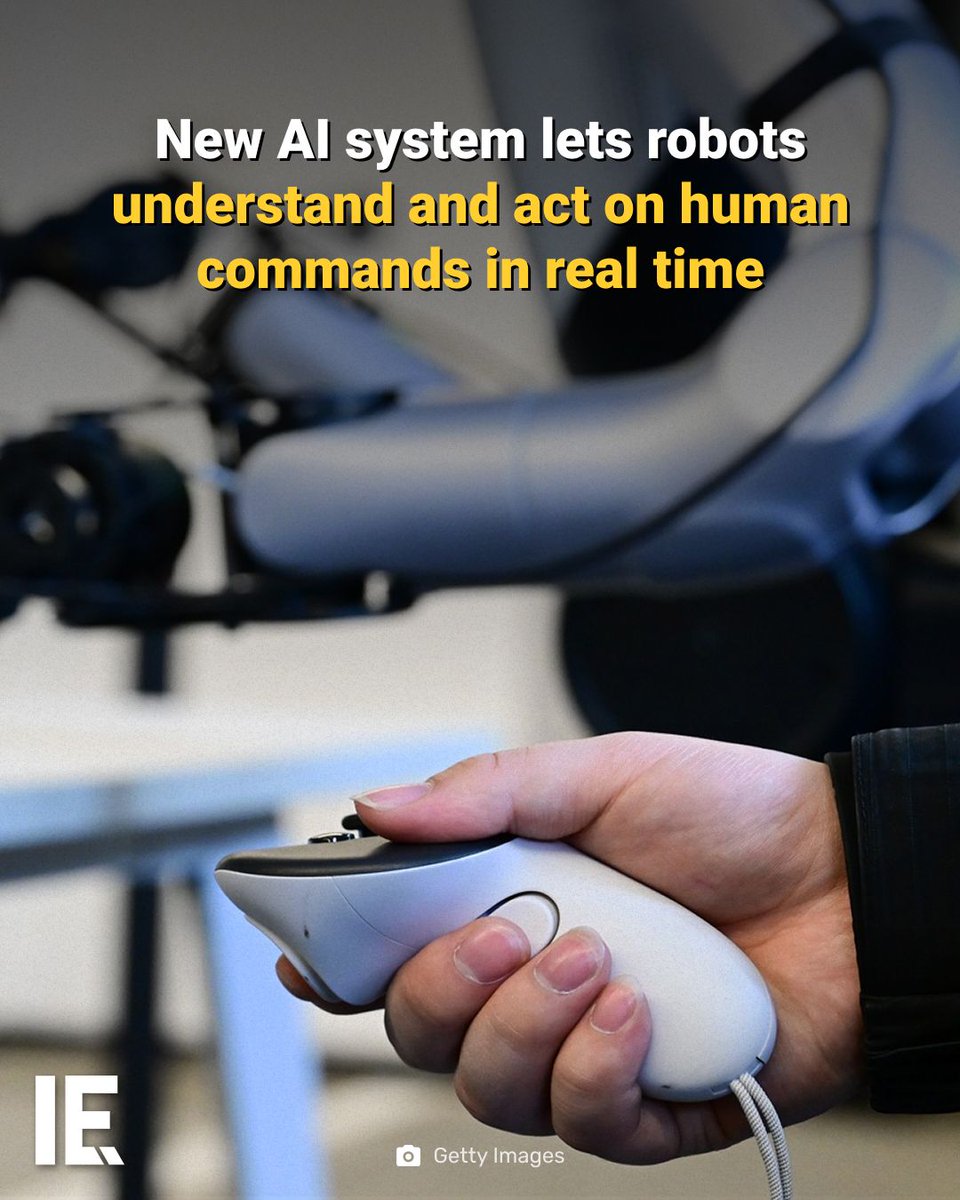
New #AI system lets #Robots understand and act on human commands in real time by Neetika Walter @IntEngineering Learn more: bit.ly/4vqhaKe #Robotics #Engineering #ArtificialIntelligence #Innovation #Technology
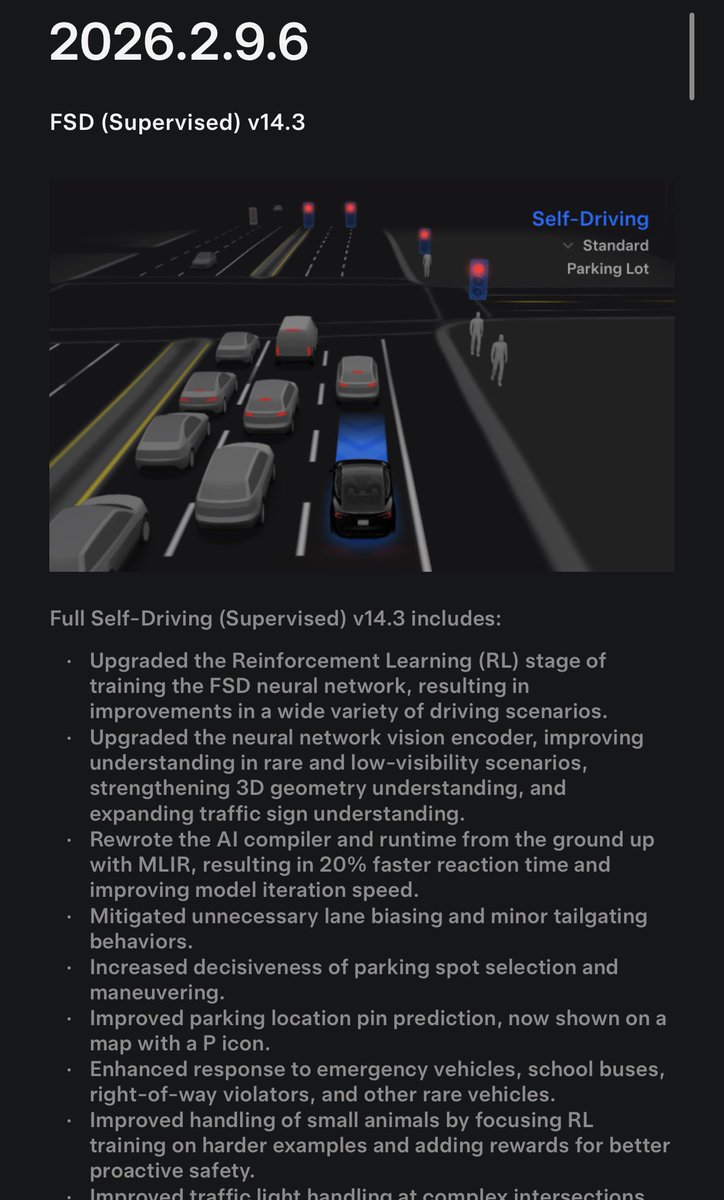
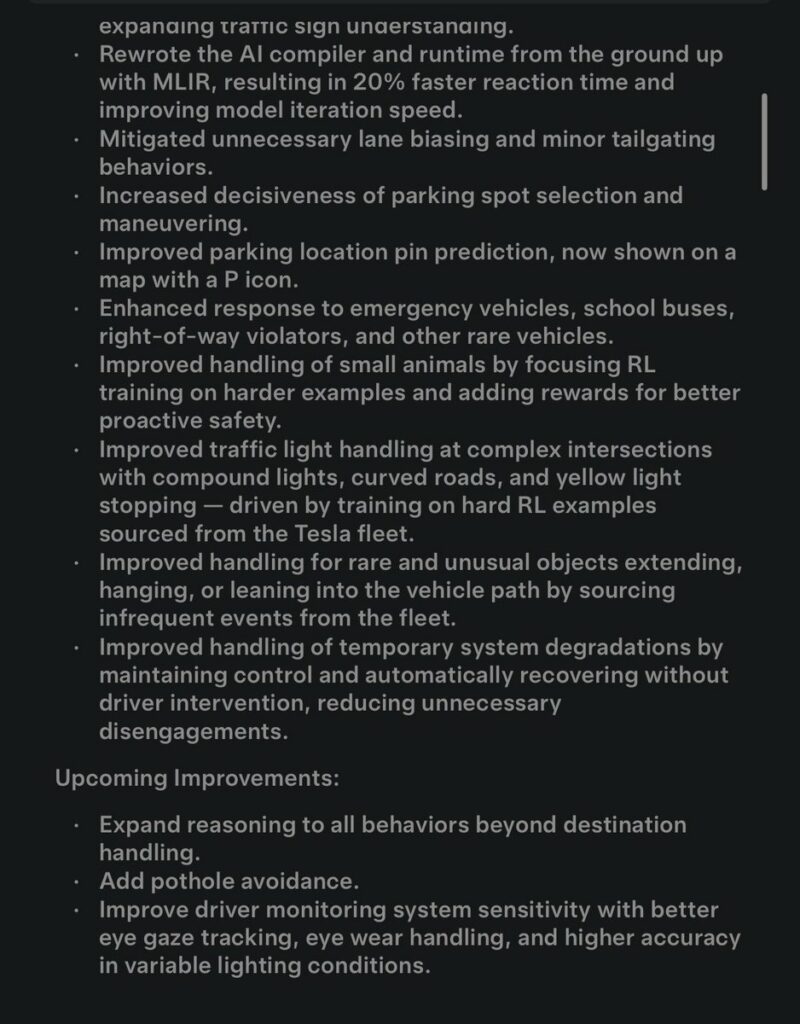
BREAKING: Tesla has officially released FSD V14.3 I'm downloading it in my Model Y right now. Here's everything that's new: • Improved parking location pin prediction, now shown on a map with a P icon. • Increased decisiveness of parking spot selection and maneuvering. • Rewrote the Al compiler and runtime from the ground up with MLIR, resulting in 20% faster reaction time and improving model iteration speed. • Enhanced response to emergency vehicles, school buses, right-of-way violators, and other rare vehicles. • Mitigated unnecessary lane biasing and minor tailgating behaviors. • Improved handling of small animals by focusing RL training on harder examples and adding rewards for better proactive safety. • Improved traffic light handling at complex intersections with compound lights, curved roads, and yellow light stopping – driven by training on hard RL examples sourced from the Tesla fleet. • Upgraded the Reinforcement Learning (RL) stage of training the FSD neural network, resulting in improvements in a wide variety of driving scenarios. • Upgraded the neural network vision encoder, improving understanding in rare and low-visibility scenarios, strengthening 3D geometry understanding, and expanding traffic sign understanding. • Improved handling for rare and unusual objects extending, hanging, or leaning into the vehicle path by sourcing infrequent events from the fleet. • Improved handling of temporary system degradations by maintaining control and automatically recovering without driver intervention, reducing unnecessary disengagements. Upcoming Improvements: • Expand reasoning to all behaviors beyond destination handling. • Add pothole avoidance. • Improve driver monitoring system sensitivity with better eye gaze tracking, eye wear handling, and higher accuracy in variable lighting conditions.
What if your LLM could dramatically reduce memory usage without sacrificing quality, even in tough situations? Researchers at University of Science and Technology of China & Data Darkness Lab present DefensiveKV. They tackle the fragility of LLM Key-Value cache eviction by using a smart, two-step "defensive aggregation strategy." This approach proactively controls worst-case risks, preventing performance drops in extreme scenarios with negligible computational cost. Layer-DefensiveKV extends this with intelligent layer-wise budget allocation. Their methods slash generation quality loss by an impressive 2.3x and 4.3x respectively against the strongest baselines, across seven task domains and 18 datasets, even when cache is cut to just 20%. This breakthrough sets new performance benchmarks for efficient LLM inference! DefensiveKV: Taming the Fragility of KV Cache Eviction in LLM Inference Paper: openreview.net/forum?id=nJgS… Code: github.com/FFY0/DefensiveKV/… Our report: mp.weixin.qq.com/s/81wiPTdye… 📬 #PapersAccepted by Jiqizhixin
Y FUAH! Independientemente de lo costoso del modelo y tal, esta es una evidencia clara de que esto no para, y sobre todo en programación. Habiendo asumido un ritmo rápido pero progresivo con cada nuevo modelo, sorprende ver un salto tan bestia de golpe. Curvas vienen
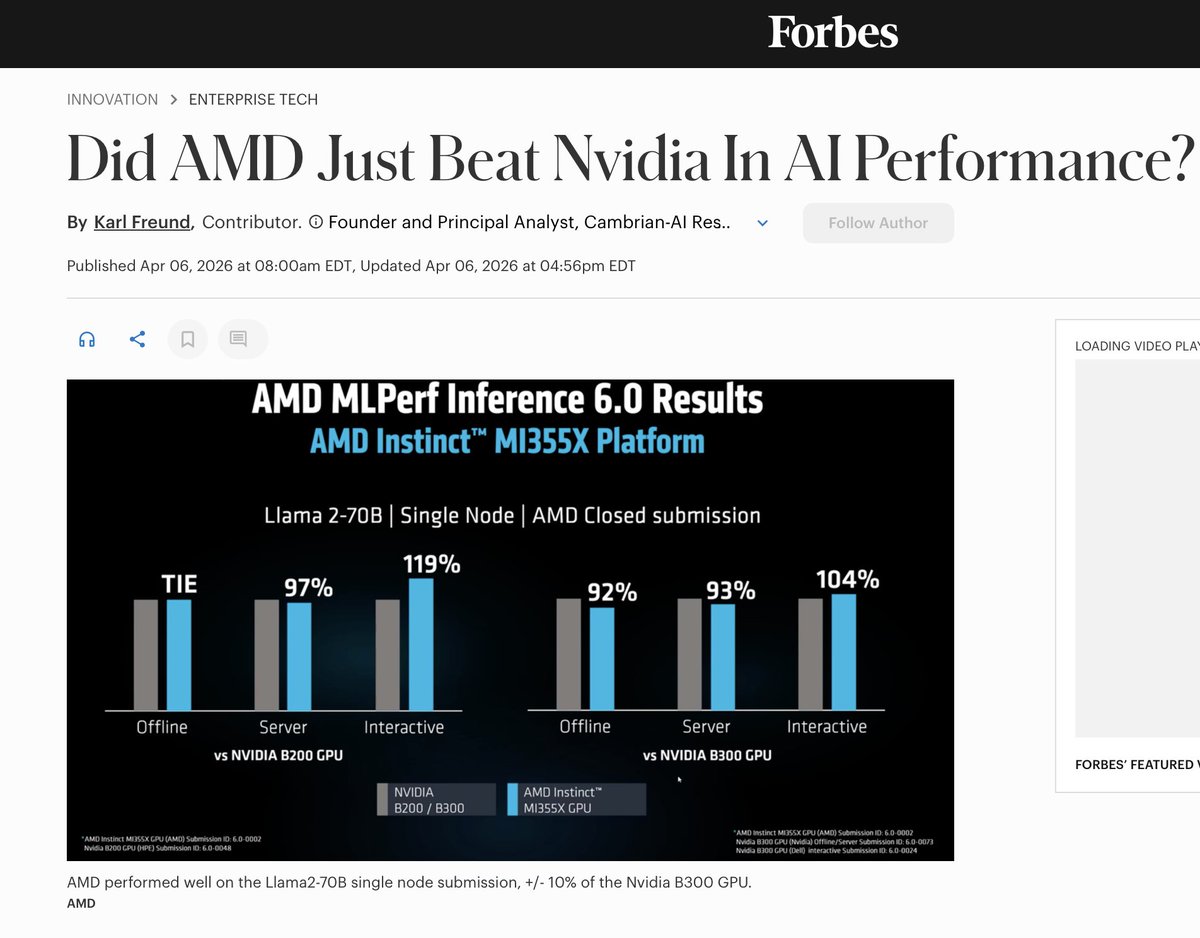
Did AMD Just Beat NVIDIA In AI Performance? No. And the article itself says so. I really don't like clickbaity headlines. They even state it at the very end, though the title suggest a bit otherwise: "NVIDIA ran every newly added benchmark and won every one of them. Only two of these were attempted by AMD, and for which Nvidia out-performed them by ~30 and ~50%. So, no, AMD did not beat Nvidia." MLPerf 6.0 results are out and the actual data tells a clear story: -NVIDIA won every new benchmark it entered -GB300 NVL72 delivered nearly 3x more throughput than 6 months ago, same hardware, better software -2.5M tokens/sec on DeepSeek R1 with 288 B300s AMD made real progress with the MI355X; getting within 10-30% on select single-node tests is no joke. And they deserve credits for that. But they skipped most new benchmarks and didn't compete on the hardest models. Imho / take: The real story isn't GPU vs GPU anymore. It's full-stack AI infrastructure: networking, software optimization, disaggregated serving. And tbh that's where NVIDIA keeps pulling ahead.
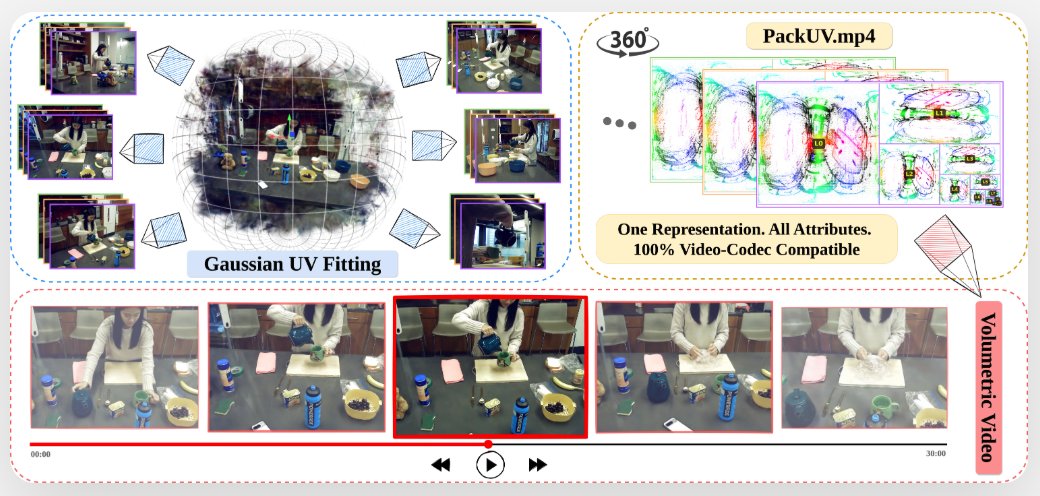
Imagine watching a concert not from a fixed camera angle, but from any angle. The catch? Volumetric video is incredibly hard to store and stream. Our work, PackUV, tackles exactly this problem. Learn more and see PackUV at work at Brown CS Blog: blog.cs.brown.edu/2026/04/07/packuv-video-native-representations-for-streaming-4d-scenes [Translated from EN to English]
Today, Niantic Spatial introduces Scaniverse — our flagship product and the gateway to our spatial intelligence platform and Large Geospatial Model.
Here’s what’s new:
🔹Scaniverse (iOS mobile + web): Capture once, generate multiple outputs—VPS maps, meshes, and Gaussian splats… pic.twitter.com/ChYvXSsGbO
— Niantic Spatial 🌎 (@NianticSpatial) 7 avril 2026
Today, Niantic Spatial introduces Scaniverse — our flagship product and the gateway to our spatial intelligence platform and Large Geospatial Model. Here’s what’s new: 🔹Scaniverse (iOS mobile + web): Capture once, generate multiple outputs—VPS maps, meshes, and Gaussian splats (Android coming soon) 🔹Collaborative mapping: Multi-user scans fused into a single, continuously improving model 🔹 On-device validation: Preview VPS coverage and test localization in real time 🔹VPS 2.0: Global-scale positioning—centimeter-accurate where mapped, reliable everywhere else (even where GPS fails) 🔹NSDK 4.0 (coming soon): A unified SDK across Unity, Swift, Android, and ROS 2 Read more: hubs.ly/Q049Tpkb0 #NianticSpatial #Scaniverse #VPS #GeospatialAI #AI
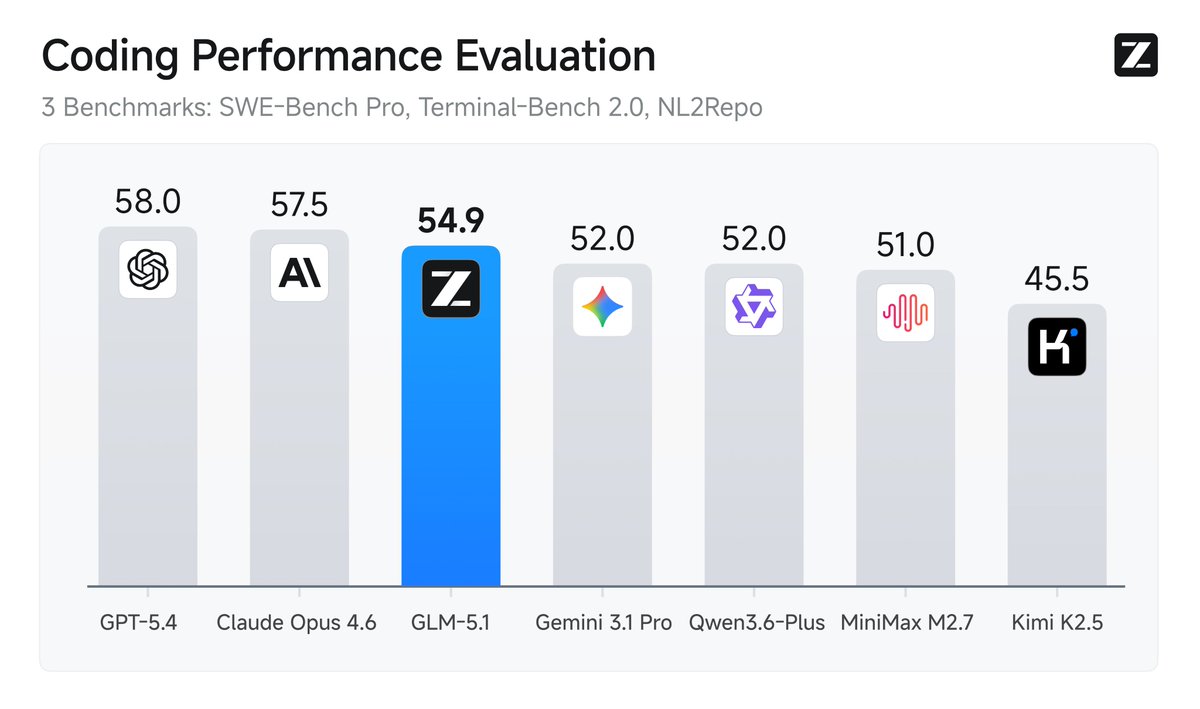
754B parameters, 1.51TB on Hugging Face Z.ai (@Zai_org) Introducing GLM-5.1: The Next Level of Open Source – Top-Tier Performance: #1 in open source and #3 globally across SWE-Bench Pro, Terminal-Bench, and NL2Repo. – Built for Long-Horizon Tasks: Runs autonomously for 8 hours, refining strategies through thousands of iterations. Blog: z.ai/blog/glm-5.1 Weights: huggingface.co/zai-org/GLM-5… API: docs.z.ai/guides/llm/glm-5.1 Coding Plan: z.ai/subscribe Coming to chat.z.ai in the next few days. — https://nitter.net/Zai_org/status/2041550153354519022#m
Releasing one of our *largest* robotics project yet in the open We collected and annotated hours of clothes folding with open-arms and collaborators. We then explored how to train the best clothes folding robotic model for bimanual setups. And now we're releasing it all fully in the open: data, code, models, software, explorations, learnings, you name it Enjoy, play with it, use these learnings and share yours! PS: the hub is increasingly *the* place where robotics data is being shared and used, come take a look if you haven't yet. Robotics data has been our fastest growing dataset category by far over the past few months. LeRobot (@LeRobotHF) Releasing the Unfolding Robotics blog! Time to unfold robotics: we trained a robot to fold clothes using 8 bimanual setups, 100+ hours of demonstrations, and 5k+ GPU hours. Flashy robot demos are everywhere. But you rarely see the real story: the data, the failures, the engineering. We’re sharing everything: code, data, and details in the blog → huggingface.co/spaces/lerobo… — https://nitter.net/LeRobotHF/status/2041542790610297259#m