Read our technical blog and access the open-source toolkit for kUPS in the link below. No more context switching… just science. Blog: https://
medium.com/@CuspAI/kups-a
-molecular-simulation-engine-for-the-ai-era-b213963a2359
… Github:
MACHINE LEARNING
-
kUPS: Molecular Simulation Engine for AI Era
By
–
-
ML accelerates molecular simulation for faster scientific discovery
By
–
We’re breaking down the barriers between ML research and molecular simulation to help scientists run diverse simulations – such as this one showing proton hopping in a sulfuric acid solution – faster than ever.
— Max Welling (@wellingmax) 23 avril 2026
Massive shoutout to the team for making this a reality. pic.twitter.com/THc05nBRrEWe’re breaking down the barriers between ML research and molecular simulation to help scientists run diverse simulations – such as this one showing proton hopping in a sulfuric acid solution – faster than ever. Massive shoutout to the team for making this a reality.
-
Computational Scientists Face Workflow Friction in Molecular Modeling
By
–
Whether it’s screening semiconductor materials or exploring drug-protein interactions, computational scientists hit the same wall: workflow friction and inefficiency. But modelling complex molecular phenomena shouldn't feel like a battle.
-
Streamlining AI Workflows: GPU Efficiency and Integration Challenges
By
–
Real-world applications usually require a clunky, fragmented workflow: Chaining disparate, complex packages
Writing hundreds of lines of configuration
Poor GPU efficiency -
kUPS: Molecular Simulation Engine for AI Workflows
By
–
Today at @iclr_conf 2026, I was excited to announce kUPS: a molecular simulation engine built for the AI era, optimized for GPU in collaboration with NVIDIA. kUPS is a plug-and-play, Python-native toolkit designed to integrate seamlessly with modern ML workflows.
-
AI Models Reaching Excellence in Code, Struggling Elsewhere
By
–
It's not "meh", and it's not plateauing. I think we're just reaching a point where, for the things the models were already good at (i.e. code), they are becoming absolutely excellent, and it's hard to tell the difference between releases. And for things that they're not yet good
-
Early Access to GPT-5.5 Pro Version Announced
By
–
I had early access to GPT-5.5. It is very good, especially the Pro version. Full writeup very shortly.
-
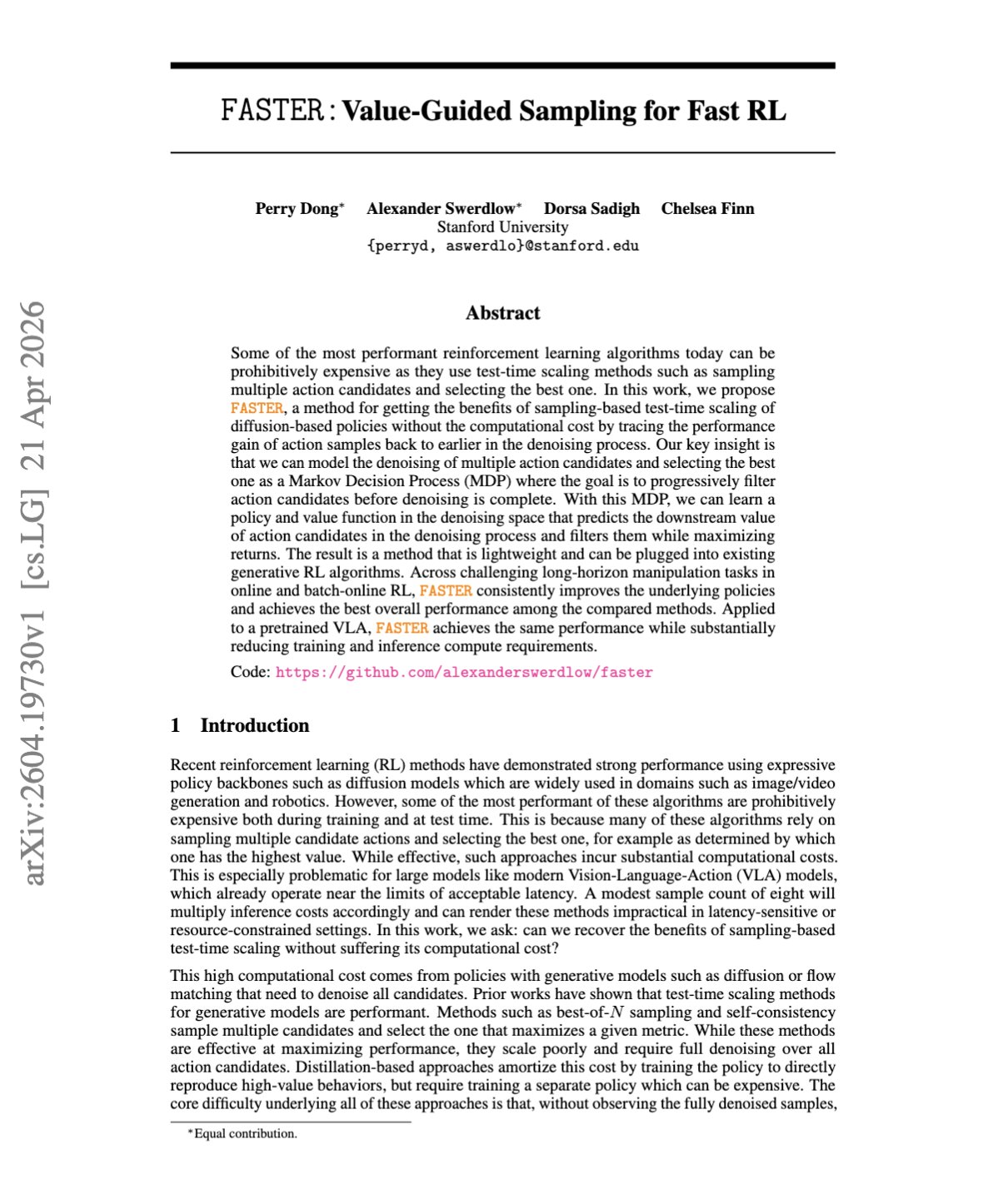
FASTER: Value-Guided Sampling Improves Reinforcement Learning Efficiency
By
–
"FASTER: Value-Guided Sampling for Fast RL" Instead of fully denoising many action candidates and picking the best one at the end, it learns a critic over the noise seed and selects the promising sample upfront. They showed that the advantage of best-of-N is already visible
-

OpenAI announces GPT-5.5: smarter, faster AI model
By
–
Hello GPT-5.5!
— Romain Huet (@romainhuet) 23 avril 2026
Our best model yet is here. It’s smarter, faster, and gets more done.
I had the chance to capture first reactions from developers building with it: it writes better code, understands more complex tasks, and keeps going.
Can’t wait to see what you build with it! pic.twitter.com/k1w60WZeaDHello GPT-5.5! Our best model yet is here. It’s smarter, faster, and gets more done. I had the chance to capture first reactions from developers building with it: it writes better code, understands more complex tasks, and keeps going. Can’t wait to see what you build with it!
-

Vision Banana: Rethinking AI Model Generalization in Vision
By
–
Vision Banana: Rethinking How AI Models See and Generalize
— Satya Mallick (@LearnOpenCV) 23 avril 2026
In this episode of Artificial Intelligence: Papers and Concepts, we explore Vision Banana, a concept that challenges how vision models learn and generalize from visual data. Instead of focusing purely on performance… pic.twitter.com/vgp0LQbMFiVision Banana: Rethinking How AI Models See and Generalize In this episode of Artificial Intelligence: Papers and Concepts, we explore Vision Banana, a concept that challenges how vision models learn and generalize from visual data. Instead of focusing purely on performance