Long-running agentic execution: GPT-5.5
→ Terminal-Bench 2.0: 82.7% → Claude Opus 4.7: 69.4% That's a 13-point gap. Not noise.
→ OSWorld-Verified: 78.7% vs 78.0% → BrowseComp → CyberGym When the task requires driving a terminal, recovering from errors, and
MACHINE LEARNING
-
GPT-5.5 outperforms Claude Opus 4.7 by 13 points on terminal benchmarks
By
–
-
Claude Opus 4.7 dominates reasoning and code benchmarks
By
–
Deep reasoning and code precision: Claude Opus 4.7 → SWE-Bench Pro: 64.3% → GPT-5.5: 58.6% → MCP Atlas: 79.1% → GPT-5.5: 75.3% → GPQA Diamond, HLE (with and without tools), FinanceAgent v1.1: all Opus 4.7 When the task requires architectural thinking
-
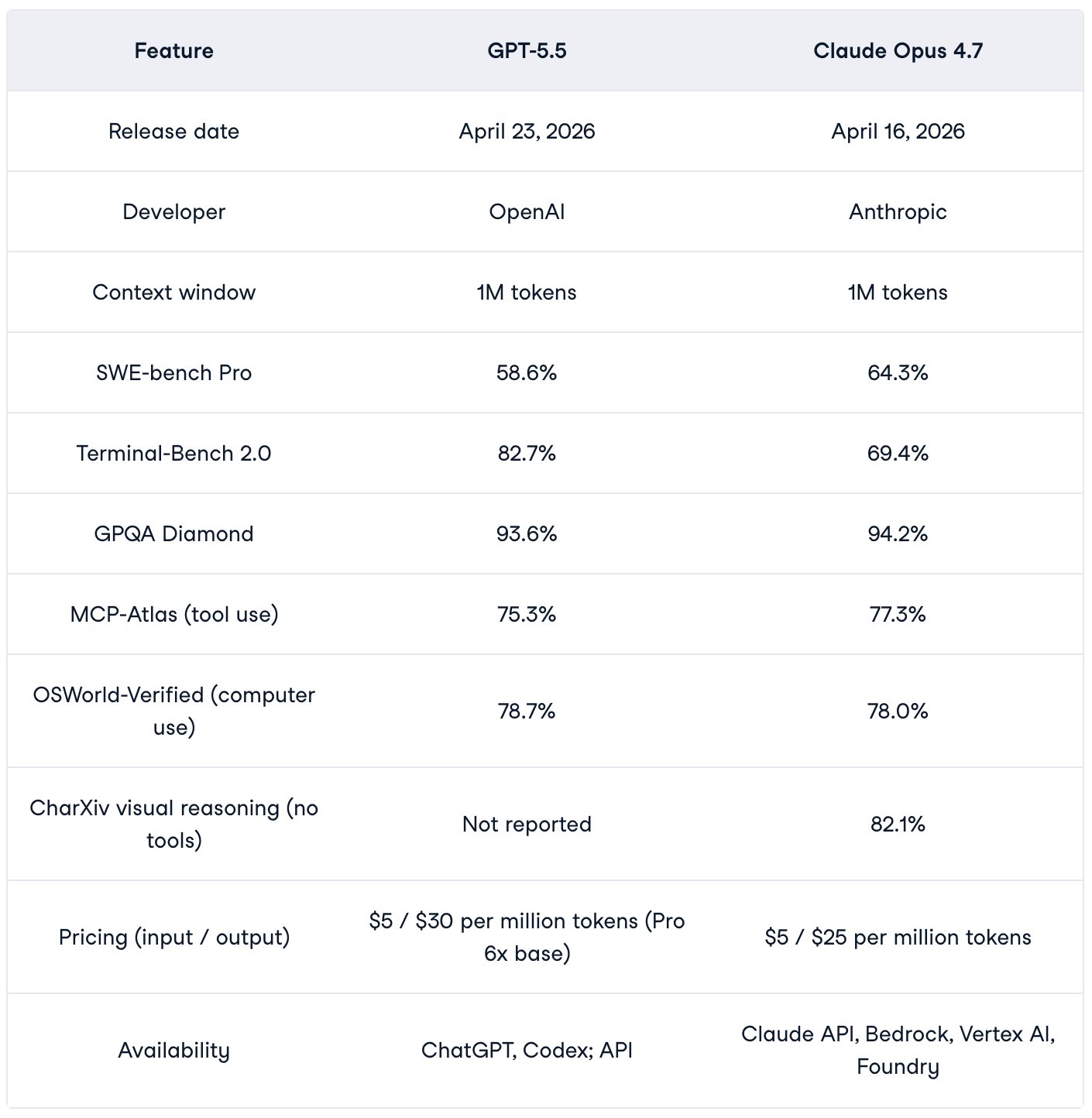
Claude Opus 4.7 leads GPT-5.5 on 6 of 10 benchmarks by category
By
–
On the 10 benchmarks where both OpenAI and Anthropic report scores, here's the split: Claude Opus 4.7 leads on 6. GPT-5.5 leads on 4. But the leads aren't random. They cluster by category. And that changes what "winning" means entirely.
-
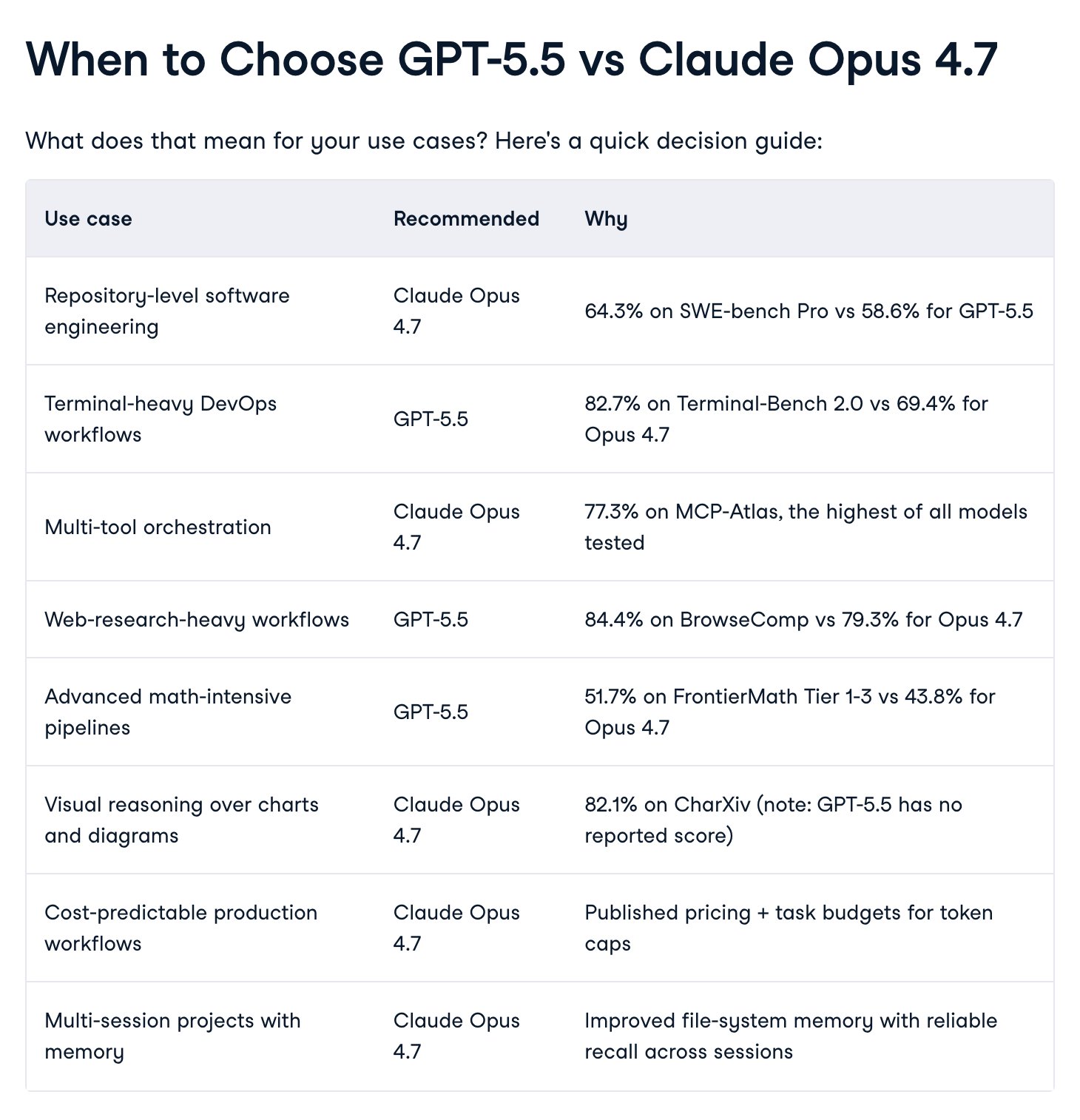
GPT-5.5 vs Claude Opus 4.7: The real benchmark story
By
–
GPT-5.5 shipped 7 days after Claude Opus 4.7. Everyone picked a winner based on headlines. I looked at every benchmark both labs published. The real story isn't what most people are reporting:
-

SAS Models Improve Fraud Detection Performance at SASInnovate
By
–
Dinesh Jayaraman, VP Fraud Strategy & Model Implementation at Discover (center) takes the #SASInnovate stage with SAS' Stu Bradley and Udo Sglavo to share more about how SAS Models are helping improve performance.
-
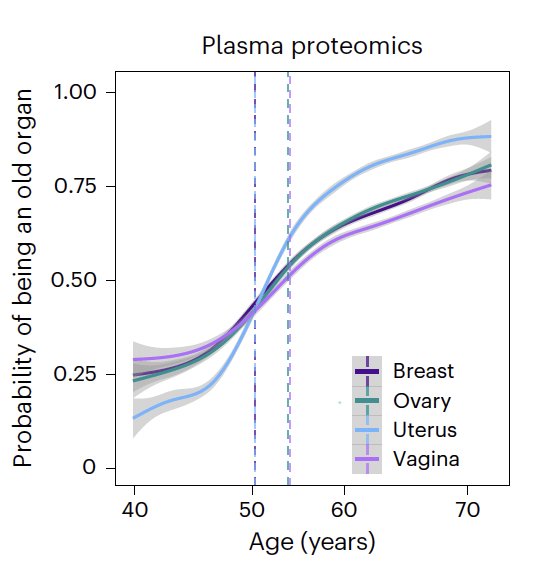
Organs Age Differently: Plasma Proteins Track Individual Aging Rates
By
–
Our organs age at a different pace intra-individual, as tracked through plasma proteins. Now confirmed for female reproductive organs @NatureAging https://
nature.com/articles/s4358
7-026-01098-y
… -
AI Model Learns to Taste from Recipe Patterns Alone
By
–
KAIKAKU AI just trained an AI to taste.
— The Rundown AI (@TheRundownAI) 29 avril 2026
Their team fed the model nothing but recipes from existing cookbooks. No nutrition data or chemistry.
The model worked out what was sweet, salty, spicy, and bitter from ingredient pairings alone.
It even picked up texture (chewy vs.… pic.twitter.com/DBywifYj0AKAIKAKU AI just trained an AI to taste. Their team fed the model nothing but recipes from existing cookbooks. No nutrition data or chemistry. The model worked out what was sweet, salty, spicy, and bitter from ingredient pairings alone. It even picked up texture (chewy vs.
-
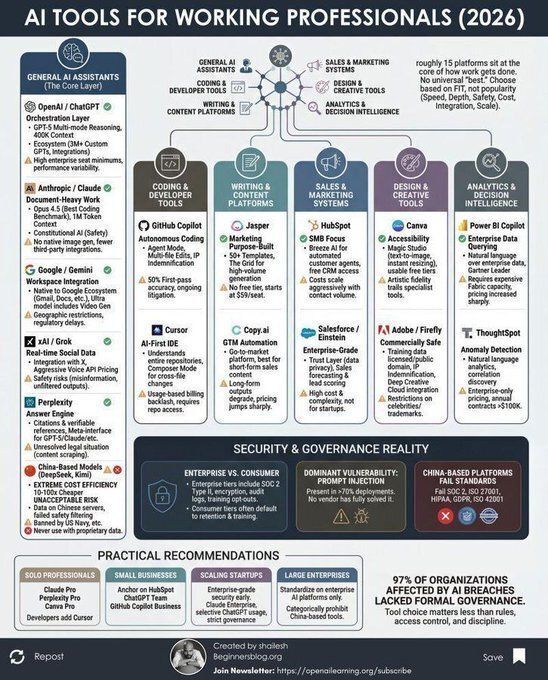
AI Tools for Working Professionals in Machine Learning
By
–
#AI Tools for Working Professional
by @AlwaysKeepL #MachineLearning #ArtificialIntelligence #ML -
Embedding Layers in Small Models: Architecture and Training Optimization
By
–
Did you know that the embedding layer can contain 63% of total model parameters? In this talk, I present unique challenges of small models from architecture (don't build giant embedding layers) to post-training (how to fix doom looping) ↓ Slides in the comments ↓
-
AI Generation Quality Assessment Beyond Candidate Quantity
By
–
Generating candidates is now easy compared to back then. An AI can generate: 100 prompt variants 50 code changes 20 tool-routing ideas 10 eval rewrites 5 new workflows
The question is not “can it come up with changes?”
The question is “which changes are actually better?”