Good summary about our LTM Benchmark
MACHINE LEARNING
-
179x Speedup Breakthrough in Molecular Dynamics with CS-2
By
–
🎉 Our MLSys Mixer was a smash!🎉
— Cerebras (@cerebras) 16 mai 2024
We had over 100+ register and join on the eve of our monumental announcements!
In case you missed it, we announced the following:
📢 Molecular Dynamics Breakthrough: 179x speedup over Frontier Supercomputer using a single CS-2 -… pic.twitter.com/kMHDhNyL34Our MLSys Mixer was a smash! We had over 100+ register and join on the eve of our monumental announcements! In case you missed it, we announced the following: Molecular Dynamics Breakthrough: 179x speedup over Frontier Supercomputer using a single CS-2 –
-
LMSYS Could Monetize Preference Data Through Reward Model Licensing
By
–
lmsys is sitting on a gold mine. If they train on all of the preference data they’ve collected, they will have (by far) the best AI-agnostic reward model in the world. License that out to model developers — they’ll pay a ton, as more robust preference models = far better AIs.
-
Daily Content Sharing on Python, Data Science, and Machine Learning
By
–
That's a wrap! If you are interested in any of these below topics: – Python – Data Science – Machine Learning – Data Analysis – LLMs – MLOps Find me → @Sumanth_077 I'm sharing daily content over here.
-

cuDF Pandas Accelerator: Overcome In-Memory Limitations
By
–
Pandas operates in-memory, as it loads the entire dataset into the local memory of the machine it is running on. This limits its ability to handle large datasets. With cuDF’s pandas accelerator you can now bring accelerated computing to pandas workflows.
-
RAPIDS cuDF Library Now Integrated in Google Colab
By
–
Also their cuDF library will automatically know if you're running on GPU or CPU and speed up your processing. RAPIDS cuDF is now integrated directly into Google Colab. Checkout the Colab Notebook: https://
colab.research.google.com/github/rapidsa
i-community/showcase/blob/main/getting_started_tutorials/cudf_pandas_colab_demo.ipynb?ncid=ref-inor-594904
… Check out the Repo: -
NVIDIA Makes Pandas 150x Faster with Simple Code Addition
By
–
Pandas is a powerful data analysis and manipulation library for Python!
— Sumanth (@Sumanth_077) 16 mai 2024
NVIDIA just made Pandas 150x faster with zero code changes🔥
All you have to add is just a couple of lines of code:
%load_ext cudf.pandas
import pandas as pd pic.twitter.com/bgllBZCqDTPandas is a powerful data analysis and manipulation library for Python! NVIDIA just made Pandas 150x faster with zero code changes All you have to add is just a couple of lines of code: %load_ext cudf.pandas
import pandas as pd -

Residual Quantisation: VQ-VAE Improvement for Data Compression
By
–
This is a great K-AI paper on residual quantisation. It is an improvement over VQ-VAE. In short, after quantising the data (images, video, audio) one also quantizes the resulting error to get a finer aggregate description, which is then passed to the decoder. @kchonyc I’m
-
Prompt variations and dimensionality-reduction terms for ChatGPT
By
–
Good catch — when I saw this on ChatGPT 4 (not 4o) a few weeks ago I used “Quantum UMAP” and “HyperPCA” instead of the prompt here. I changed it for this post because I found there is indeed a HyperPCA (though no Quantum UMAP). Lots of variations work though; not hard to find.
-
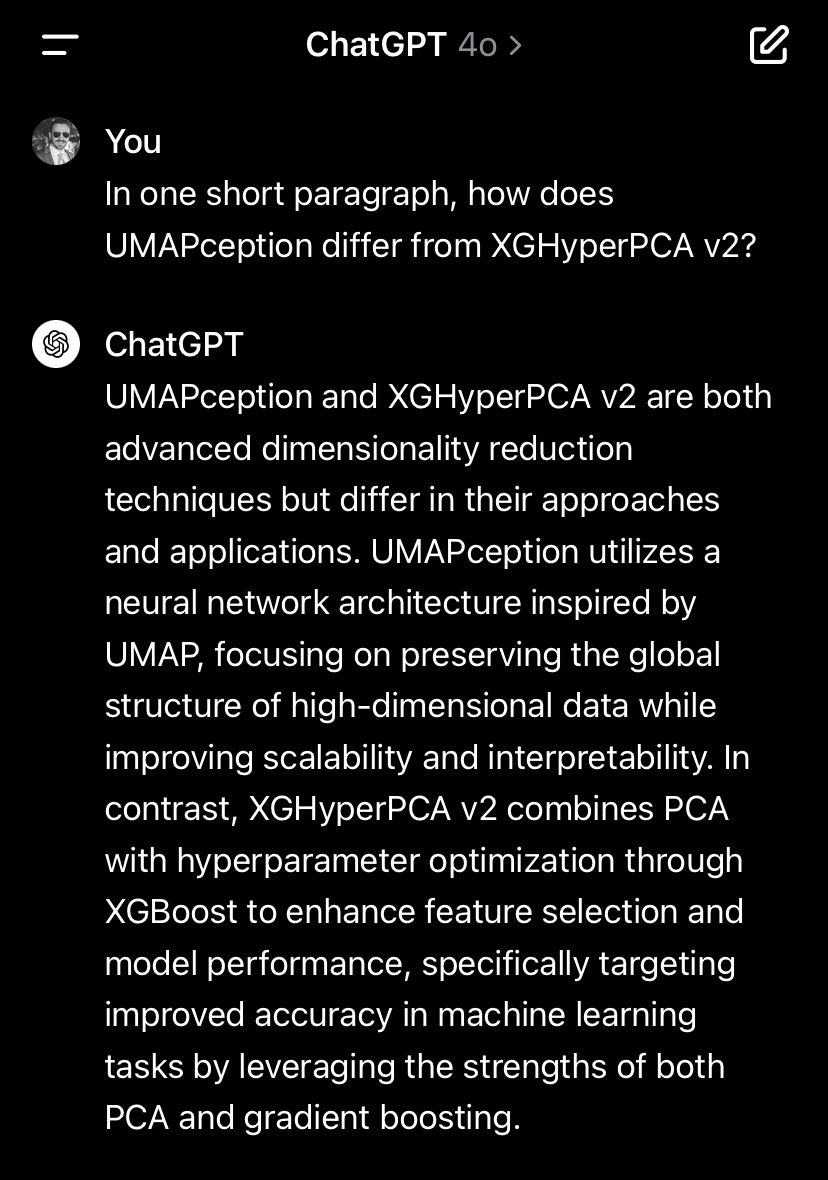
ChatGPT explains fictional nonlinear dimensionality-reduction methods
By
–
ChatGPT 4o explains the difference between UMAPception and XGHyperPCA v2, two advanced methods for nonlinear dimensionality reduction I completely made up just now.