The industry is taking notice Terminal-Bench scores now appear on: DeepSeek-V3.1-Terminus model card Qwen3-Coder release Claude Sonnet 4.5 announcement
800+ GitHub stars | ~100 developer contributors
MACHINE LEARNING
-
Terminal-Bench Gains Recognition Across Major AI Models
By
–
-
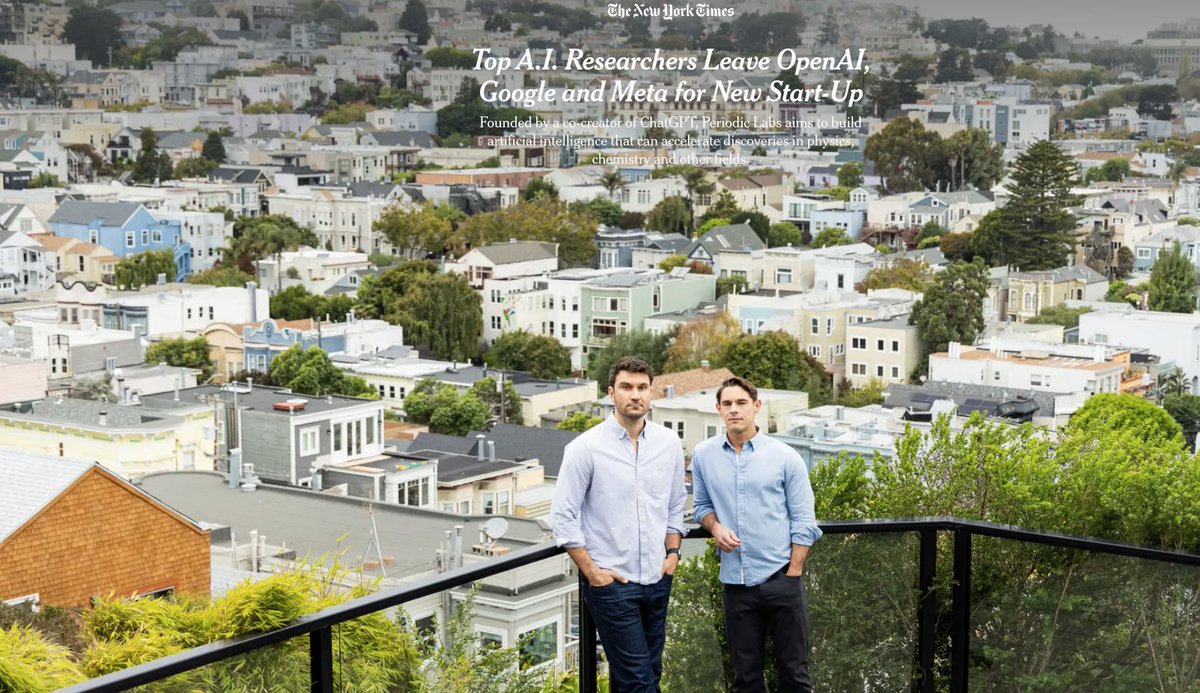
AI for Science: Periodic Labs Launches Autonomous Scientific Discovery Platform
By
–
Bullish, in the coming decades majority of compute will be spent on ai for science William Fedus (@LiamFedus) Today, @ekindogus and I are excited to introduce @periodiclabs. Our goal is to create an AI scientist. Science works by conjecturing how the world might be, running experiments, and learning from the results. Intelligence is necessary, but not sufficient. New knowledge is created when ideas are found to be consistent with reality. And so, at Periodic, we are building AI scientists and the autonomous laboratories for them to operate. Until now, scientific AI advances have come from models trained on the internet. But despite its vastness — it’s still finite (estimates are ~10T text tokens where one English word may be 1-2 tokens). And in recent years the best frontier AI models have fully exhausted it. Researchers seek better use of this data, but as any scientist knows: though re-reading a textbook may give new insights, they eventually need to try their idea to see if it holds. Autonomous labs are central to our strategy. They provide huge amounts of high-quality data (each experiment can produce GBs of data!) that exists nowhere else. They generate valuable negative results which are seldom published. But most importantly, they give our AI scientists the tools to act. We’re starting in the physical sciences. Technological progress is limited by our ability to design the physical world. We’re starting here because experiments have high signal-to-noise and are (relatively) fast, physical simulations effectively model many systems, but more broadly, physics is a verifiable environment. AI has progressed fastest in domains with data and verifiable results – for example, in math and code. Here, nature is the RL environment. One of our goals is to discover superconductors that work at higher temperatures than today's materials. Significant advances could help us create next-generation transportation and build power grids with minimal losses. But this is just one example — if we can automate materials design, we have the potential to accelerate Moore’s Law, space travel, and nuclear fusion. We’re also working to deploy our solutions with industry. As an example, we're helping a semiconductor manufacturer that is facing issues with heat dissipation on their chips. We’re training custom agents for their engineers and researchers to make sense of their experimental data in order to iterate faster. Our founding team co-created ChatGPT, DeepMind’s GNoME, OpenAI’s Operator (now Agent), the neural attention mechanism, MatterGen; have scaled autonomous physics labs; and have contributed to some of the most important materials discoveries of the last decade. We’ve come together to scale up and reimagine how science is done. We’re fortunate to be backed by investors who share our vision, including @a16z who led our $300M round, as well as @Felicis, DST Global, NVentures (NVIDIA’s venture capital arm), @Accel and individuals including @JeffBezos , @eladgil , @ericschmidt, and @JeffDean. Their support will help us grow our team, scale our labs, and develop the first generation of AI scientists. — https://nitter.net/LiamFedus/status/1973055380193431965#m
→ View original post on X — @_jasonwei, 2025-09-30 16:04 UTC
-
Axelera AI Community Builds Smart Detection Applications
By
–
Over the last few weeks, the amazing Axelera AI community has built fall detectors that trigger smart home alerts. Marine surveillance that controls gimbals to track vessels. Pet feeders that know when to dispense. Gym buddies that count reps. Number plate readers that open
-
NumPy’s Simple File I/O API and PyTorch Tensor Limitations
By
–
Numpy’s fromfile()/tofile() make me smile — no typing or byte order metadata, they just write/read the raw bytes. A joyful API! I wish PyTorch had them natively on tensors, so I wasn’t doing so many tensor.cpu().numpy() operations.
-
Deeper reasoning across all domains
By
–
Reasoning gains across every domain. Finance professionals, lawyers, medical researchers, STEM academics all tested it independently. Universal feedback: "dramatically better domain knowledge and reasoning" than Opus 4.1. Not faster answers. Deeper thinking.
-

Sonnet 4.5 tops SWE-bench leaderboard
By
–
SWE-bench Verified: state-of-the-art. This benchmark tests real software engineering. Actual GitHub issues that require multi-file edits, testing, dependency management. Sonnet 4.5 leads the leaderboard. It maintains focus for 30+ hours on complex tasks.
-
Anthropic’s Sonnet 4.5: A Coding Breakthrough
By
–
Anthropic dropped Sonnet 4.5 today. It's the best coding model in the world. Same price as Sonnet 4. But the capabilities gap is massive. This isn't incremental. It's a different category of reasoning.
-
Claude 4.5 Sonnet: 3 Quick Projects
By
–
Claude 4.5 Sonnet is insanely powerful 🤯
— God of Prompt (@godofprompt) 30 septembre 2025
Here are 3 projects I made in it in few seconds:
1. Retro Snake in pure JavaScript pic.twitter.com/VTkTERWuTmClaude 4.5 Sonnet is insanely powerful Here are 3 projects I made in it in few seconds: 1. Retro Snake in pure JavaScript
-
Proprioceptive States in Visuomotor Policies Research
By
–
#PapersAccepted by Jiqizhixin
Our report: https://
mp.weixin.qq.com/s/9W7rBdtTtW0W
cmSyodtPow
… Do You Need Proprioceptive States in Visuomotor Policies? Shanghai Jiao Tong University, Spirit AI, Tsinghua University, and others
Paper: https://
arxiv.org/abs/2509.18644
Project: https://
statefreepolicy.github.io -

State-free Robot Policy: Vision-only Visuomotor Learning Breakthrough
By
–
Do You Need Proprioceptive States in Visuomotor Policies? New robot manipulation breakthrough: Ditching proprioceptive inputs in imitation learning, the State-free Policy relies purely on visual observations. Full task-relevant vision via dual wrist cameras Huge spatial