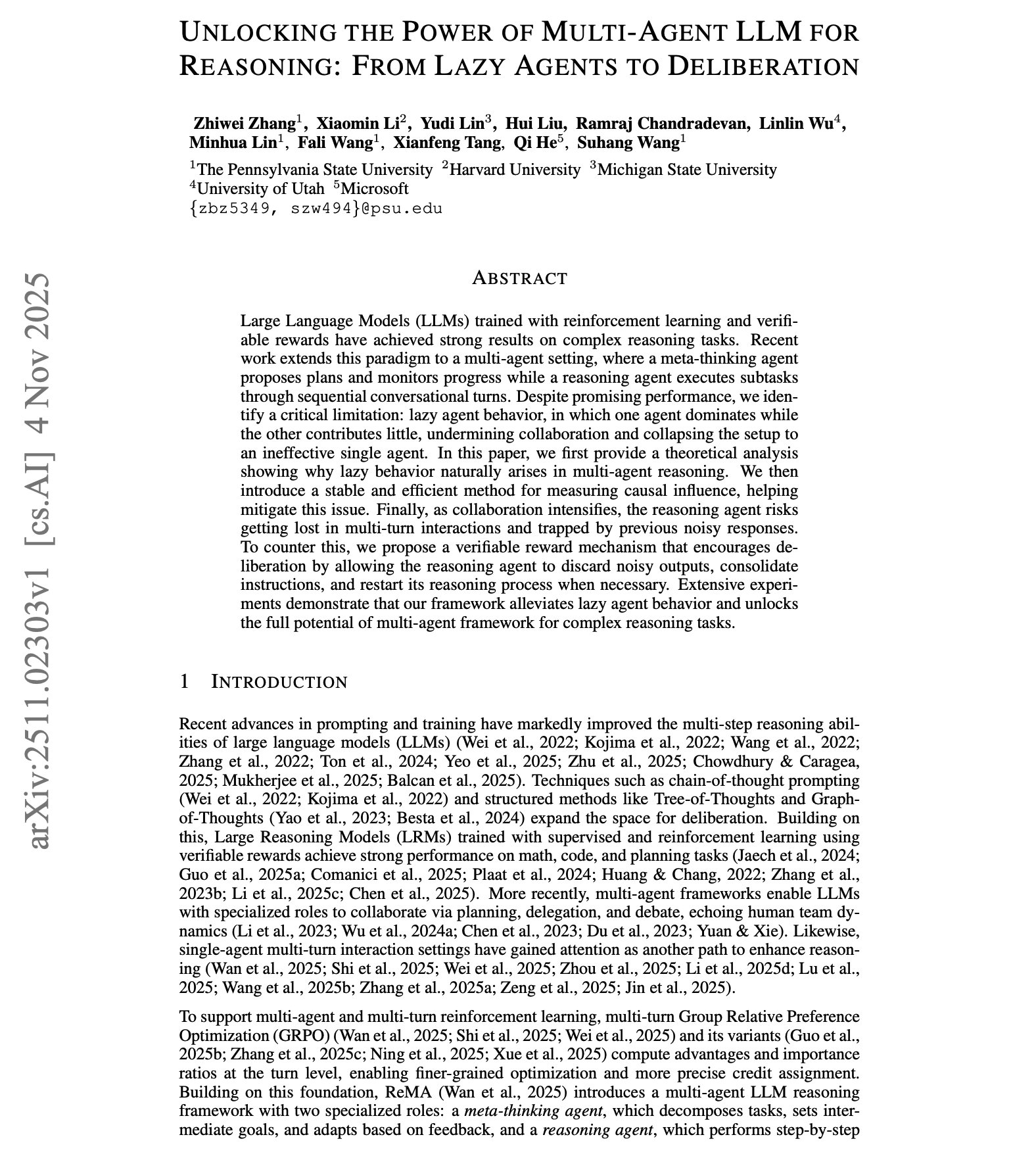
10. Unlocking the Power of Multi-Agent LLM for Reasoning Introduces Dr. MAMR, which addresses the “lazy agent” problem in multi-agent LLM reasoning through Shapley-inspired causal influence measurement and verifiable restart mechanisms.
MACHINE LEARNING
-
Differentiable Artificial Life Framework for Continuous Agent Learning
By
–
9. PD-NCA
— DAIR.AI (@dair_ai) 9 novembre 2025
A differentiable artificial life framework where multiple independent agents continuously update their parameters through gradient descent during simulation, enabling within-lifetime learning and open-ended behavioral change.https://t.co/0omPU6a4Un9. PD-NCA A differentiable artificial life framework where multiple independent agents continuously update their parameters through gradient descent during simulation, enabling within-lifetime learning and open-ended behavioral change.
-

AlphaEvolve: AI Autonomously Discovers Mathematical Constructions
By
–
8. Mathematical Exploration at Scale Terence Tao and colleagues apply AlphaEvolve, an AI system using LLM-guided evolutionary search to autonomously discover mathematical constructions across analysis, combinatorics, geometry, and number theory.
-
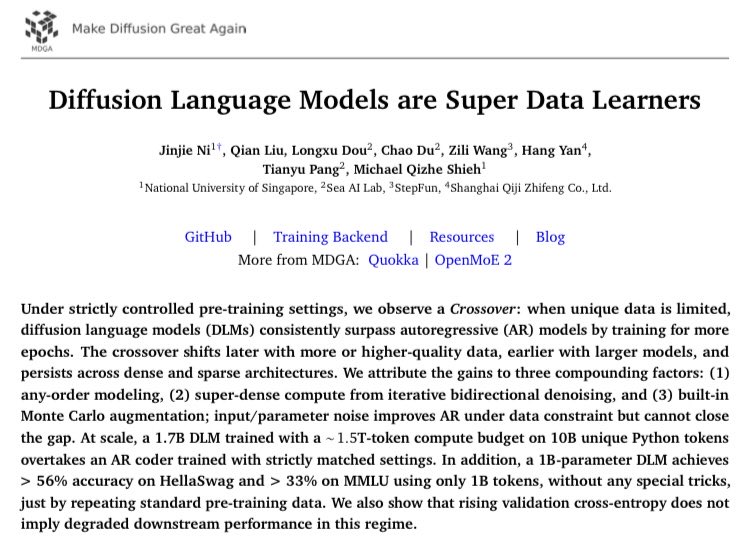
Diffusion Language Models Outperform Autoregressive With Limited Data
By
–
7. Diffusion LMs are Super Data Learners Researchers from NUS, Sea AI Lab, StepFun, and collaborators demonstrate that diffusion language models (DLMs) consistently outperform autoregressive models when unique training data is limited.
-
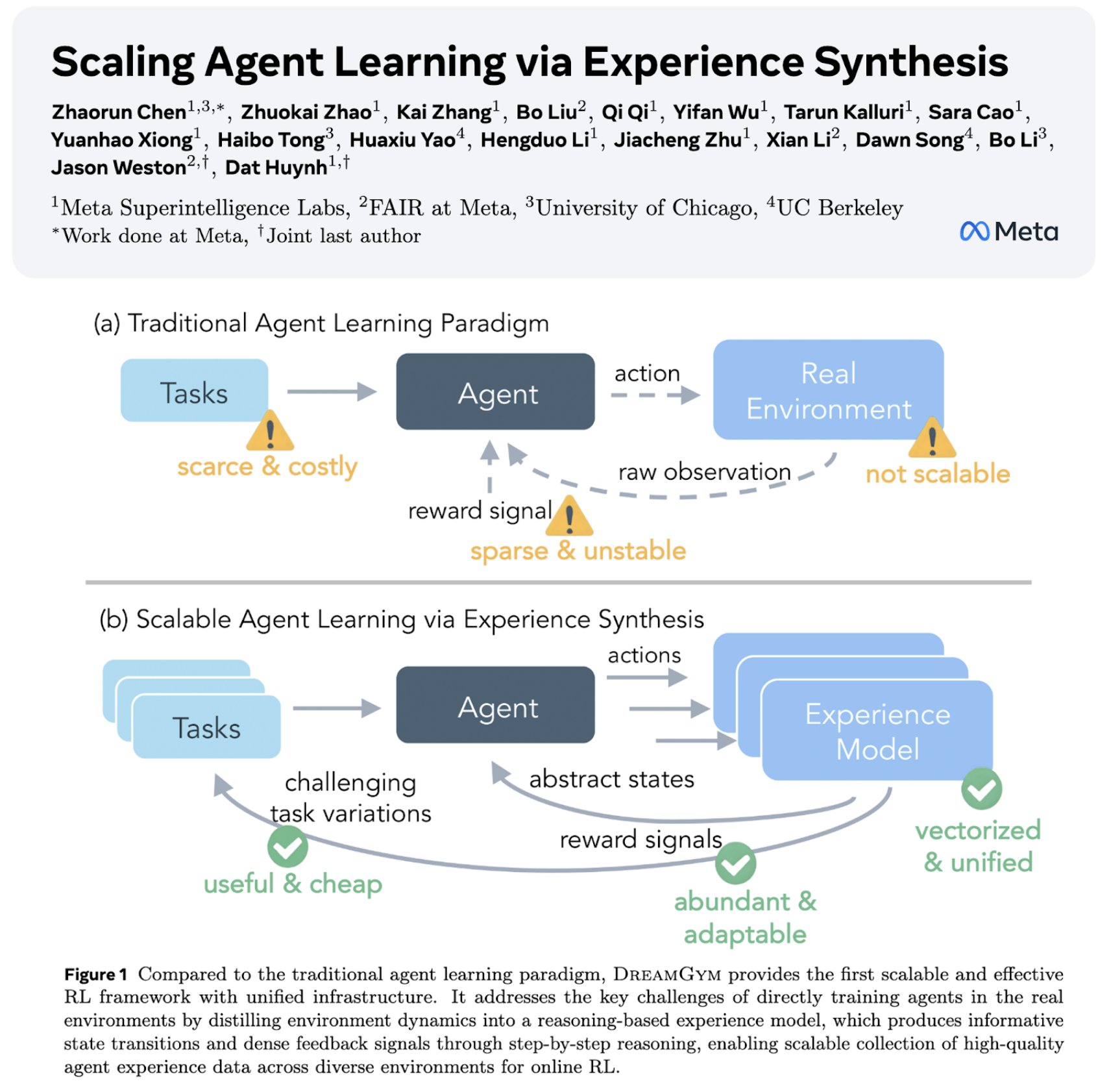
DreamGym: Scaling Agent RL via Experience Synthesis
By
–
3. Scaling Agent RL via Experience Synthesis Meta researchers introduce DreamGym, a unified framework that synthesizes diverse training experiences to enable scalable reinforcement learning for LLM agents without costly real-environment rollouts.
-
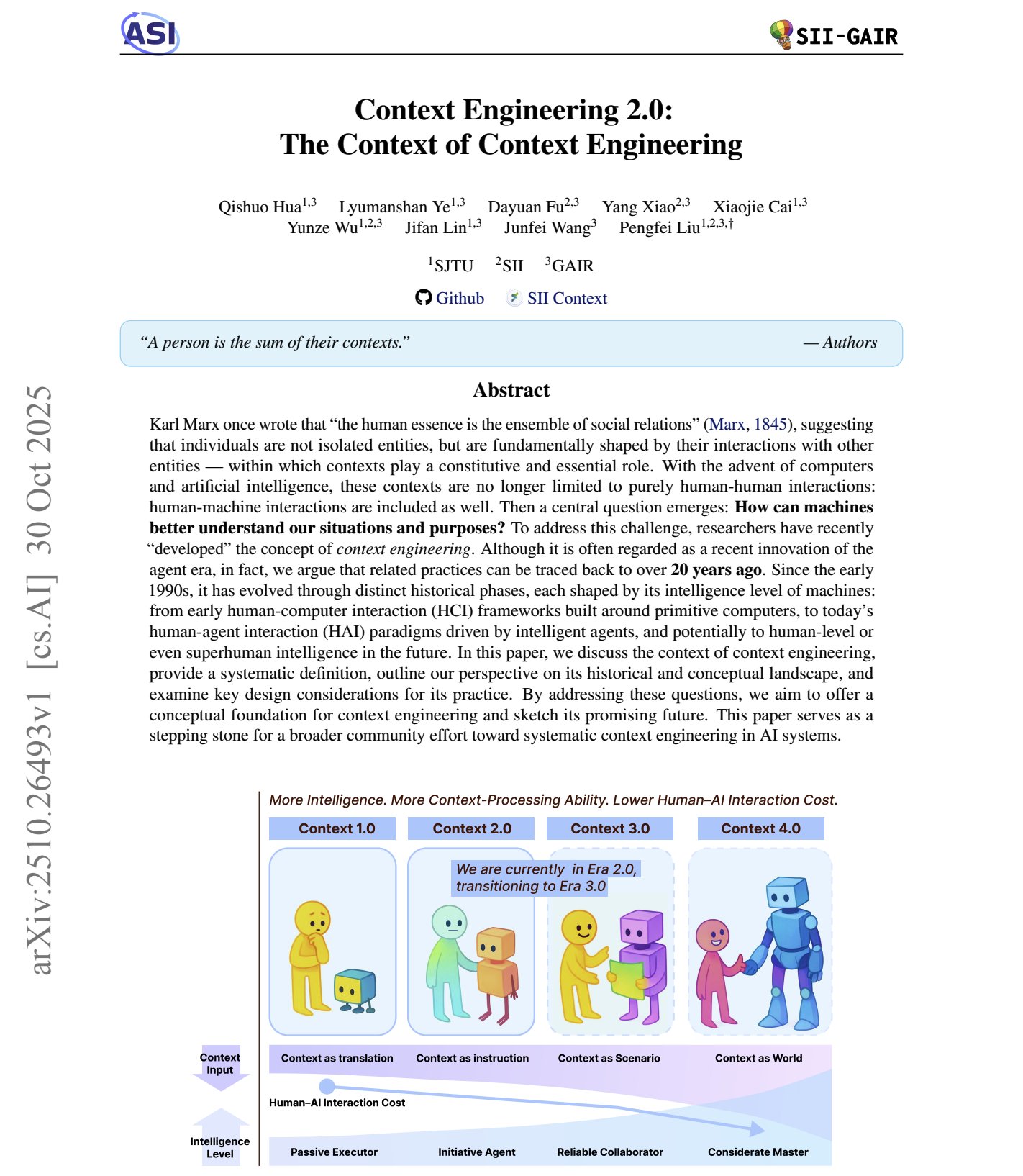
Context Engineering Evolution: From Computing 1.0 to Intelligent Agents
By
–
2. Context Engineering 2.0 Traces the 20+ year evolution of context engineering, reframing it as a fundamental challenge in human-machine communication spanning from primitive computing (Era 1.0) to today’s intelligent agents (Era 2.0) and beyond.
-
Google DeepMind Introduces IMO-Bench for Mathematical Reasoning
By
–
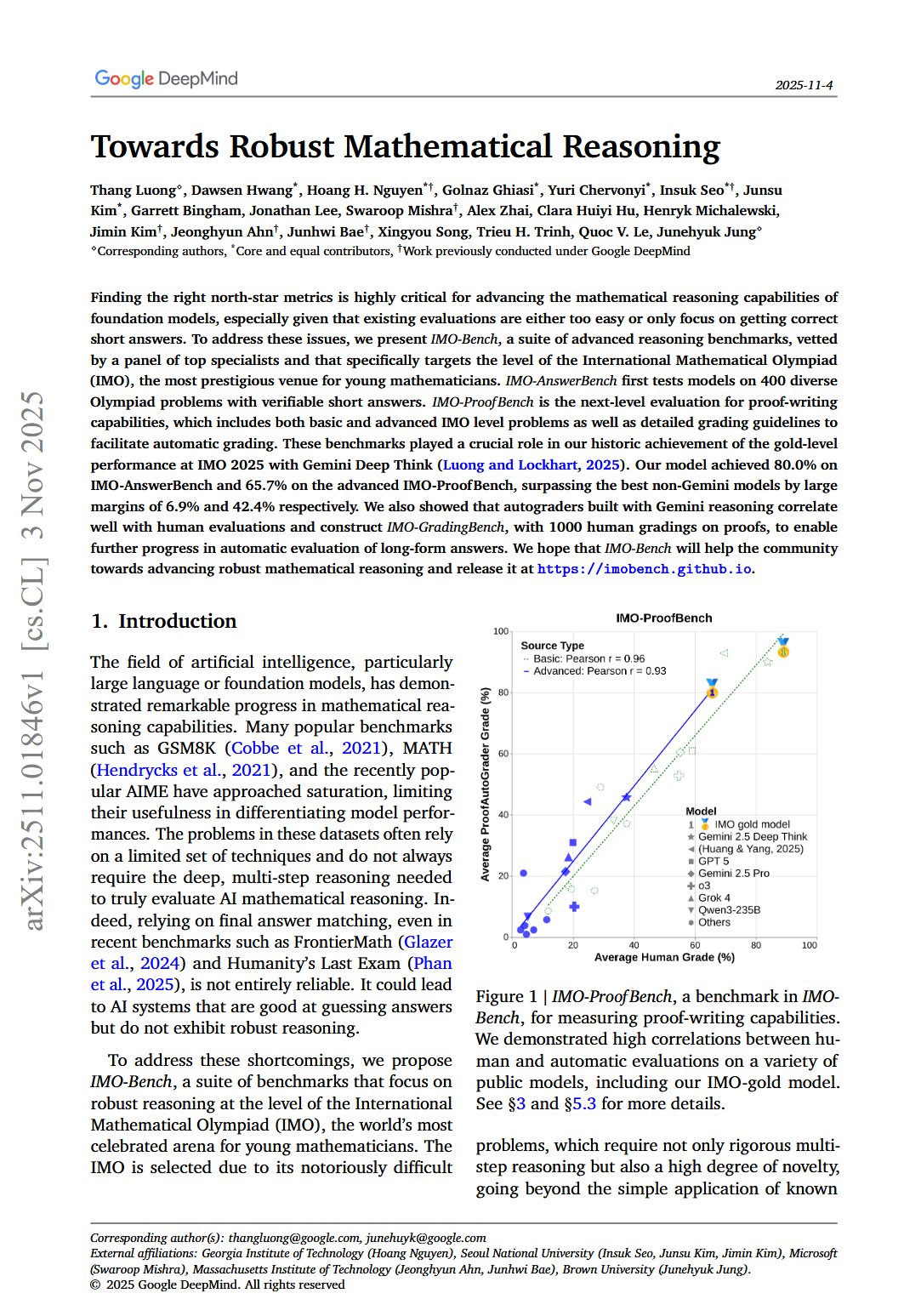
1. Towards Robust Mathematical Reasoning Google DeepMind introduces IMO-Bench, a comprehensive suite of benchmarks vetted by IMO medalists targeting International Mathematical Olympiad-level reasoning.
-
Top AI Research Papers: Agents, LLMs, and Mathematical Exploration
By
–
Top AI Papers of the Week (Nov 3 – 9): – Tool-to-Agent Retrieval
– Context Engineering 2.0
– Mathematical Exploration at Scale
– Petri Dish Neural Cellular Automata
– Enhancing Long-Term Memory in LLMs
– Diffusion LMs are Super Data Learners
– Towards Robust Mathematical -

How Agentic AI Works: Data, Reasoning, and Autonomous Action
By
–
How does Agentic AI work? Collects data (APIs, sensors, logs, queries) Reasons & plans with memory + context Executes actions, learns from feedback Produces autonomous, adaptive responses AI that doesn’t just respond — it acts.
#AgenticAI #AI #Automation -

AI-Trader: Five AI Models Compete Autonomously in Market Trading
By
–
AI-Trader enables five distinct AI models, each employing unique investment strategies, to compete autonomously in the same market and determine which can generate the highest profits in NASDAQ 100 or SSE 50 trading! 9k stars already! AI-Trader: Can AI Beat the Market?