AI Dynamics

Global AI News Aggregator

About

INNOVATION

  • Software Engineers Transform Robotics: New Infrastructure Opportunities Emerge

    There are now two types of robotics founders and the split matters more than consumer vs. industrial. A growing wave of software engineers are building robots, but they're bringing software expectations with them: simulation should work like Vercel, hardware talent should be sourceable via API, and if CAD takes three months to learn, they'll find a workaround in three days. The gap between what they expect and what exists is enormous. There's no Common Crawl for robotics data. Selling hardware is nothing like selling SaaS. And the entire tooling stack was built for people willing to spend weeks wiring things together. That gap is where the next generation of robotics infrastructure companies gets built. Diego Prats | 🤖 (@mexitlan) Are you fleeing to robotics because Claude Code cooked your job? Yeah… me neither… 😅… As part of building in the open, here are some more learnings from the physical AI ecosystem: Folks under-estimate the number of pain points and problems worth solving for the software-first robotics founder persona! — https://nitter.net/mexitlan/status/2039870415401836773#m

    → View original post on X — @whiteafrican, 2026-04-03 13:15 UTC
  • VoxCPM: Real-time Voice Cloning Without Tokenization
    VoxCPM: Real-time Voice Cloning Without Tokenization

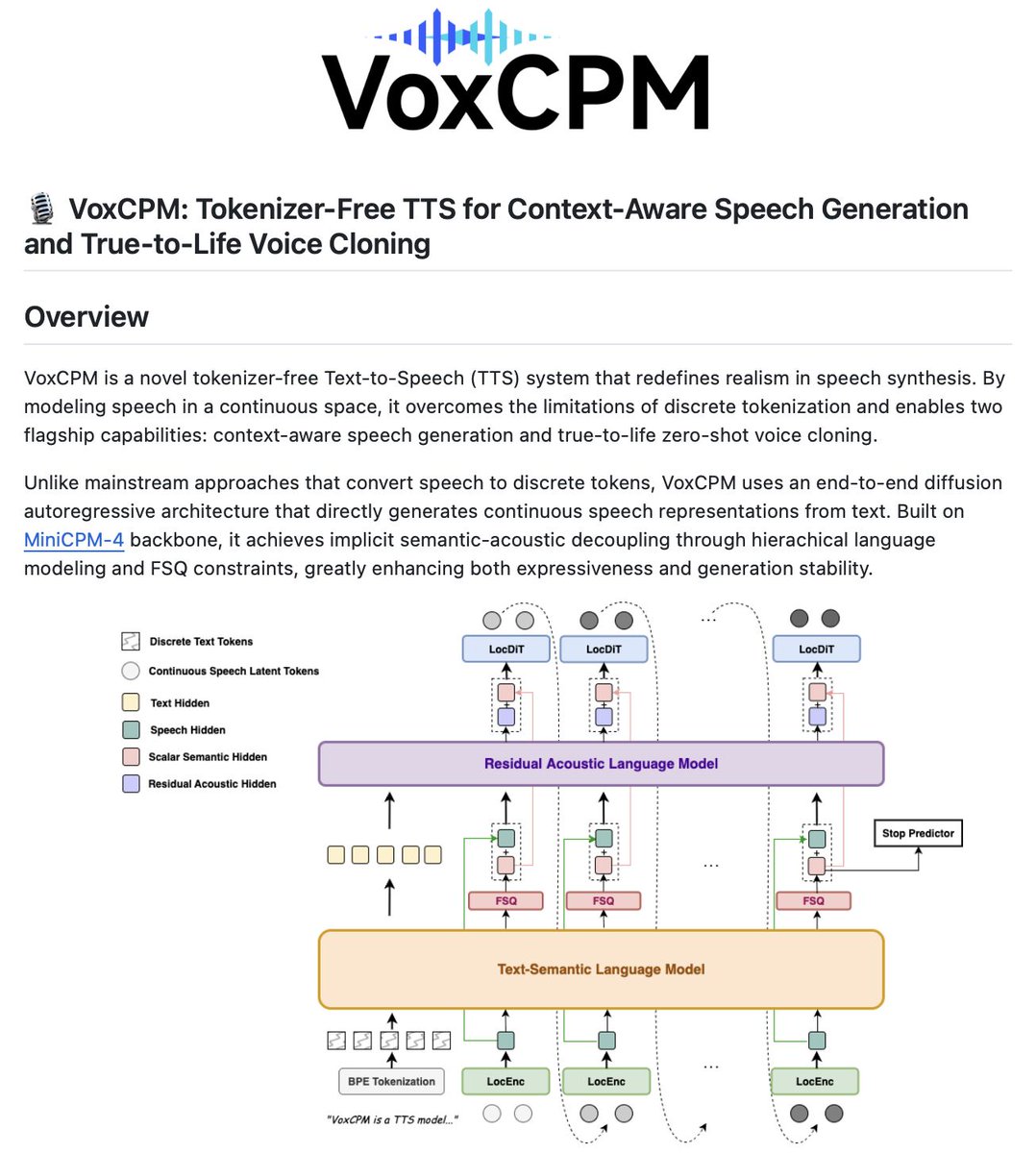
    Clone a human voice in real time without tokenization! VoxCPM is an open-source text-to-speech system that models speech in continuous space instead of discrete tokens. Most TTS systems convert speech to discrete tokens before generation. This quantization creates a fundamental trade-off: tokens provide stability but lose acoustic details like breath, vocal texture, and subtle articulation. VoxCPM skips tokenization entirely. It models speech directly in continuous space using an end-to-end diffusion autoregressive architecture built on MiniCPM-4. The system uses hierarchical language modeling with two specialized components: a Text-Semantic Language Model that captures high-level prosody and structure, and a Residual Acoustic Model that recovers fine-grained acoustic details. This separation eliminates dependency on external speech tokenizers and prevents error accumulation from multi-stage pipelines. Two flagship capabilities: 1. Context-aware speech generation: The model comprehends text to infer appropriate prosody and speaking style. Explanations slow down naturally, emphasis appears in the right places, questions sound like questions. 2. Zero-shot voice cloning: With just 3-10 seconds of reference audio, it replicates speaker timbre, accent, emotional tone, rhythm, and pacing. Key features: • Tokenizer-free architecture with continuous speech modeling
    • Context-aware prosody generation without manual tuning
    • Zero-shot voice cloning from short reference audio
    • Streaming synthesis support for real-time applications
    • SFT and LoRA fine-tuning support It's 100% open source Link to the GitHub repo in the comments! [Translated from EN to English]

    → View original post on X — @sumanth_077, 2026-04-03 13:14 UTC

  • Lovable Launches AI-Powered Visual Edits for Full-Stack Apps

    New on Lovable: AI‑powered Visual Edits turn your full‑stack app into a Figma‑like canvas. – Click any element in a live preview
    – Tweak layout, colors, Tailwind classes
    – Lovable safely rewrites the JSX/TSX and hot‑reloads in seconds Paired with Plan Mode, Lovable Cloud, and

    → View original post on X — @futurepedia_io

  • HACRL: AI Agents Learn Together Without Losing Autonomy
    HACRL: AI Agents Learn Together Without Losing Autonomy

    What if diverse AI agents could mutually learn and improve without sacrificing their autonomy? Researchers from Beihang University, Bytedance China, Tsinghua University, and Peking University have just unveiled Heterogeneous Agent Collaborative Reinforcement Learning (HACRL)! This innovative framework allows different types of AI agents to share verified learning experiences during training, creating a bidirectional flow of knowledge to enhance performance for everyone. Unlike other multi-agent systems, it requires no coordinated deployment and fosters true peer-to-peer growth, not one-way teaching. Their HACPO algorithm consistently boosts all participating agents, outperforming GSPO by 3.3% on diverse reasoning benchmarks while dramatically cutting training data costs in half. Heterogeneous Agent Collaborative Reinforcement Learning Paper: arxiv.org/abs/2603.02604 Github Page: zzx-peter.github.io/hacrl/ Huggingface: huggingface.co/papers/2603.0… Our report: mp.weixin.qq.com/s/ggzim_4Pc… 📬 #PapersAccepted by Jiqizhixin

    → View original post on X — @jiqizhixin, 2026-04-03 12:43 UTC

  • Edge AI Models Sprint Forward With Local Processing Power

    This is huge We're no longer running, we are sprinting towards a future with edge models doing a lot of the work locally at cost of electricity. Gemma for me has always been a benchmark in how far we've gotten. Locally. The ghost will truly be inside the shell

    → View original post on X — @linusekenstam

  • Weekly Roundup: Moon, OpenAI Acquisition, Gemma 4, Solar Efficiency
    Weekly Roundup: Moon, OpenAI Acquisition, Gemma 4, Solar Efficiency

    We're going back to the fucking Moon.
    OpenAI acquires TBPN.
    Google DeepMind (what a great lab! hey guys!) releases Gemma 4.
    Solar cells hit 130% efficiency (?).
    Somos raises $40M. + Science Breakthroughs, grid, Bangalter What a week for the optimists.

    → View original post on X — @packym

  • Global Data Center Distribution: US Dominates With 43 Percent
    Global Data Center Distribution: US Dominates With 43 Percent

    The Countries With the Most Data Centers Key Takeaways: The U.S. hosts 43% of the world’s data centers, with 4,088 total. Germany and the UK are nearly tied for second place, separated by just one facility. Europe’s FLAP-D corridor remains a global hub for cloud and

    → View original post on X — @mvollmer1

  • Deep CDR Technology Defeats Zero-Day Threats Without Signatures

    Traditional antivirus fails on zero-day threats because it needs known signatures. Deep CDR sidesteps this entirely by rebuilding everything.

    → View original post on X — @fogoros

  • Shipping Real Value: Code Building Over Gaming

    It's because you actually ship something at the end that might have some value (to you and or others). Gaming is fun, but vibe coding gives you a real artifact you can use or sell. It combines the fun of building and gambling together.

    → View original post on X — @whats_ai

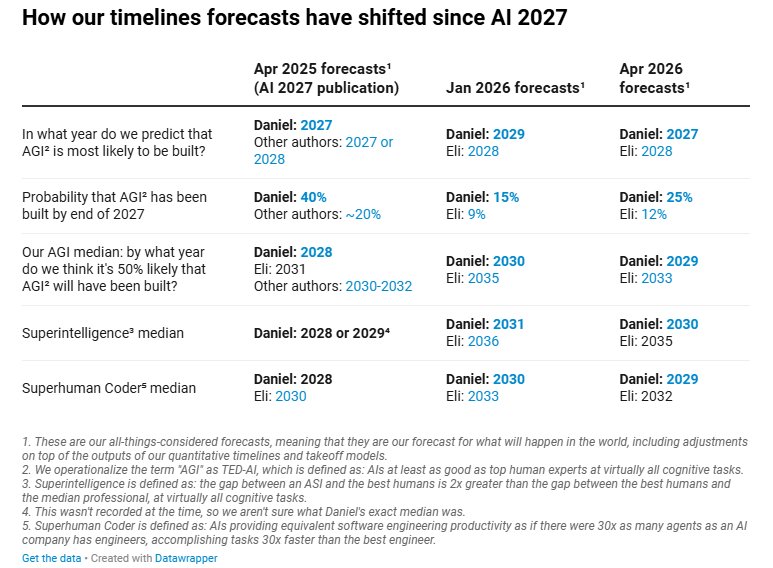
  • AI-2027 Accelerates Predictions for Automated Coding Development Timeline
    AI-2027 Accelerates Predictions for Automated Coding Development Timeline

    The authors of AI-2027 have moved forward their predictions for "AI timelines and takeoff speeds" in a brief post because, contrary to their expectations, the pace of development is accelerating. "Daniel’s Automated Coder (AC) median has moved from late 2029 to mid 2028, and

    → View original post on X — @kimmonismus