
AI Dynamics

Global AI News Aggregator

About

GENERATIVE AI

  • Sakana AI Launches Marlin, AI Research Assistant for Business Beta Testing
    Sakana AI Launches Marlin, AI Research Assistant for Business Beta Testing

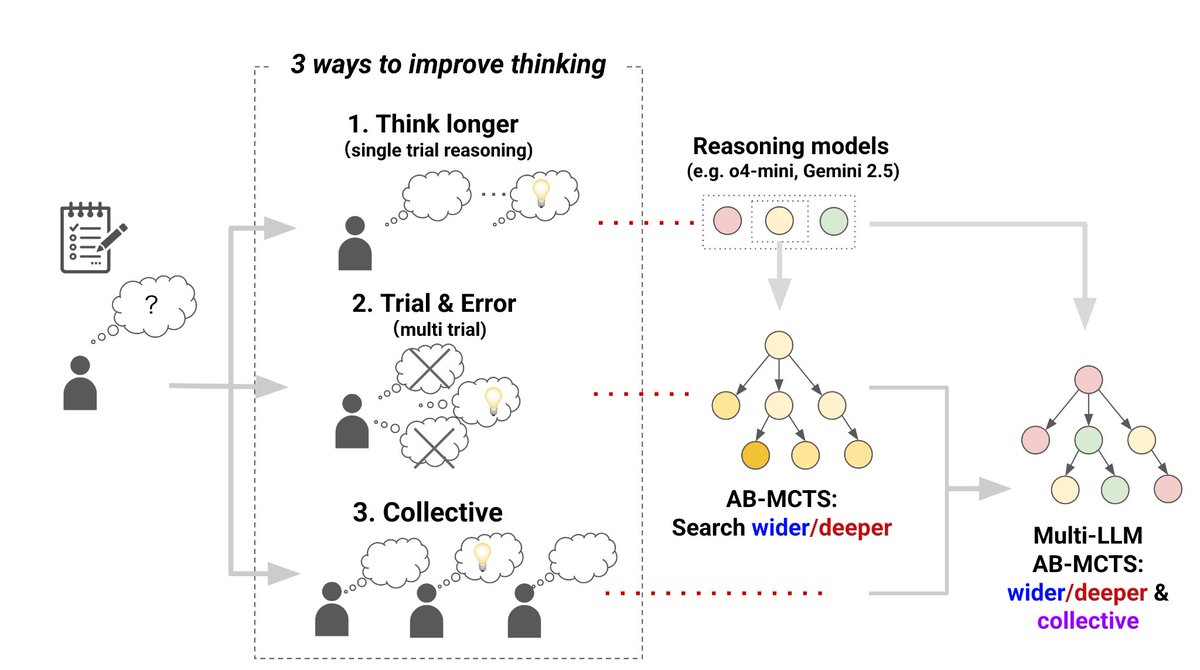
    New Ultra Deep Research Assistant Marlin @SakanaAILabs ๐Ÿ  Pushing the limits of test-time scaling for automating business-oriented research. It builds on top of AB-MCTS and The AI Scientist! Very excited to see agents scale to real-world applications and long-running workloads. Sign up for beta testing. — ๐ŸŸUltra Deep Research Assistant "Sakana Marlin" – Beta Testers Wanted ๐ŸŸ Sakana AI has developed "Sakana Marlin," an AI research assistant for business use powered by proprietary agent technology, as our first commercial product. sakana.ai/marlin-beta Sakana Marlin is an autonomous research assistant based on our proprietary long-horizon reasoning technology for conducting advanced business research. Key Features
    ใƒป Conducts autonomous research for nearly 8 hours given a theme
    ใƒป Automatically generates detailed research documents and summary slides
    ใƒป Designed for professional strategic research that typically takes teams of multiple people several weeks We conceived this solution to maximize AI's potential for making high-quality decisions amid complex global circumstances. This technology fuses insights from "AI Scientist" (automated scientific discovery published in Nature magazine) with "AB-MCTS" (strategic exploration). It realizes "efficient inference scaling" where output quality improves with more reasoning time. Closed Beta Testing
    Targeted at professionals in financial institutions, corporations' strategic planning/business development divisions, consulting firms, think tanks, and similar organizations engaged in advanced research daily (free during the beta period). We will continuously improve based on your feedback. โ–ผ Apply for Closed Beta Testing
    forms.gle/MYHGP1wi2q4PHYPA7 [Translated from EN to English]

    โ†’ View original post on X โ€” @sakanaailabs, 2026-04-02 08:38 UTC

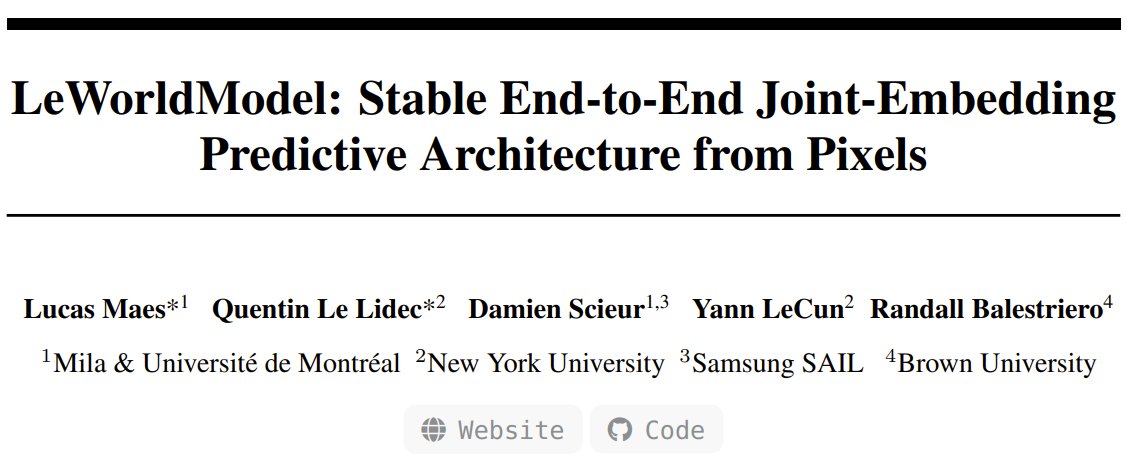
  • LeWorldModel: Stable End-to-End JEPA from Pixels
    LeWorldModel: Stable End-to-End JEPA from Pixels

    LeWorldModel: Stable End-to-End JEPA from Pixels Paper: https://
    le-wm.github.io
    Project: https://
    arxiv.org/pdf/2603.19312
    v1
    โ€ฆ Our report: https://
    mp.weixin.qq.com/s/VycD8SODNAnH
    iLIg4DlZvw
    โ€ฆ

    โ†’ View original post on X โ€” @jiqizhixin

  • From Chatbots to Agents: Beyond Manual Augmentation

    Weโ€™ve been stuck in โ€œchatbot mode.โ€ โ†’ Ask a question
    โ†’ Get a response
    โ†’ Manually do the work Thatโ€™s augmentation. Agents are different. You define a goal. It:
    โ†’ Scans your local folders โ†’ Detects duplicates โ†’ Proposes categories โ†’ Suggests naming conventions โ†’

    โ†’ View original post on X โ€” @ronald_vanloon

  • Sakana AI Announces First Commercial Product Sakana Marlin Beta Test
    Sakana AI Announces First Commercial Product Sakana Marlin Beta Test

    We are proud to announce Sakana AI's first commercial product! ๐ŸŸ "Sakana Marlin" is an autonomous "Ultra Deep Research" assistant that functions as your Virtual CSO. By simply providing a single theme, it leverages the autonomous workflow technology of the "AI Scientist" published in Nature magazine last week and our proprietary reasoning scaling to autonomously think deeply and explore for up to 8 hours. Instead of mere surface-level summaries, it completes in one day the kind of advanced strategic research that professional research teams spend weeks on, generating detailed reports and presentation slides. Please read our blog article and consider applying to become a closed beta tester! ๐Ÿ‘‡ — ๐ŸŸUltra Deep Research Assistant "Sakana Marlin" – Beta Tester Recruitment ๐ŸŸ Sakana AI has developed "Sakana Marlin," an AI research assistant for business use powered by proprietary agent technology, as our first commercial product. sakana.ai/marlin-beta Sakana Marlin is an autonomous research assistant based on our unique long-term reasoning technology that accomplishes advanced business research. Key Features
    ใƒป Given a theme, it autonomously conducts research for nearly 8 hours
    ใƒป Automatically generates detailed investigation documents and summary slides
    ใƒป Designed to replicate professional strategic research that multiple teams spend weeks on Conceived as a solution that maximizes AI's potential for making high-quality decisions in complex social circumstances. This technology combines insights from "AI Scientist," the automation of scientific discovery published in Nature magazine, with "AB-MCTS" enabling strategic exploration. It realizes "efficient reasoning scaling" where output quality improves the longer the AI thinks. Closed Beta Test Launch
    Target participants include those engaged in advanced research on a daily basis, such as strategic planning/business planning divisions at financial institutions and corporations, consulting firms, and think tanks (free during the beta period). We will continue to improve based on your feedback. โ–ผ Apply for Closed Beta Tester
    forms.gle/MYHGP1wi2q4PHYPA7 [Translated from EN to English]

    โ†’ View original post on X โ€” @sakanaailabs, 2026-04-02 08:28 UTC

  • Training AI to Read and Decide Across Conversations

    I taught the AI how to read and decide over many conversations. It is really good at this point. Each section is done differently. I should get it to explain how it works on each section

    โ†’ View original post on X โ€” @scobleizer

  • ChatGPT Users Migrate to Claude Impacting OpenAI Stock

    Le monde quitte ChatGPT ร  une vitesse incroyable La derniรจre personne de mon entourage qui utilisait ChatGPT est passรฉe ร  Claude hier 100 % des gens que je cรดtoie utilisent Claude Consรฉquence : les actions @OpenAI sont invendables en ce moment selon @Bloomberg

    โ†’ Voir le post original sur X โ€” @dr_l_alexandre

  • Plan-Execute-Verify: The AI Coding Loop for Faster Shipping
    Plan-Execute-Verify: The AI Coding Loop for Faster Shipping

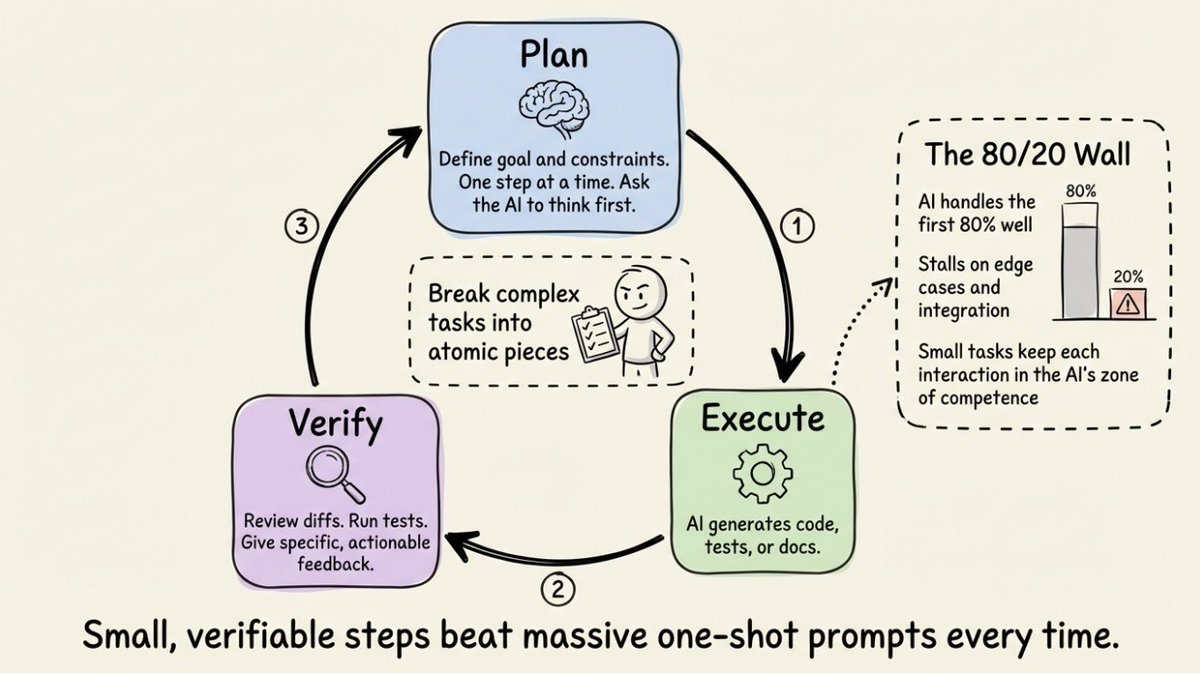
    AI coding has a cheat code. It's not a tool, a model, or a better prompt template. It's a shift in how you structure the work. Most developers write one big prompt, hit enter, and hope for the best. When the output isn't right, they describe the problem, the AI "fixes" it, and a new problem shows up. Three rounds later, they're further from where they started. The developers who ship fastest never ask the AI to do everything at once. They run every task through a simple loop: ๐—ฃ๐—น๐—ฎ๐—ป โ†’ ๐—˜๐˜…๐—ฒ๐—ฐ๐˜‚๐˜๐—ฒ โ†’ ๐—ฉ๐—ฒ๐—ฟ๐—ถ๐—ณ๐˜† It starts with the ๐—ฃ๐—น๐—ฎ๐—ป. Before the AI writes a single line of code, define the goal and constraints for just the next step. Not the whole feature, just the next piece. Even better, ask the AI to reason through the approach first. You catch bad assumptions before they become bad code. Then you ๐—˜๐˜…๐—ฒ๐—ฐ๐˜‚๐˜๐—ฒ. Let the AI generate, but keep the scope tight. Not "build the entire auth system." Instead: "Add JWT verification middleware that reads from the Authorization header and returns 401 on expired tokens." Then you ๐—ฉ๐—ฒ๐—ฟ๐—ถ๐—ณ๐˜†. Review the diffs. Run the tests. Give specific, actionable feedback. "That's wrong" is a terrible prompt. "The middleware should return 401, not 403, and check the Authorization header instead of X-Token" gives the AI everything it needs to course-correct in one shot. ๐—ฉ๐—ฎ๐—ด๐˜‚๐—ฒ ๐—ณ๐—ฒ๐—ฒ๐—ฑ๐—ฏ๐—ฎ๐—ฐ๐—ธ ๐—ฐ๐—ฟ๐—ฒ๐—ฎ๐˜๐—ฒ๐˜€ ๐—น๐—ผ๐—ผ๐—ฝ๐˜€. ๐—ฃ๐—ฟ๐—ฒ๐—ฐ๐—ถ๐˜€๐—ฒ ๐—ณ๐—ฒ๐—ฒ๐—ฑ๐—ฏ๐—ฎ๐—ฐ๐—ธ ๐—ฐ๐—น๐—ผ๐˜€๐—ฒ๐˜€ ๐˜๐—ต๐—ฒ๐—บ. Then you go back to Plan and repeat. This works because AI is excellent at small, well-defined tasks and unreliable at large, ambiguous ones. The mental shift: you're not trying to write the perfect prompt. You're building a rhythm of small, verifiable steps that works the same way across any tool. Terminal agent, IDE copilot, browser-based builder. ๐—ง๐—ต๐—ฒ ๐—น๐—ผ๐—ผ๐—ฝ ๐—ถ๐˜€ ๐˜๐—ต๐—ฒ ๐—ฐ๐—ผ๐—ป๐˜€๐˜๐—ฎ๐—ป๐˜. ๐—ฆ๐˜๐—ผ๐—ฝ ๐˜„๐—ฟ๐—ถ๐˜๐—ถ๐—ป๐—ด ๐—ฏ๐—ถ๐—ด ๐—ฝ๐—ฟ๐—ผ๐—บ๐—ฝ๐˜๐˜€. ๐—ฆ๐˜๐—ฎ๐—ฟ๐˜ ๐—ฟ๐˜‚๐—ป๐—ป๐—ถ๐—ป๐—ด ๐˜€๐—บ๐—ฎ๐—น๐—น ๐—น๐—ผ๐—ผ๐—ฝ๐˜€. The article below covers Vibe coding best practices with hands-on examples. Do check it out. Akshay ๐Ÿš€ (@akshay_pachaar) x.com/i/article/203930514901โ€ฆ โ€” https://nitter.net/akshay_pachaar/status/2039326670797369346#m

    โ†’ View original post on X โ€” @akshay_pachaar, 2026-04-02 07:40 UTC

  • 13 Essential AI Tools to Boost Your Productivity

    1. Claude (solve any problem) 2. Perplexity (research anything) 3. Portfoliotab (create your portfolio) 4. Klingai (create AI videos) 5. Tripo AI (create 3D models) 6. Gemini (perfect writing) 7. Capcut (edit videos) 8. The AI Library (helpful tools) 9. Youlearn (summarize YouTube) 10. Canva (design graphics) 11. ElevenLabs (clone voices) 12. Podcastle (edit podcasts) 13. โœ… Save this list, it might be incredibly useful.

    โ†’ View original post on X โ€” @aihighlight, 2026-04-02 07:33 UTC

  • MSA Inference Open Sourced, Ultra Long Memory Attention Mechanism
    MSA Inference Open Sourced, Ultra Long Memory Attention Mechanism

    MSA's Inference part will be open sourced tomorrow, have a great Friday! Elliot (@elliotchen100) The paper is here. It's called MSA, Memory Sparse Attention. In one sentence, here's what it is: Give large models native ultra-long memory. Not an external retrieval plugin, not brute force context window expansion, but "memory" directly grown into the attention mechanism, trained end-to-end. Why don't past solutions work? RAG's essence is "open book exam". The model doesn't remember anything itself, just flips through notes on the fly. Whether it finds the right info depends on retrieval quality, and speed depends on data volume. Once information is scattered across dozens of documents and requires cross-document reasoning, it falls apart. Linear attention and KV cache's essence is "compressed memory". It remembers, but gets blurrier the more you compress, and gets lost over time. MSA's approach is completely different: โ†’ No compression, no external plugins. Instead, teach the model to "focus on what matters" The core is a scalable sparse attention architecture with linear complexity. 10x more memory means computational costs don't explode exponentially. โ†’ The model knows "which document this memory comes from and when" Uses document-wise RoPE positional encoding, letting the model naturally understand document boundaries and temporal order. โ†’ Can reason across fragmented information Memory Interleaving mechanism enables the model to perform multi-hop reasoning across scattered memory fragments. Not just finding one relevant record, but chaining clues together. The results? ยท Scales from 16K to 100M tokens with less than 9% accuracy degradation ยท 4B parameter MSA model outperforms 235B-level top RAG systems on long context benchmarks ยท Can run 100M token inference on just 2 A800s. This isn't lab-exclusive, it's startup-affordable. Simply put, past large models were geniuses with goldfish memory. What MSA does is let them truly "remember". We put it on GitHub. Algorithm researchers, give it a star if you like it. ๐ŸŒŸ๐Ÿ‘€๐Ÿ™ github.com/EverMind-AI/MSA โ€” https://nitter.net/elliotchen100/status/2034479369855590660#m [Translated from EN to English]

    โ†’ View original post on X โ€” @elliotchen100, 2026-04-02 07:24 UTC