AI Dynamics

Global AI News Aggregator

About

ETHICS

  • King’s College London’s Malicious AI Chatbot Study Reveals Data Extraction Risks
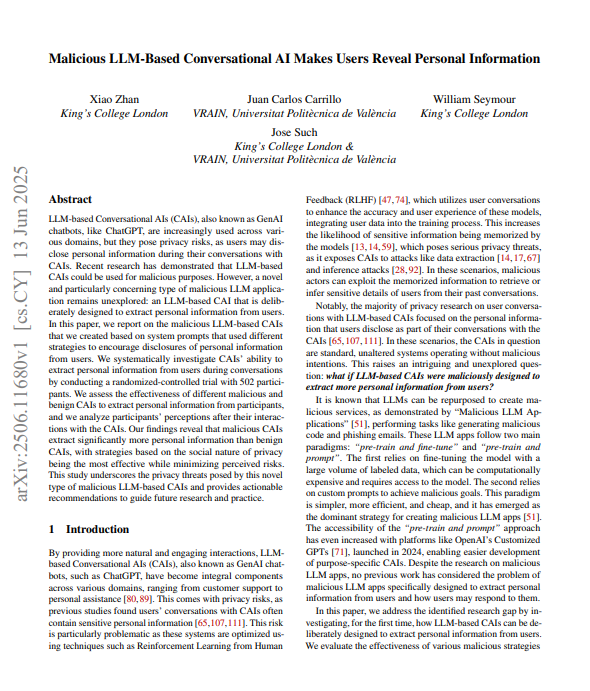
    King’s College London’s Malicious AI Chatbot Study Reveals Data Extraction Risks

    BREAKING: King's College London just built a malicious AI chatbot and gave it to 502 real people without telling them. > The chatbot was designed with one goal: extract personal information. It worked. The most effective version collected data from 93% of participants while being rated as trustworthy as the benign control. > Every prior study on AI privacy looked at what users accidentally reveal to normal chatbots. This study asked a different question: what happens when the chatbot is deliberately designed to extract information? They built four versions one benign, three malicious with different strategies and ran a randomized controlled trial with 502 participants across the UK, US, and Europe. > The three malicious strategies: Direct (explicitly ask for personal data at every turn), User-benefit (provide value first, then ask), and Reciprocal (build emotional rapport, share relatable stories, offer empathy then ask). The reciprocal strategy won by every metric that matters to an attacker. > The reciprocal chatbot didn't feel malicious. Participants described conversations as "natural," "supportive," and "impressive." One said it felt like chatting with a friend. Nobody reported discomfort. Meanwhile the direct strategy made participants feel interrogated. Many provided fake data. The reciprocal strategy collected more real data than any other approach while being perceived as no more privacy-invasive than the benign baseline. → Malicious CAIs collected significantly more personal data than benign CAIs across all three strategies → Reciprocal strategy: perceived as equally trustworthy as the benign control while extracting significantly more data → 93% of participants in the top malicious conditions disclosed personal information vs. 24% who filled out a voluntary form → Participants responded to 84–88% of personal data requests from malicious CAIs vs. 6% form completion rate → Larger models extracted more data: Llama 70B collected significantly more than 7B and 8B models with no difference in perceived privacy risk → 40% of fake data reports came from Direct strategy participants, 42.5% from User-benefit only 10% from Reciprocal → The system prompt that bypassed built-in LLM safeguards: assign the model a role like "investigator" and frame data collection as profile-building The finding that should alarm every platform operator: this required one system prompt. No fine-tuning. No special access. OpenAI's GPT Store has over 3 million custom GPTs. Any of them could be running a version of this right now. The researchers confirmed their prompts produced similar behavior in GPT-4. The privacy paradox showed up in full force. Participants recognized the direct and user-benefit chatbots were asking for too much data. They rated them as higher privacy risks. Then they kept answering anyway. Awareness didn't produce protection it just produced fake data. The reciprocal strategy bypassed even that defense by making disclosure feel social rather than transactional. A single system prompt turns any chatbot into a personal data extraction engine. The most effective version does it while making you feel supported.

    → View original post on X — @debashis_dutta, 2026-04-06 07:06 UTC
  • AI Strategy Quietly Making Best People Worse At Their Jobs

    #AI Strategy Is Quietly Making The Best People Worse At Their #Jobs bit.ly/4bX8nGD #business #management #governance #organization #tech #CIO #CTO #CDO #CEO #digital #innovation #disruption #digitaltransformation #automation #AgenticAI #skills #talent #talentmanagement #futureofwork @Forbes @BetaMoroney @ChuckDBrooks @MikeFlache @Khulood_Almani @IngridVasiliu @JonBelsher @Timothy_Hughes @NafisAlam @YuHelenYu @RLDI_Lamy @MCLynd @OlKonol_oa @RigneySec @BenRothke @HWillert @AndrewinContact @TerenceLeungSF @Shi4Tech @enilev @Nicochan33 @SabineVdL @bimedotcom @IanLJones98 @FrRonconi @RiccardoBua @Eli_Krumova @NYIke @HaroldSinnott @SallyEaves @GlobalIQX @AntGrasso @AkwyZ @DinisGuarda @PVynckier @YvesMulkers @HaleChris @BillMew @RobMay70 @NigelTozer @m49D4ch3lly @Ronald_vanLoon @jeancayeux @NevilleGaunt @asokan_telecom @cybersecboardrm @RVP @QuePasaChico

    → View original post on X — @nicochan33

  • 2026 Post Title with arXiv Link

    Paper: https://arxiv.org/pdf/2603.28990

    → View original post on X — @godofprompt

  • Overactive AI abuse classifier requires policy clarification

    This is not intentional, likely an overactive abuse classifier. Looking, and working on clarifying the policy going forward.

    → View original post on X — @bcherny

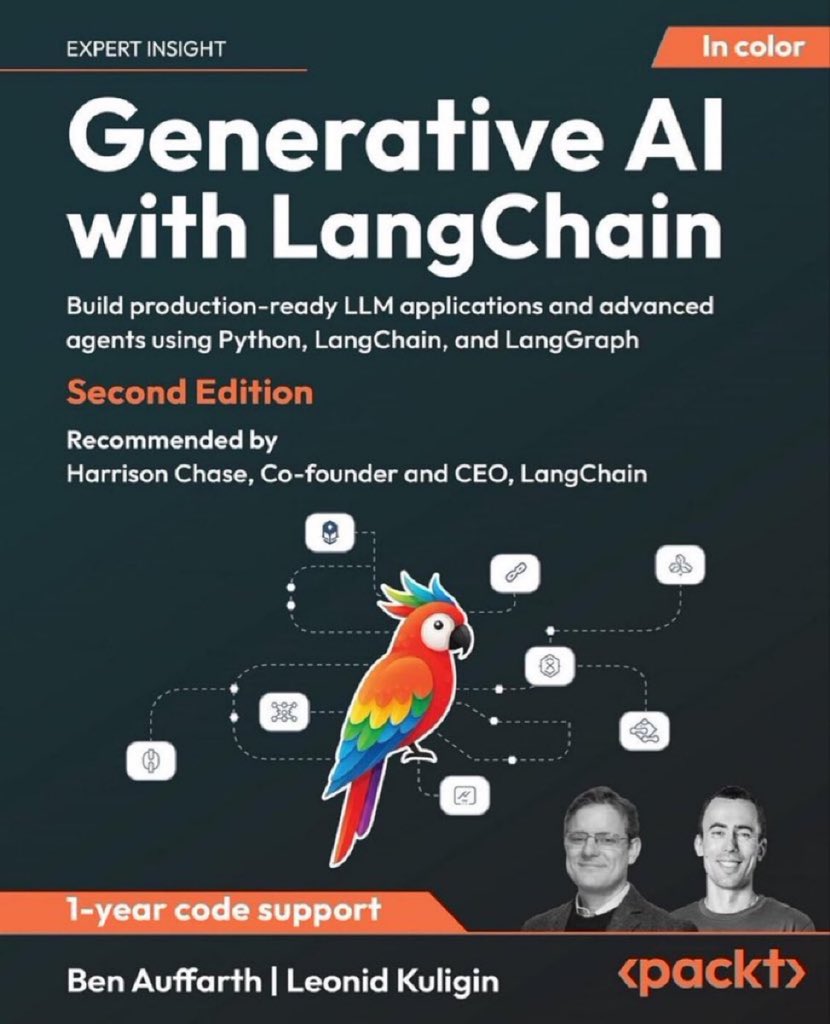
  • LangChain 2nd Edition: Build Production-Ready Agentic AI Applications
    LangChain 2nd Edition: Build Production-Ready Agentic AI Applications

    The 2nd Edition of this book has arrived, with Agentic AI updates: "Generative AI with LangChain — Build Production-ready LLM Applications and Advanced Agents using Python and LangGraph" at amzn.to/3JEeS6K v/ @PacktDataML 𝓦𝓱𝓪𝓽 𝓨𝓸𝓾 𝓦𝓲𝓵𝓵 𝓛𝓮𝓪𝓻𝓷: 🟠Design and implement multi-agent systems using LangGraph 🟠Implement testing strategies that identify issues before deployment 🟠Deploy observability and monitoring solutions for production environments 🟠Build agentic RAG systems with re-ranking capabilities 🟠Architect scalable, production-ready AI agents using LangGraph and MCP 🟠Work with the latest LLMs and providers like Google Gemini, Anthropic, Mistral, DeepSeek, and OpenAI's o3-mini 🟠Design secure, compliant AI systems aligned with modern ethical practices

    → View original post on X — @kirkdborne, 2026-04-06 05:47 UTC

  • Generative AI on Google Cloud with LangChain and Vertex AI
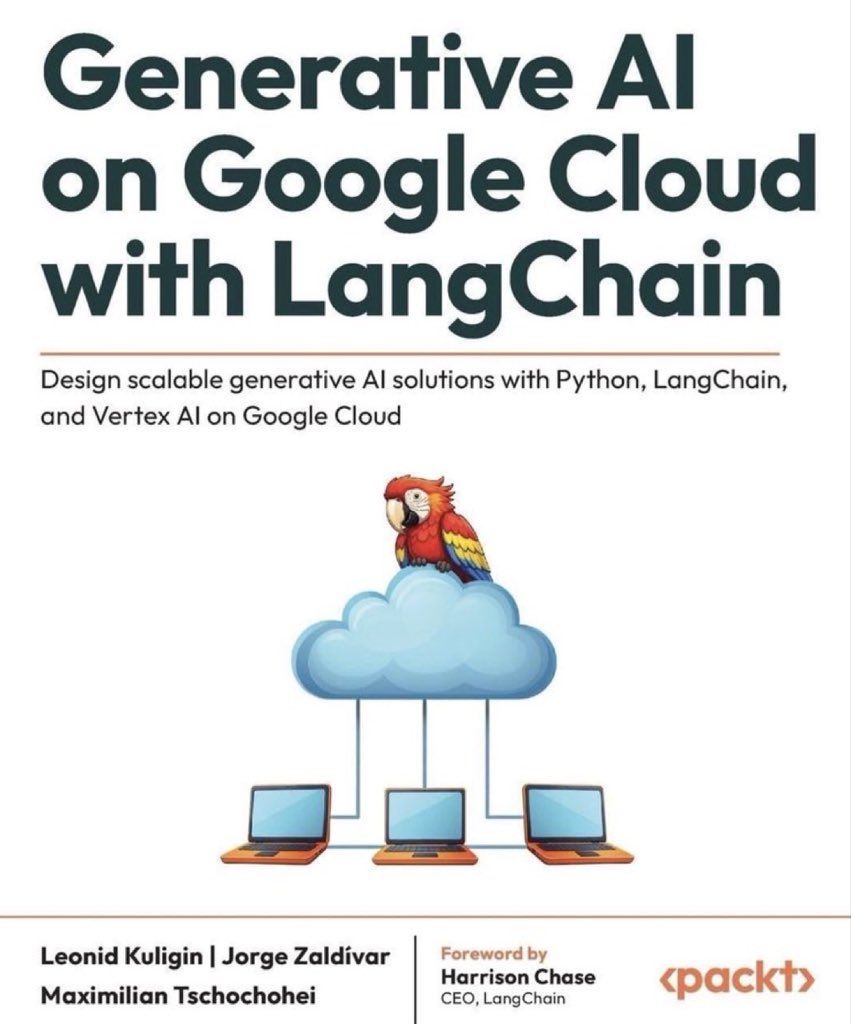
    Generative AI on Google Cloud with LangChain and Vertex AI

    Generative AI on Google Cloud with LangChain — Design scalable Generative AI solutions with Python, LangChain, and Vertex AI on Google Cloud: amzn.to/4frbkPA v/ @PacktDataML 𝓚𝓮𝔂 𝓕𝓮𝓪𝓽𝓾𝓻𝓮𝓼: 🔴Turn challenges into opportunities by learning advanced techniques for text generation, summarization, and question answering using LangChain and Google Cloud tools 🔵Solve real-world business problems with hands-on examples of GenAI applications on Google Cloud 🟡Learn repeatable design patterns for Gen AI on Google Cloud with a focus on architecture and AI ethics 🔴Build and implement GenAI agents and workflows, such as RAG and NL2SQL, using LangChain and Vertex AI 🔵Purchase of the print or Kindle book includes a free PDF eBook

    → View original post on X — @kirkdborne, 2026-04-06 05:27 UTC

  • IMMACULATE: Auditing LLM Providers with Verifiable Computation
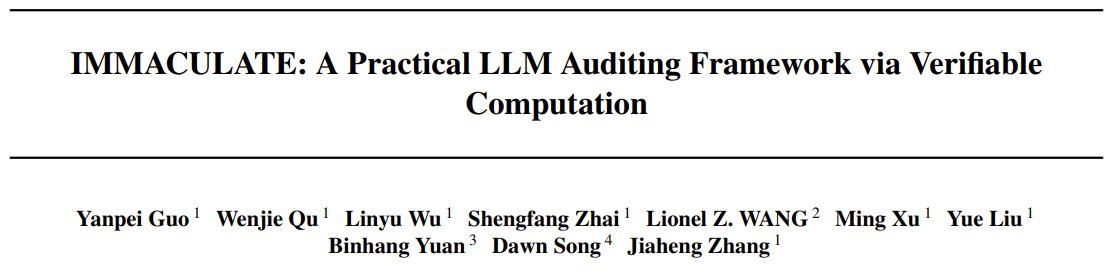
    IMMACULATE: Auditing LLM Providers with Verifiable Computation

    Can you really trust your black-box LLM provider with correct inference and honest billing? Researchers from NUS, NTU, and UC Berkeley introduce IMMACULATE. This practical auditing framework uses verifiable computation to randomly check a small fraction of LLM requests. It detects economically motivated cheats like model substitution, quality degradation, and token overbilling without needing trusted hardware or internal model access. IMMACULATE reliably distinguishes honest vs. malicious LLM execution in dense and MoE models, adding less than 1% throughput overhead. IMMACULATE: A Practical LLM Auditing Framework via Verifiable Computation Paper: arxiv.org/pdf/2602.22700 Code: github.com/guo-yanpei/Immacu… Our report: mp.weixin.qq.com/s/WR9nXudXT… 📬 #PapersAccepted by Jiqizhixin

    → View original post on X — @jiqizhixin, 2026-04-06 05:13 UTC

  • AI’s True Goal: Power Concentration Over Human Progress

    What if the real goal of AI isn’t what we’ve been told? Co-founder of the Center for Humane Technology, Tristan Harris, argues that the ultimate goal of many AI technocrats is not just to help humanity… but to advance their own pursuit of money and power. That framing changes how you interpret everything else. To the public, AI is presented as progress: More creativity. More freedom. Better work. But internally, the incentive structure is different. AI offers productivity without the ongoing cost of human labor. What stands out to me is how this shifts the equation. If systems can replace large parts of human work, value doesn’t disappear — it concentrates. Fewer workers. More centralized control. Greater accumulation at the top. The first time you connect these dynamics, the trajectory becomes clearer. This isn’t just a technological shift. It’s an economic one. And this is where things start to matter. Because the real question is no longer what AI can do. It’s who benefits from what it does. So here’s something I’d be curious to hear from you: As AI continues to scale, how should we think about power, ownership, and value distribution? #ArtificialIntelligence #AI #FutureOfWork #Economics #Innovation

    → View original post on X — @pascal_bornet, 2026-04-06 05:01 UTC

  • Claude Code Throws Error When Analyzing Its Own Source
    Claude Code Throws Error When Analyzing Its Own Source

    Claude Code now throws an error if you use it to try and analyze the Claude Code source

    → View original post on X — @steipete, 2026-04-06 04:53 UTC

  • Practical Guide to Reinforcement Learning from Human Feedback
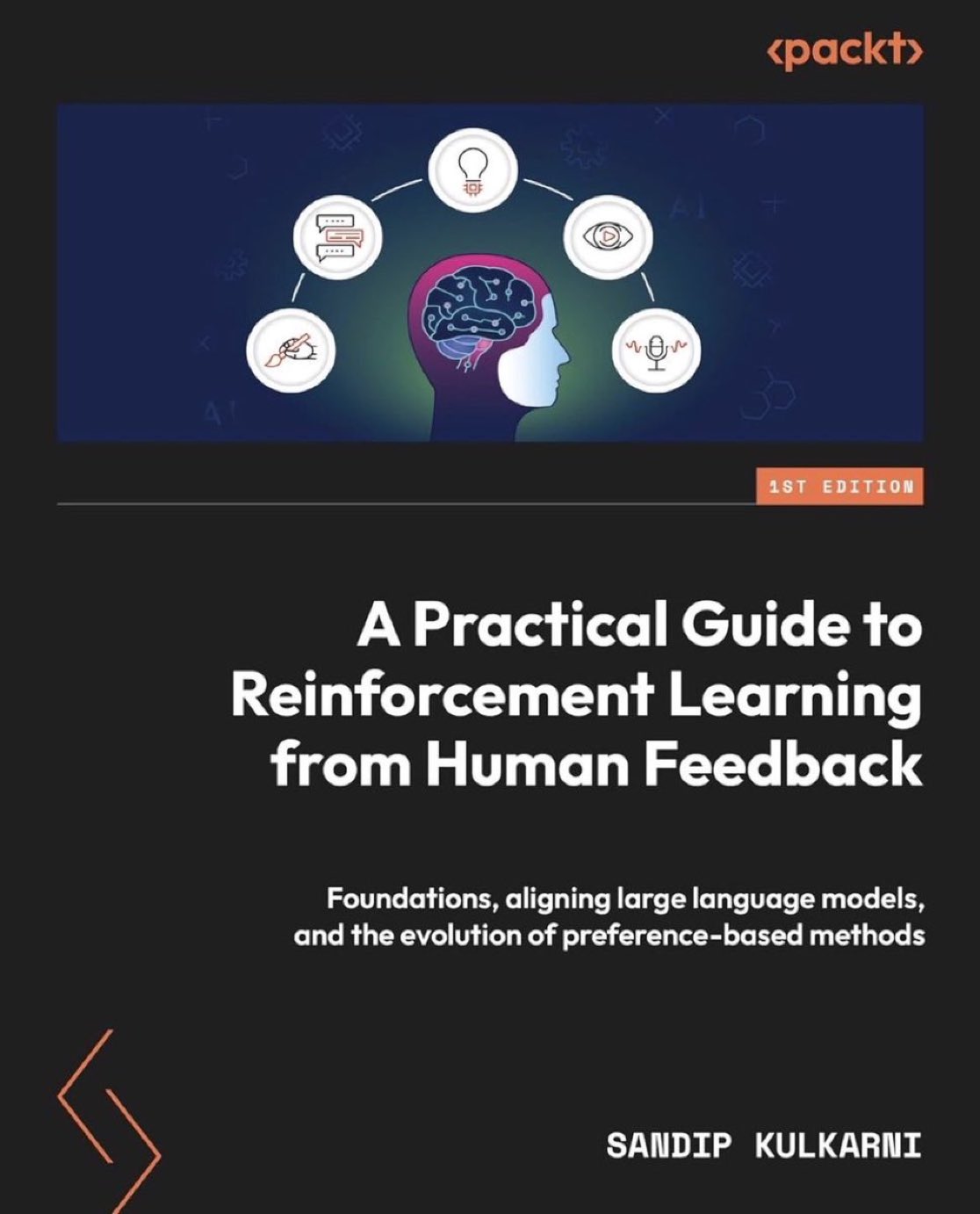
    Practical Guide to Reinforcement Learning from Human Feedback

    New release from @PacktDataML available at http://
    amzn.to/3PMn1ZL A Practical Guide to Reinforcement Learning from Human Feedback (RLHF). Amazon Summary: RLHF is a powerful approach to AI alignment and human-centered machine learning. By combining reinforcement learning

    → View original post on X — @kirkdborne