AI Dynamics

Global AI News Aggregator

About

ECONOMY

  • OpenAI Superintelligence: New Policy Blueprint for Intelligence Age
    OpenAI Superintelligence: New Policy Blueprint for Intelligence Age

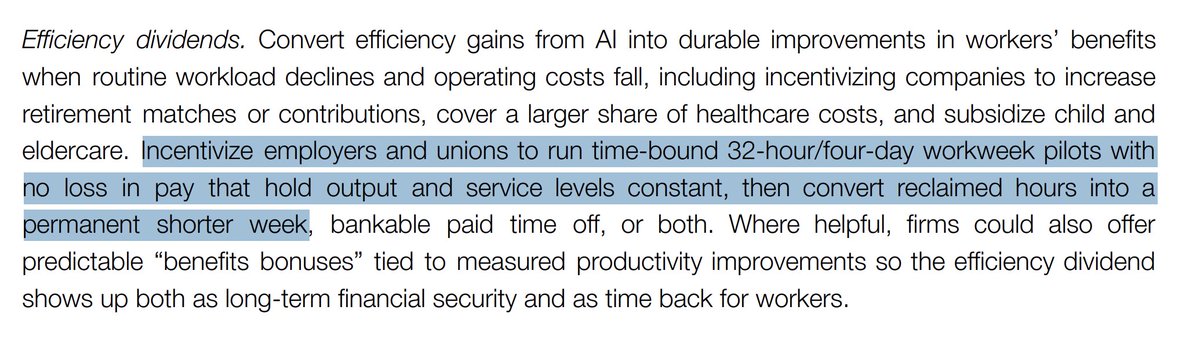
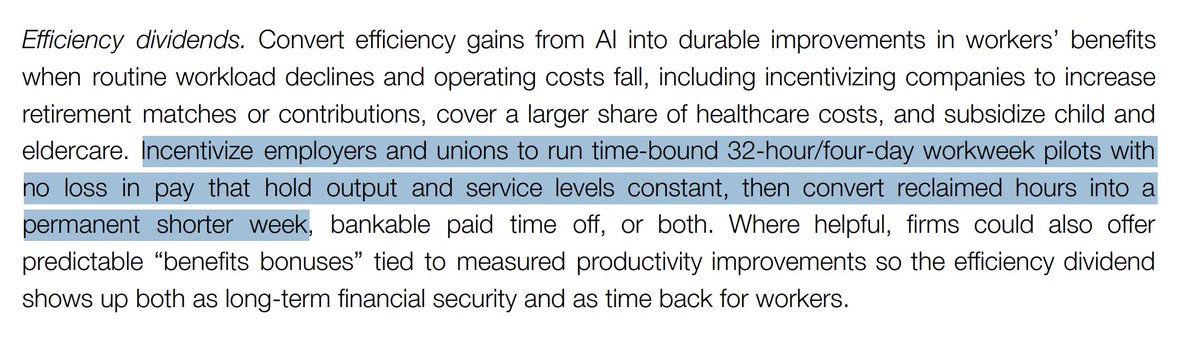
    OpenAI is preparing ready to launch their new and next generation of models. They are about to revolutionizing science & economy. "A very significant step forward" compared to their current models. Imho this is preparing people for the launch, very very soon, maybe even this week. Chubby♨️ (@kimmonismus) Looks like OpenAI reached Superintelligence. OpenAI: "Now, we’re beginning a transition toward superintelligence: AI systems capable of outperforming the smartest humans even when they are assisted by AI." OpenAI just published a 13-page policy blueprint for the "Intelligence Age"- proposing a Public Wealth Fund, 32-hour workweek pilots, portable benefits, a formal "Right to AI," and tax reforms to offset shrinking payroll revenue as automation scales. The document frames superintelligence not as a distant scenario *but an active transition requiring New Deal-level ambition*: new safety nets, containment playbooks for dangerous models, and international coordination modeled on aviation safety institutions. Here are OpenAI's suggestions (tl;dr): Open Economy: -Give workers a formal voice in AI deployment decisions -Microgrants and "startup-in-a-box" for AI-native entrepreneurs -Treat AI access as basic infrastructure (like electricity) -Shift tax base from payroll toward capital gains and corporate income -Public Wealth Fund — every citizen gets a stake in AI growth -Fast-track energy grid expansion via public-private partnerships -32-hour workweek pilots, better benefits from productivity gains -Auto-scaling safety nets triggered by displacement metrics -Portable benefits untied from employers -Invest in care economy as a transition path for displaced workers -Distributed AI-enabled labs to accelerate scientific discovery Resilient Society: -Safety tools for cyber, bio, and large-scale risks -AI trust stack — provenance, verification, audit logs -Competitive auditing market for frontier models -Containment playbooks for dangerous released models -Frontier AI companies adopt Public Benefit Corporation structures -Codified rules and auditing for government AI use -Democratic public input on AI alignment standards -Mandatory incident and near-miss reporting -International AI safety network for joint evaluations and crisis coordination Notably, OpenAI calls for stricter controls only on a narrow set of frontier models while keeping the broader ecosystem open, a clear attempt to position regulation as targeted, not industry-wide. They're backing it with up to $100K in fellowships and $1M in API credits for policy research, plus a new DC workshop opening in May. — https://nitter.net/kimmonismus/status/2041130939175284910#m

    → View original post on X — @kimmonismus, 2026-04-06 15:03 UTC
  • Gary Marcus Criticizes Altman’s Finances and Confirms Cyberattack Risk
    Gary Marcus Criticizes Altman’s Finances and Confirms Cyberattack Risk

    1. The more Sam's finances don't add up, the hype he generates gets bigger. 2. But he's right that a massive cyberattack is likely imminent. (See my January 2025 @politico essay for why.) Chubby♨️ (@kimmonismus)
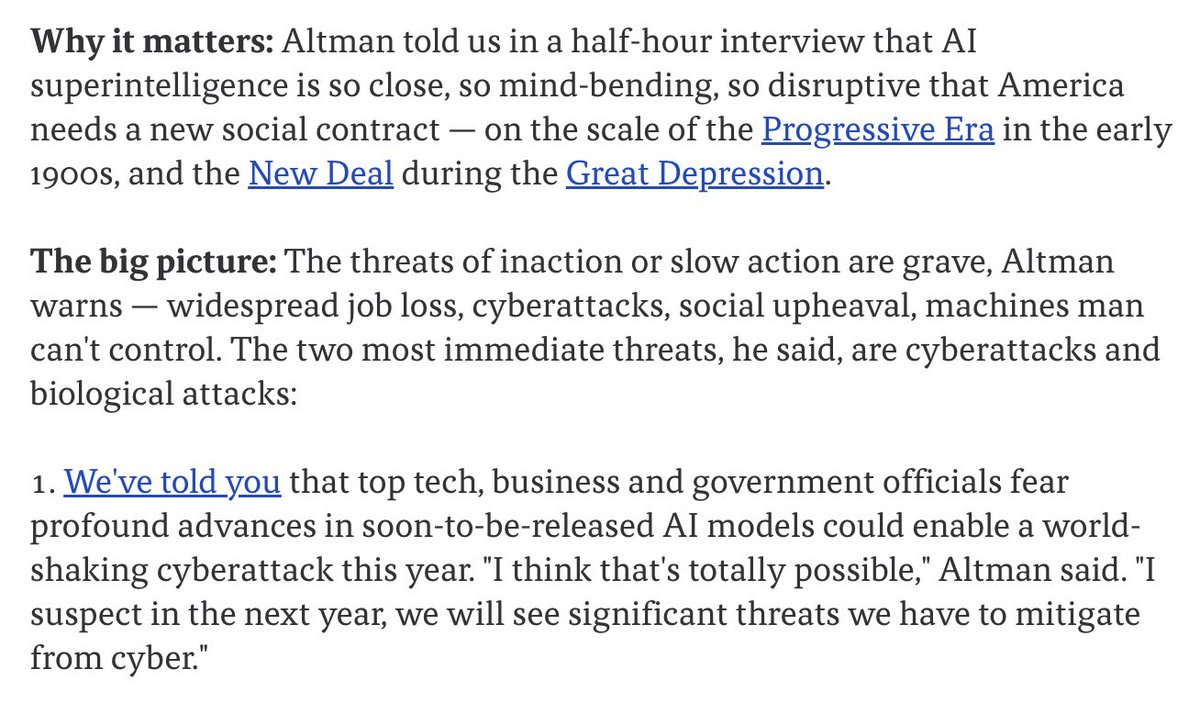
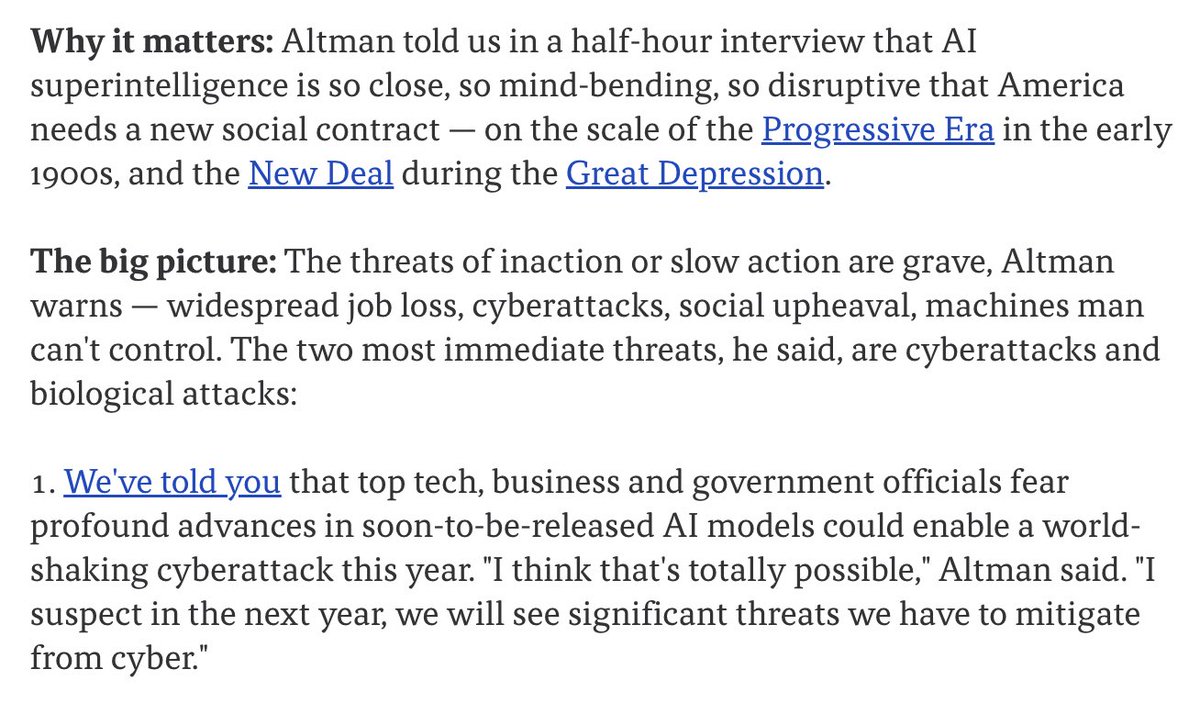
    Holy moly: Sam Altman told Axios in a half-hour interview that AI superintelligence is so close, so mind-bending, so disruptive that America needs a new social contract. – It's on the scale of the Progressive Era in the early 1900s, and the New Deal during the Great Depression. – Altman warns: widespread job loss, cyberattacks, social upheaval, machines man can't control – "Soon-to-be-released AI models could enable a world-shaking cyberattack this year. I think that's totally possible," Altman said. "I suspect in the next year, we will see significant threats we have to mitigate from cyber." [Translated from EN to English]

    → View original post on X — @garymarcus, 2026-04-06 14:57 UTC

  • Goldman Sachs: AI Impact on U.S. Employment Shows Net Negative Effect
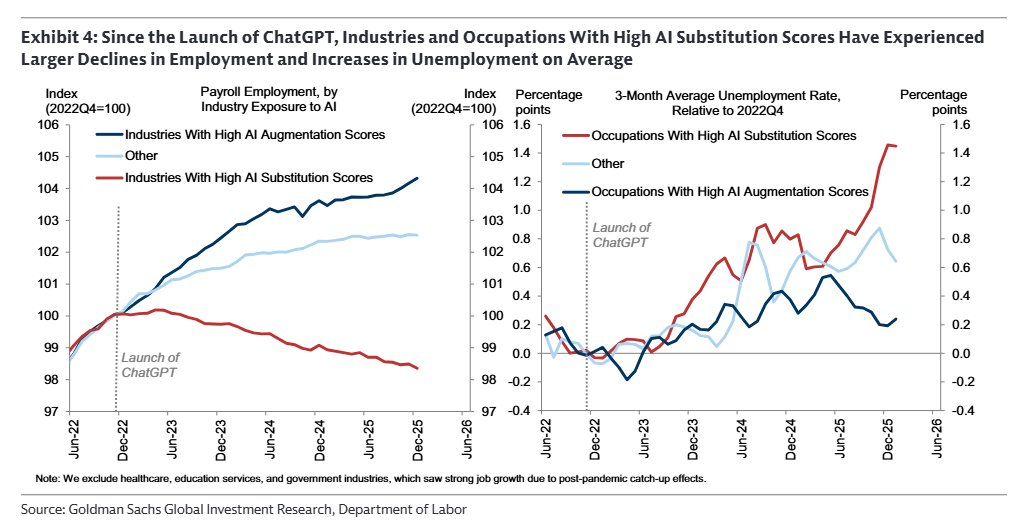
    Goldman Sachs: AI Impact on U.S. Employment Shows Net Negative Effect

    Goldman tries to quantify the net effect of AI both substituting for and augmenting U.S. employment. Their conclusion: AI substitution in occupations like phone operations and insurance claims administration have reduced monthly payroll gains by around -25K and raised the unemployment rate by 0.16 pp over the past year. AI augmentation in occupations including medicine and education have added +9K to monthly payrolls and lowered the unemployment rate by 0.06 pp. This nets out to a slight -16K drag on payrolls and an increase in the unemployment rate by 0.1 pp. Caveat: This exercise doesn't account for the possible benefit from either construction hiring due to data-center buildout or AI-driven productivity/income gains.

    → View original post on X — @mfordfuture, 2026-04-06 14:57 UTC

  • AGI Jobs Will Fundamentally Transform Knowledge Work Structure
    AGI Jobs Will Fundamentally Transform Knowledge Work Structure

    AGI Jobs will alter knowledge work at the substrate level—one of those rare inflection points where the very grammar of work is rewritten. #AIAgents #AGIJobs #Jobs

    → View original post on X — @ceobillionaire, 2026-04-06 14:47 UTC

  • Sam Altman calls for new social contract amid rapid AI advancement

    JUST IN: Sam Altman says AI is advancing so fast that America needs a “new social contract”

    → View original post on X — @montreal_ai, 2026-04-06 14:46 UTC

  • Top Robotics Stories: AI Talent, Humanoids, and Japan’s Robot Workforce
    Top Robotics Stories: AI Talent, Humanoids, and Japan’s Robot Workforce

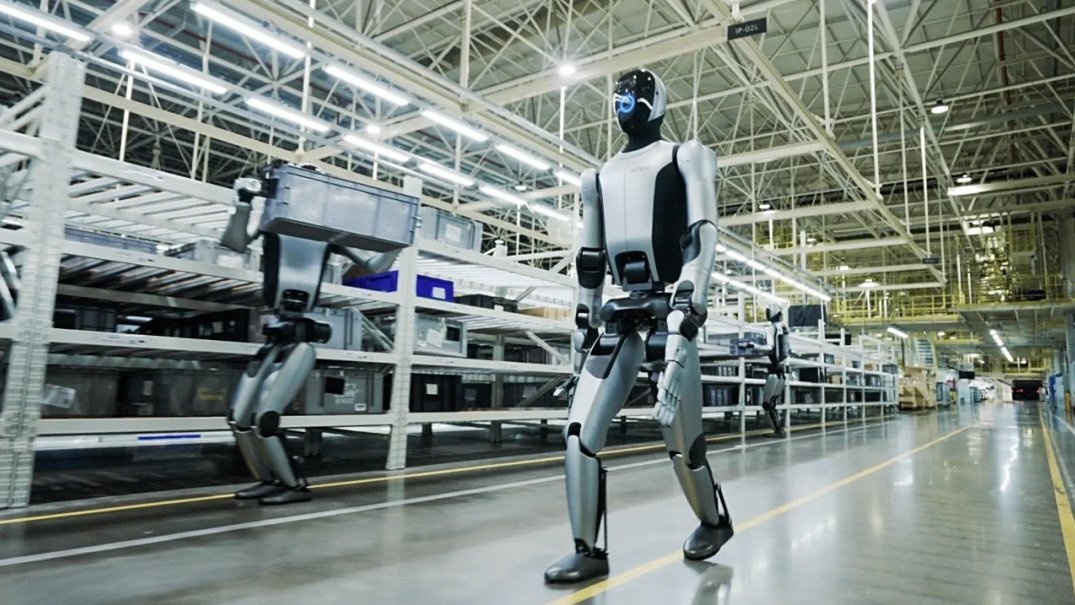
    Top stories in robotics today: – UBTech offers $18M a year for one AI scientist
    – This tiny bot grows its own nervous system
    – Japan’s new workforce: robots wanted
    – New gig economy teaches humanoids how to work – Quick hits on other robotics news

    → View original post on X — @therundownai

  • Sam Altman: AGI Here, Superintelligence Close, New Social Contract Needed
    Sam Altman: AGI Here, Superintelligence Close, New Social Contract Needed

    I don't know what Sam Altman saw internally at OpenAI, but it seems that, according to their definition, AGI is here, and superintelligence is incredibly close. AI models that independently conduct scientific research and find novel solutions are already here, and their internal model appears to surpass everything seen before. Chubby♨️ (@kimmonismus) Holy moly: Sam Altman told Axios in a half-hour interview that AI superintelligence is so close, so mind-bending, so disruptive that America needs a new social contract. – It's on the scale of the Progressive Era in the early 1900s, and the New Deal during the Great Depression. – Altman warns: widespread job loss, cyberattacks, social upheaval, machines man can't control – "soon-to-be-released AI models could enable a world-shaking cyberattack this year. "I think that's totally possible," Altman said. "I suspect in the next year, we will see significant threats we have to mitigate from cyber." — https://nitter.net/kimmonismus/status/2041126936097812598#m

    → View original post on X — @kimmonismus, 2026-04-06 13:48 UTC

  • OpenAI Claims Superintelligence Transition, Proposes Policy Blueprint
    OpenAI Claims Superintelligence Transition, Proposes Policy Blueprint

    Update: OpenAI officially states they now transition into superintelligence: nitter.net/kimmonismus/status/204… Chubby♨️ (@kimmonismus) Looks like OpenAI reached Superintelligence. OpenAI: "Now, we’re beginning a transition toward superintelligence: AI systems capable of outperforming the smartest humans even when they are assisted by AI." OpenAI just published a 13-page policy blueprint for the "Intelligence Age"- proposing a Public Wealth Fund, 32-hour workweek pilots, portable benefits, a formal "Right to AI," and tax reforms to offset shrinking payroll revenue as automation scales. The document frames superintelligence not as a distant scenario *but an active transition requiring New Deal-level ambition*: new safety nets, containment playbooks for dangerous models, and international coordination modeled on aviation safety institutions. Here are OpenAI's suggestions (tl;dr): Open Economy: -Give workers a formal voice in AI deployment decisions -Microgrants and "startup-in-a-box" for AI-native entrepreneurs -Treat AI access as basic infrastructure (like electricity) -Shift tax base from payroll toward capital gains and corporate income -Public Wealth Fund — every citizen gets a stake in AI growth -Fast-track energy grid expansion via public-private partnerships -32-hour workweek pilots, better benefits from productivity gains -Auto-scaling safety nets triggered by displacement metrics -Portable benefits untied from employers -Invest in care economy as a transition path for displaced workers -Distributed AI-enabled labs to accelerate scientific discovery Resilient Society: -Safety tools for cyber, bio, and large-scale risks -AI trust stack — provenance, verification, audit logs -Competitive auditing market for frontier models -Containment playbooks for dangerous released models -Frontier AI companies adopt Public Benefit Corporation structures -Codified rules and auditing for government AI use -Democratic public input on AI alignment standards -Mandatory incident and near-miss reporting -International AI safety network for joint evaluations and crisis coordination Notably, OpenAI calls for stricter controls only on a narrow set of frontier models while keeping the broader ecosystem open, a clear attempt to position regulation as targeted, not industry-wide. They're backing it with up to $100K in fellowships and $1M in API credits for policy research, plus a new DC workshop opening in May. — https://nitter.net/kimmonismus/status/2041130939175284910#m

    → View original post on X — @kimmonismus, 2026-04-06 12:36 UTC