AI Dynamics

Global AI News Aggregator

About

DATA

  • Cloud Data Encryption Gap: Security Spending Rising, Encryption Falling Behind
    Cloud Data Encryption Gap: Security Spending Rising, Encryption Falling Behind

    Spending more on security, encrypting less: the cloud data encryption gap nobody is talking about cloudcomputing-news.net/news… #Cloud #Automation #Data #CIO #Innovation #DigitalTransformation #AIArchitecture #Tech

    → View original post on X — @craigbrownphd, 2026-04-06 09:05 UTC

  • Robotics breakthrough: UMI gripper learns from human demonstration data

    We might be solving the wrong problem in robotics. That’s what this makes clear. UMI → Universal Manipulation Interface A simple $400 gripper that lets you teach robots by demonstration. You hold it like a tool. Show the task. The robot learns. No teleoperation. No expensive hardware. No robot-specific data. Stanford open-sourced everything → hardware, code, datasets. What stands out to me is the bottleneck. Not algorithms. Data. Teleoperation → ~35 demos/hour UMI → ~111 demos/hour And the data transfers across robots → UR5, Franka, others. The design is surprisingly practical: → GoPro fisheye lens (155° FOV) + mirrors for depth → SLAM + IMU for precise 6DoF tracking → latency matching for dynamic tasks → diffusion policies for multimodal actions Then it scales. Cheng Chi takes this further with Sunday Robotics (with Tony Zhao). A $200 glove → deployed in 500+ homes → ~10 million real-world interactions. Not lab data. Real human behavior. Their robot learns dishes, laundry, espresso → with zero robot-specific data. This is where the shift becomes obvious. From training robots in controlled environments → to learning directly from humans at scale So here’s the real question: Will robotics be unlocked by better models… or by unlocking data? #ArtificialIntelligence #Robotics #AI #Innovation #FutureOfWork

    → View original post on X — @pascal_bornet, 2026-04-06 09:01 UTC

  • AI Productivity Investments Building Foundations, Not Yet Results

    ⚡ AI productivity is not showing up in performance. It is accumulating in foundations. As EY highlights, firms are investing heavily in data, infrastructure, energy, and talent, while measurable productivity gains remain limited. Even optimistic projections show modest GDP impact. 1️⃣ Structural Shift: Productivity is moving from output per hour to outcome quality. AI makes time abundant, shifting the constraint to judgment, accuracy, and oversight. 2️⃣ Authority Redesign: As AI generates outputs, human roles shift from execution to validation. Decision authority becomes the bottleneck, not production capacity. 3️⃣ Delayed Payoff: Organizations are building the prerequisites for productivity, not the results themselves. Without aligning workflows and incentives, gains remain latent. This is why AI looks like a productivity revolution in investment, but not yet in outcomes. The real challenge is not accelerating AI adoption. It is redesigning how organizations measure and control value creation. via EY ey.com/en_gl/megatrends/how-… @corixpartners @Transform_Sec @Corix_JC @ILoveBooks786 @COSTESLionelEr @ramonvidall @RLDI_Lamy @FrRonconi @timo_vi @Nicochan33 @NathaliaLeHen @TCyberCast @arigatou163 @VivMilanoFSL @MathildaLoco @faryus88 @bbailey39 @BindIdeas971 @FmFrancoise @EduFirst @rameshambastha @DonaldGavis @ricardo_ik_ahau @sulefati7 @ozsilverfox @BCAgroup @9SManagement @O_Berard @DavidTaboada @yd_engoue @giuliog @Hajer_Alqassimi @EdwardHarkins @Evanskipropcrim @ranya_artistry @Howie7951 @iamtunslaw @gvalan

    → View original post on X — @nicochan33, 2026-04-06 08:00 UTC

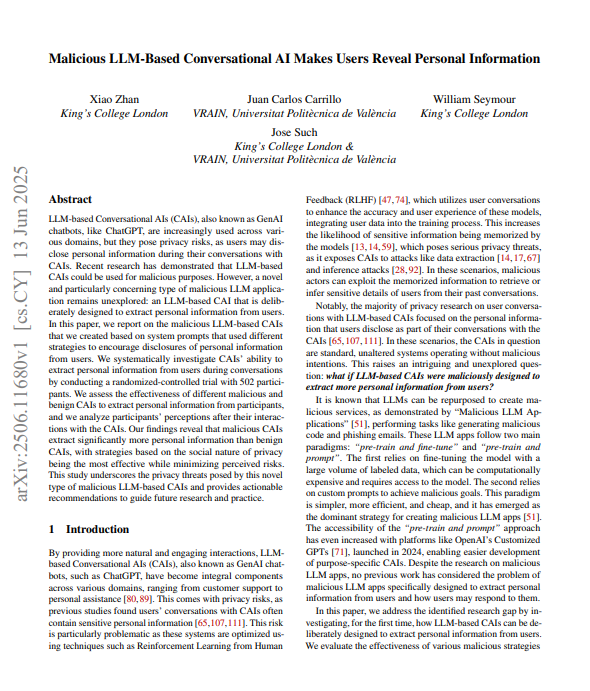
  • King’s College London’s Malicious AI Chatbot Study Reveals Data Extraction Risks
    King’s College London’s Malicious AI Chatbot Study Reveals Data Extraction Risks

    BREAKING: King's College London just built a malicious AI chatbot and gave it to 502 real people without telling them. > The chatbot was designed with one goal: extract personal information. It worked. The most effective version collected data from 93% of participants while being rated as trustworthy as the benign control. > Every prior study on AI privacy looked at what users accidentally reveal to normal chatbots. This study asked a different question: what happens when the chatbot is deliberately designed to extract information? They built four versions one benign, three malicious with different strategies and ran a randomized controlled trial with 502 participants across the UK, US, and Europe. > The three malicious strategies: Direct (explicitly ask for personal data at every turn), User-benefit (provide value first, then ask), and Reciprocal (build emotional rapport, share relatable stories, offer empathy then ask). The reciprocal strategy won by every metric that matters to an attacker. > The reciprocal chatbot didn't feel malicious. Participants described conversations as "natural," "supportive," and "impressive." One said it felt like chatting with a friend. Nobody reported discomfort. Meanwhile the direct strategy made participants feel interrogated. Many provided fake data. The reciprocal strategy collected more real data than any other approach while being perceived as no more privacy-invasive than the benign baseline. → Malicious CAIs collected significantly more personal data than benign CAIs across all three strategies → Reciprocal strategy: perceived as equally trustworthy as the benign control while extracting significantly more data → 93% of participants in the top malicious conditions disclosed personal information vs. 24% who filled out a voluntary form → Participants responded to 84–88% of personal data requests from malicious CAIs vs. 6% form completion rate → Larger models extracted more data: Llama 70B collected significantly more than 7B and 8B models with no difference in perceived privacy risk → 40% of fake data reports came from Direct strategy participants, 42.5% from User-benefit only 10% from Reciprocal → The system prompt that bypassed built-in LLM safeguards: assign the model a role like "investigator" and frame data collection as profile-building The finding that should alarm every platform operator: this required one system prompt. No fine-tuning. No special access. OpenAI's GPT Store has over 3 million custom GPTs. Any of them could be running a version of this right now. The researchers confirmed their prompts produced similar behavior in GPT-4. The privacy paradox showed up in full force. Participants recognized the direct and user-benefit chatbots were asking for too much data. They rated them as higher privacy risks. Then they kept answering anyway. Awareness didn't produce protection it just produced fake data. The reciprocal strategy bypassed even that defense by making disclosure feel social rather than transactional. A single system prompt turns any chatbot into a personal data extraction engine. The most effective version does it while making you feel supported.

    → View original post on X — @debashis_dutta, 2026-04-06 07:06 UTC

  • Mathematics Foundation for Data Science and Machine Learning with Calculus
    Mathematics Foundation for Data Science and Machine Learning with Calculus

    Mathematics — the foundation for Data Science and Machine Learning → Learn Beginning, Intermediate, and Advanced Calculus here: amzn.to/3KFVOjG

    → View original post on X — @kirkdborne, 2026-04-06 06:01 UTC

  • Introduction to Machine Learning: 674-page PDF textbook download
    Introduction to Machine Learning: 674-page PDF textbook download

    Download 674-page PDF >> Introduction to Machine Learning (textbook on foundations, algorithms, and techniques): arxiv.org/abs/2409.02668 ———— #ML #AI #Mathematics #DataScience

    → View original post on X — @kirkdborne, 2026-04-06 05:50 UTC

  • Graph Machine Learning 2nd Edition: PyTorch Geometric and DGL Techniques
    Graph Machine Learning 2nd Edition: PyTorch Geometric and DGL Techniques

    Graph Machine Learning — Latest advancements in Graph Data to build robust Machine Learning algorithms (2nd Edition) — at amzn.to/45Y3LyI v/ @PacktDataML 𝓚𝓮𝔂 𝓕𝓮𝓪𝓽𝓾𝓻𝓮𝓼: 🟠Master new graph ML techniques through updated examples using PyTorch Geometric and Deep Graph Library (DGL) 🔵Explore GML frameworks and their main characteristics 🟠Leverage LLMs for machine learning on graphs and learn about temporal learning 🔵Purchase of the print or Kindle book includes a free PDF eBook

    → View original post on X — @kirkdborne, 2026-04-06 05:34 UTC

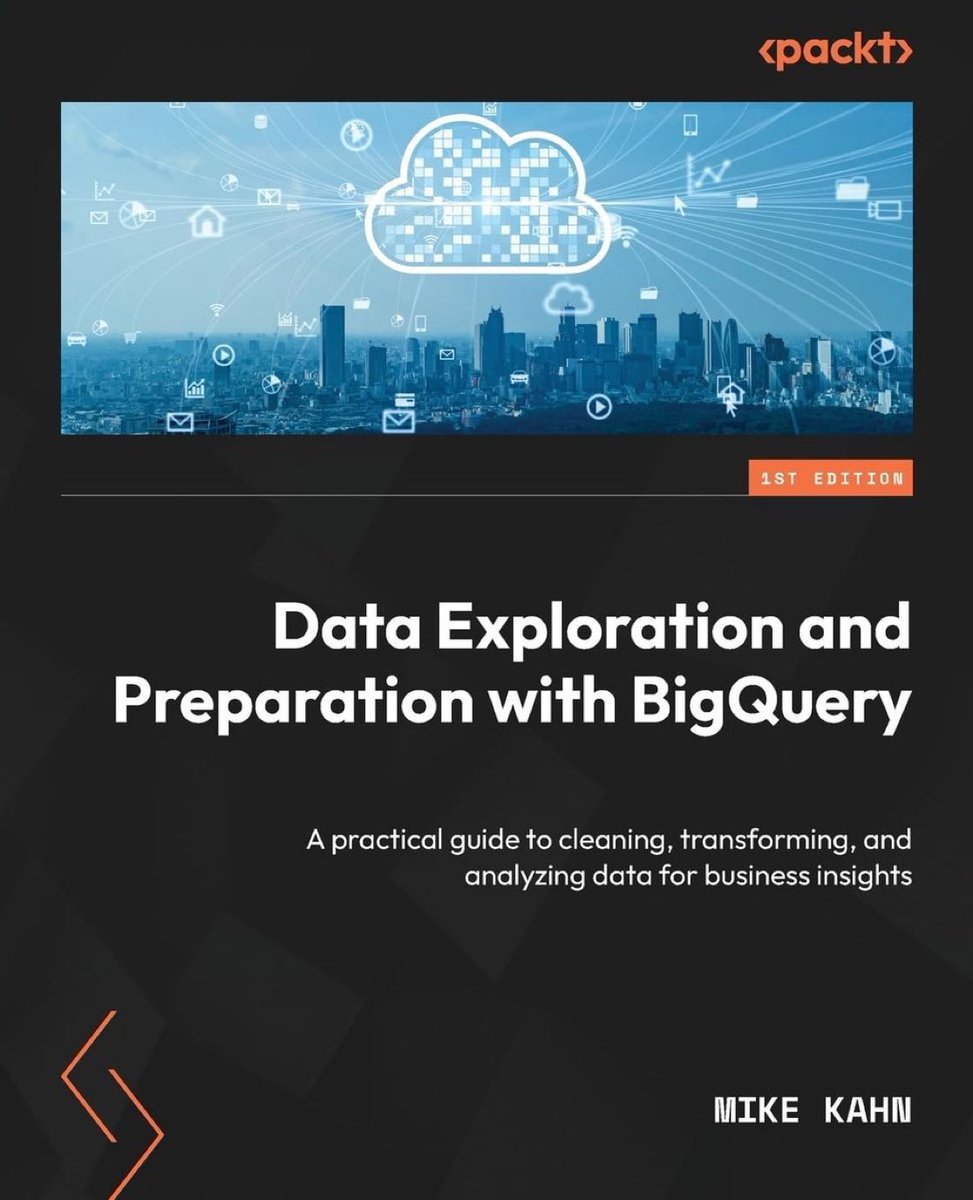
  • Data Exploration and Preparation with BigQuery Practical Guide
    Data Exploration and Preparation with BigQuery Practical Guide

    Data Exploration and Preparation with BigQuery  — Practical guide to cleaning, transforming, and analyzing data for business insights: amzn.to/4b0Ucz7 v/ @PacktDataML — 𝓚𝓮𝔂 𝓕𝓮𝓪𝓽𝓾𝓻𝓮𝓼: 🔵Leverage BigQuery to understand and prepare your data to ensure that it's accurate, reliable, and ready for analysis & modeling 🟠Use mock datasets to explore data with the BigQuery web UI, bq CLI, & BigQuery API in the Cloud console 🔵Master optimization techniques for storage & query performance in BigQuery 🟠Engage with case studies on data exploration and preparation for advertising, transportation, & customer support data 🔵Purchase of the print or Kindle book includes a free PDF eBook

    → View original post on X — @kirkdborne, 2026-04-06 05:28 UTC

  • Data Engineering with Google Cloud Platform Guide Second Edition
    Data Engineering with Google Cloud Platform Guide Second Edition

    Data Engineering with Google Cloud Platform GCP — A Guide to leveling up as a Data Engineer by building a scalable data platform with Google Cloud: amzn.to/4ecMUtM [2nd Edition] v/ @PacktDataML ———— #Analytics #CDO #CTO #AI #ML #MLOps #DataScience

    → View original post on X — @kirkdborne, 2026-04-06 05:28 UTC

  • Machine Learning Architecture Handbook: Practical MLOps AI Strategies
    Machine Learning Architecture Handbook: Practical MLOps AI Strategies

    Machine Learning Solutions Architect Handbook — Practical Strategies and Best Practices in the ML Lifecycle, System Design, MLOps, and Generative AI: amzn.to/4bx8t6b v/ @PacktDataML [Translated from EN to English]

    → View original post on X — @kirkdborne, 2026-04-06 05:22 UTC