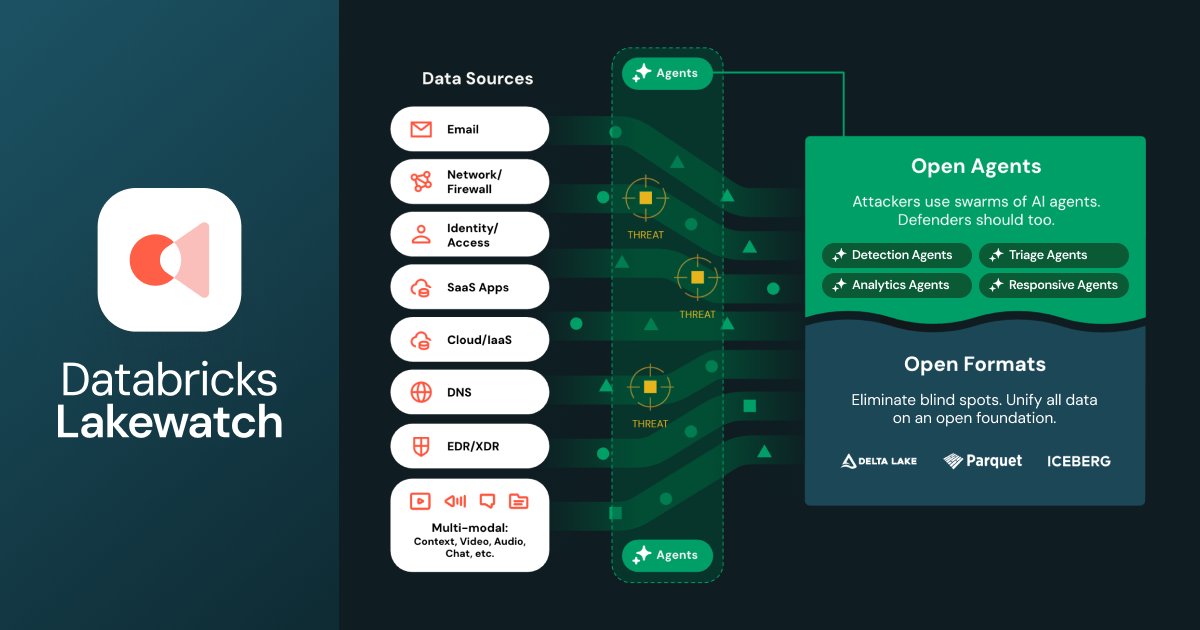
Today we’re announcing Lakewatch — a new open, agentic SIEM. Security has changed. Attackers now use agents, operating 24/7 at machine scale, while legacy security tools were built for human-speed threats. We need tools where agents work alongside humans to keep up. Lakewatch
CYBERSECURITY
-
LiteLLM Compromise: Malicious Update Alert Version 1.82.8
By
–
LiteLLM HAS BEEN COMPROMISED, DO NOT UPDATE. We just discovered that LiteLLM pypi release 1.82.8 has been compromised. It contains litellm_init.pth with base64 encoded instructions to send all the credentials it can find to a remote server and self-replicate. Link below [Translated from EN to English]
→ View original post on X — @thom_wolf, 2026-03-24 12:06 UTC
-
Claude Command Line Tool for Secure Workflow Automation
By
–
claude -p lets you execute Claude as a single command. This is nice for workflows that need intelligence for one step but need privileges for a different step. For instance you can get Claude to generate release notes or PR text, then deterministically make the PR or release, without giving Claude write permissions to your Github.
-
Protecting Journalist Sources From Government Subpoena Powers
By
–
Think about journalists who sometimes need to protect their anonymous sources from governments with subpoena powers
-
MIT Open Source Project Misused Ignoring License Terms
By
–
they are using an MIT-licensed open source project with a big warning dialog about the risks, chose to ignore both that and the license, and emailed me.
-
AI Agents Security: New Assessment Tool for OpenClaw Threats
By
–
AI agents aren’t just answering questions anymore. They’re: → calling APIs → moving data → taking actions That changes everything about security. #OpenClaw showed us the reality: Agents can be manipulated, and then act on it. That's why we just launched Agentic Security Assessments for OpenClaw Agents. Read more and try it for yourself today 👉 trent.ai/blog/trent-ai-provi… #AI #AISecurity #Cybersecurity #TrentAIHQ
-

Large-scale deanonymization attacks using language models
By
–
Large-scale online deanonymization with LLMs Lermen et al.: https://
arxiv.org/abs/2602.16800 #ArtificialIntelligence #AIAgents -

Trent AI at Cyber Startup Expo 2026 in San Francisco
By
–
Today only 🤝 Join Trent AI at Cyber Startup Expo 2026 — Meet with Eno Thereska, Co-founder and CEO & Christoph Bartenstein, Chief Product Officer. 👉 go.trent.ai/cyber-startup-ex… Monday, March 23, 2026 8am – 4pm Convene 100 Stockton 5th Floor, Pacific Hall 40 O'Farrell Street, San Francisco, CA 94108 Come by and learn how Trent secures your agentic systems with specialized AI agents that continuously scan, judge, mitigate, and evaluate. So, your team ships fast and stays secure! #CyberSecurity #AI #Startups #RSAC #TrentAIHQ
-
Edge AI Inference Without Cloud Security Vulnerabilities
By
–
How do you run AI inference at the edge without opening a security hole back to the cloud? #PaidPartnership with TDK SensEI
— Lucian Fogoros (@fogoros) 23 mars 2026
Bob Roth explains TDK SensEI's architecture: no inbound cloud-to-facility connections. Ever. #tdk_iiot pic.twitter.com/h60RrnfrWHHow do you run AI inference at the edge without opening a security hole back to the cloud? #PaidPartnership with TDK SensEI Bob Roth explains TDK SensEI's architecture: no inbound cloud-to-facility connections. Ever. #tdk_iiot
-
Identity Recognition AI: 68% Accuracy Risk Demands Policy Action
By
–
68% at 90% precision from public posts alone is sobering. Most people have no idea how much identity signal they leak across platforms. This is exactly the kind of capability research that should inform policy before it becomes a product.