"just seems like a total no-brainer that PyPi/npm/crates.io/etc. should do AI-powered scans for this pattern of attack" PyPI does that via an API used by scanning partners. I expect that may be why the package was quarantined on PyPI within an hour of it going live
CYBERSECURITY
-
AI Security Risk: Curated AI Systems Vulnerable to Hacking
By
–
That's one of my great fear. Having curated AI, and connect to other tools with a hack.
-
Commvault Expands Resilience with CrowdStrike Falcon Integration
By
–
Resilience Operations #ResOps and #PowerOfCommunity in the news! @Commvault Expands Unified Resilience with @CrowdStrike Integration: https://
commvault.com/news/integrati
on-with-crowdstrike-falcon-next-gen-siem
… This partnership enables:
Bi-directional integration with CrowdStrike Falcon Next-Gen SIEM.
Connecting data -
Commvault Acquires Satori Cyber for Enterprise Resilience
By
–
Another example of #Commvault's Identity Resilience and Cyber Resilience leadership, amplified by the Power of Community… @Commvault 's acquisition of @SatoriCyber extends enterprise resilience to structured and AI data with real-time governance controls:
-
LiteLLM Supply Chain Attack: Bug Saved Developers from Credential Theft
By
–
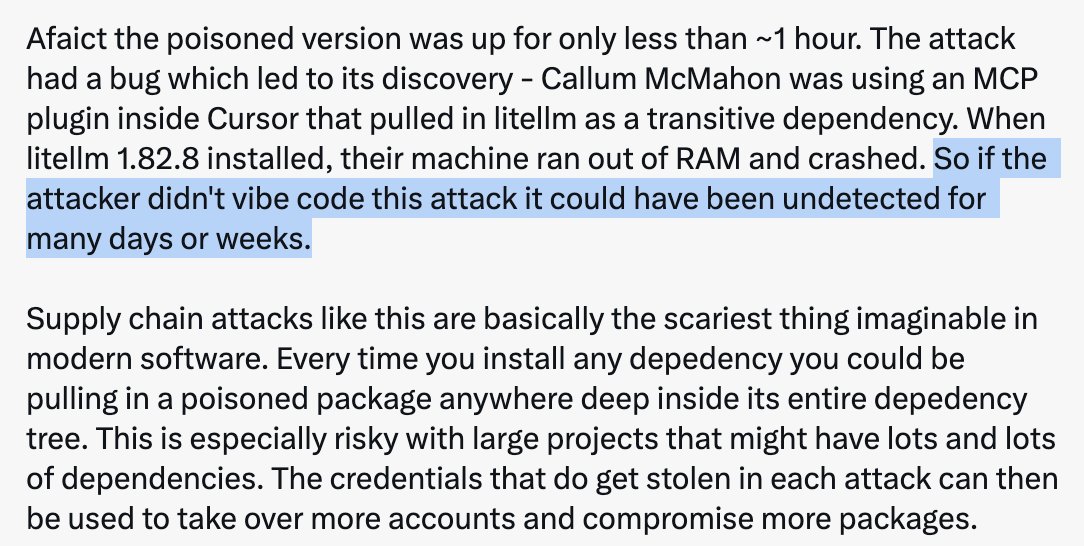
When vibe coding is an unalloyed good: your hacker vibe coded their way to a bug that limited the efficacy of their attack. 😅😮💨 (But still very serious.) Andrej Karpathy (@karpathy) Software horror: litellm PyPI supply chain attack. Simple `pip install litellm` was enough to exfiltrate SSH keys, AWS/GCP/Azure creds, Kubernetes configs, git credentials, env vars (all your API keys), shell history, crypto wallets, SSL private keys, CI/CD secrets, database passwords. LiteLLM itself has 97 million downloads per month which is already terrible, but much worse, the contagion spreads to any project that depends on litellm. For example, if you did `pip install dspy` (which depended on litellm>=1.64.0), you'd also be pwnd. Same for any other large project that depended on litellm. Afaict the poisoned version was up for only less than ~1 hour. The attack had a bug which led to its discovery – Callum McMahon was using an MCP plugin inside Cursor that pulled in litellm as a transitive dependency. When litellm 1.82.8 installed, their machine ran out of RAM and crashed. So if the attacker didn't vibe code this attack it could have been undetected for many days or weeks. Supply chain attacks like this are basically the scariest thing imaginable in modern software. Every time you install any depedency you could be pulling in a poisoned package anywhere deep inside its entire depedency tree. This is especially risky with large projects that might have lots and lots of dependencies. The credentials that do get stolen in each attack can then be used to take over more accounts and compromise more packages. Classical software engineering would have you believe that dependencies are good (we're building pyramids from bricks), but imo this has to be re-evaluated, and it's why I've been so growingly averse to them, preferring to use LLMs to "yoink" functionality when it's simple enough and possible. — https://nitter.net/karpathy/status/2036487306585268612#m
-
Security vs Speed: Oracle’s AI Advantage for Enterprise Needs
By
–
Both care about security, but for the hedge fund, speed trumps many other considerations. For the bank, speed is always second to data security, customer privacy, etc. This is where a company like Oracle will win: the AI a dev wants with the safety/security their company requires
-
LiteLLM PyPI Supply Chain Attack Steals Credentials and API Keys
By
–
Software horror: litellm PyPI supply chain attack. Simple `pip install litellm` was enough to exfiltrate SSH keys, AWS/GCP/Azure creds, Kubernetes configs, git credentials, env vars (all your API keys), shell history, crypto wallets, SSL private keys, CI/CD secrets, database passwords. LiteLLM itself has 97 million downloads per month which is already terrible, but much worse, the contagion spreads to any project that depends on litellm. For example, if you did `pip install dspy` (which depended on litellm>=1.64.0), you'd also be pwnd. Same for any other large project that depended on litellm. Afaict the poisoned version was up for only less than ~1 hour. The attack had a bug which led to its discovery – Callum McMahon was using an MCP plugin inside Cursor that pulled in litellm as a transitive dependency. When litellm 1.82.8 installed, their machine ran out of RAM and crashed. So if the attacker didn't vibe code this attack it could have been undetected for many days or weeks. Supply chain attacks like this are basically the scariest thing imaginable in modern software. Every time you install any depedency you could be pulling in a poisoned package anywhere deep inside its entire depedency tree. This is especially risky with large projects that might have lots and lots of dependencies. The credentials that do get stolen in each attack can then be used to take over more accounts and compromise more packages. Classical software engineering would have you believe that dependencies are good (we're building pyramids from bricks), but imo this has to be re-evaluated, and it's why I've been so growingly averse to them, preferring to use LLMs to "yoink" functionality when it's simple enough and possible. Daniel Hnyk (@hnykda) LiteLLM HAS BEEN COMPROMISED, DO NOT UPDATE. We just discovered that LiteLLM pypi release 1.82.8. It has been compromised, it contains litellm_init.pth with base64 encoded instructions to send all the credentials it can find to remote server + self-replicate. link below — https://nitter.net/hnykda/status/2036414330267193815#m
-
AI Agents Autonomously Execute CVE Exploits and Coordinate Attacks
By
–
This morning at #RSAC2026, Databricks Co-founder and CEO @alighodsi and @a16z Co-founder @bhorowitz took the stage to make the case for a fundamentally different approach to cybersecurity. AI agents now autonomously read CVEs, construct exploits, and coordinate attacks around
-
Guardrails 2.0: Enterprise Security and Privacy Features for AI Deployments
By
–
Guardrails 2.0 supports trusted enterprise deployments alongside robust data privacy features, optional conversation history redaction, pre-launch testing, post-deployment monitoring, and access to agent insurance policies backed by AIUC-1 certification.
→ View original post on X — @elevenlabs, 2026-03-24 15:56 UTC