Wait, what? @UnslothAI is starting to upload MLX Dynamic Quants! I have to test them ASAP! Thanks you really rock! 🚀 unsloth.ai/docs/models/gemma…
→ View original post on X — @huggingface, 2026-04-04 19:48 UTC

By
–
Wait, what? @UnslothAI is starting to upload MLX Dynamic Quants! I have to test them ASAP! Thanks you really rock! 🚀 unsloth.ai/docs/models/gemma…
→ View original post on X — @huggingface, 2026-04-04 19:48 UTC
By
–
I changed my mind. MCP can be wonderful. It just needs to be light and purpose-built and engineered instead of a shitty shim over your existing REST API braai engineer (@BraaiEngineer) MCP was a very costly mistake, but useful as an adoption vector (for now). Should have repurposed gRPC. We could have saved 6-24 months. nitter.net/braaiengineer/status/1… — https://nitter.net/BraaiEngineer/status/2040514796655632857#m
→ View original post on X — @jiquanngiam, 2026-04-04 19:46 UTC
By
–
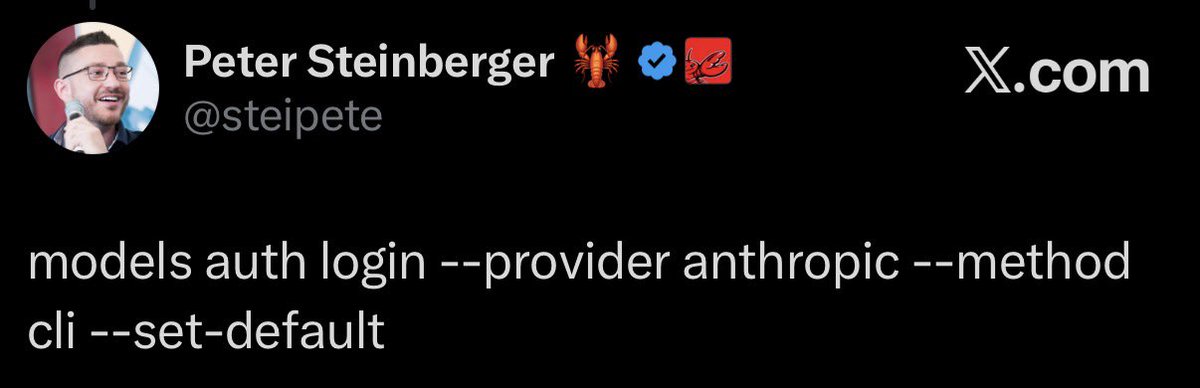
OpenClaw is 🔥 and Peter is GOAT Send this to your OpenClaw Agent: models auth login –provider anthropic –method cli –set-default This is so much fun!
→ View original post on X — @saboo_shubham_, 2026-04-04 19:37 UTC
By
–
Interesting.. Chain of thought is a reduce (in addition to attention ofc), so I guess this can be seen as a bit more of a directed context compaction mechanism, inheriting structure from the preexisting idea of a wiki.
By
–
this calls claude -p, which is their 1P harness and allowed.
By
–
Check out https://
mintmcp.com for MCP done right
By
–
models auth login –provider anthropic –method cli –set-default
By
–
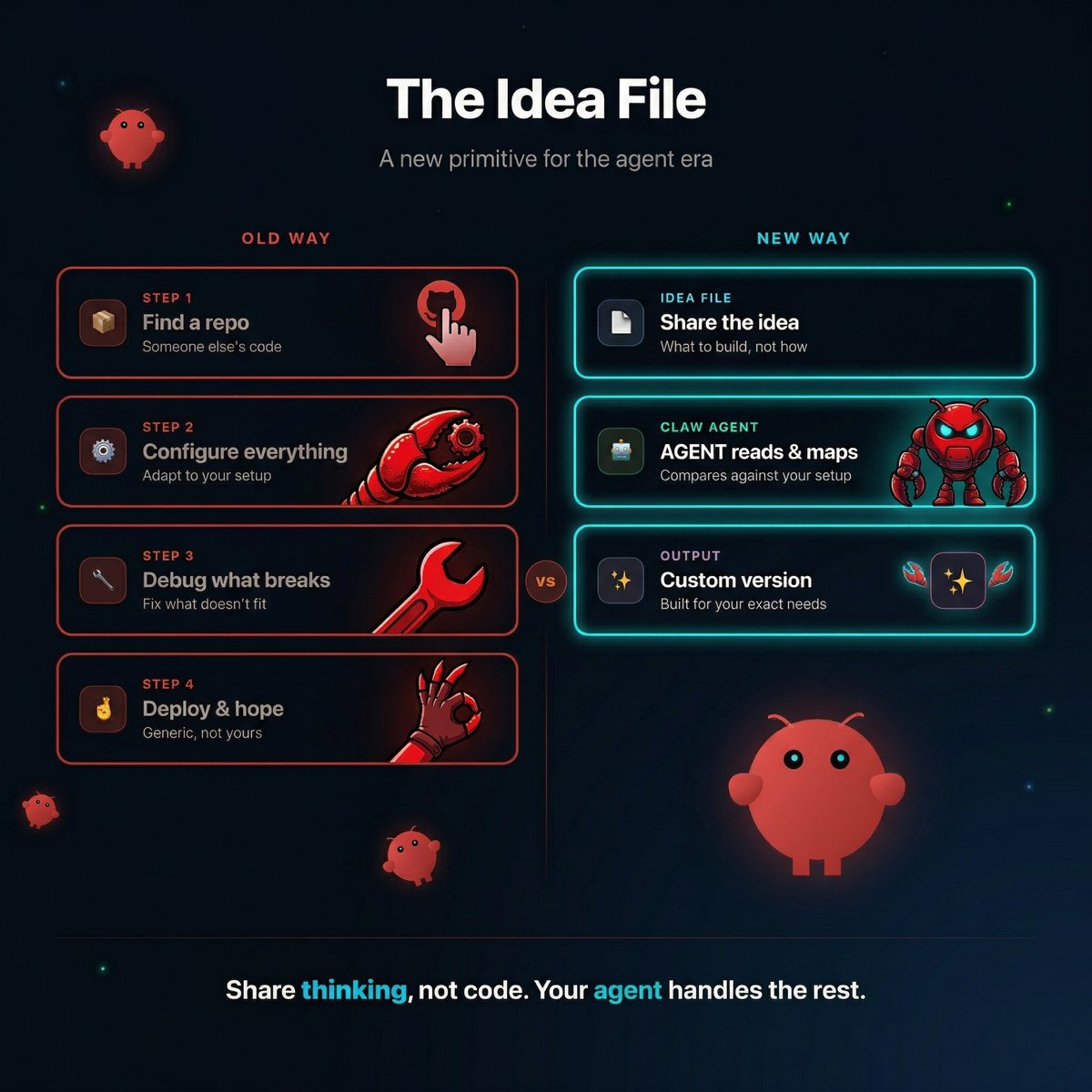
This is the way. Don't share apps, share ideas with AI Agents. Karpathy just introduced a new primitive: "the idea file". Instead of sharing a repo with code to clone, you share a markdown doc with the idea. What to build, not how to build it. Your agent reads it and figures out the rest. I pointed my OpenClaw agent Monica to it. Within one session, they read the idea file, compared it against our existing setup (6 agents already coordinating through markdown files on a Mac Mini), identified what we're already doing and what's missing, and started building the parts we don't have. Turns out we already had the ingestion layer without knowing it. Our intel agent scans sources twice a day and writes structured signals to a daily file. The raw data gets saved, but nobody ever looks at it again. What we were missing: compilation. 60 days of daily signals sitting in files, but no agent turning them into structured knowledge. My agents only see today's intel. They can't say "this is the third local OCR tool this quarter" because that context isn't compiled anywhere. Monica caught that gap on her own from the idea file. You don't need someone else's code. You need their thinking. Your agents handle the rest, and they'll customize it to what you actually need. We are moving from cloning repos to sharing ideas with Agents. Shubham Saboo (@Saboo_Shubham_) x.com/i/article/202179384677… — https://nitter.net/Saboo_Shubham_/status/2022014147450614038#m
→ View original post on X — @saboo_shubham_, 2026-04-04 17:57 UTC
By
–
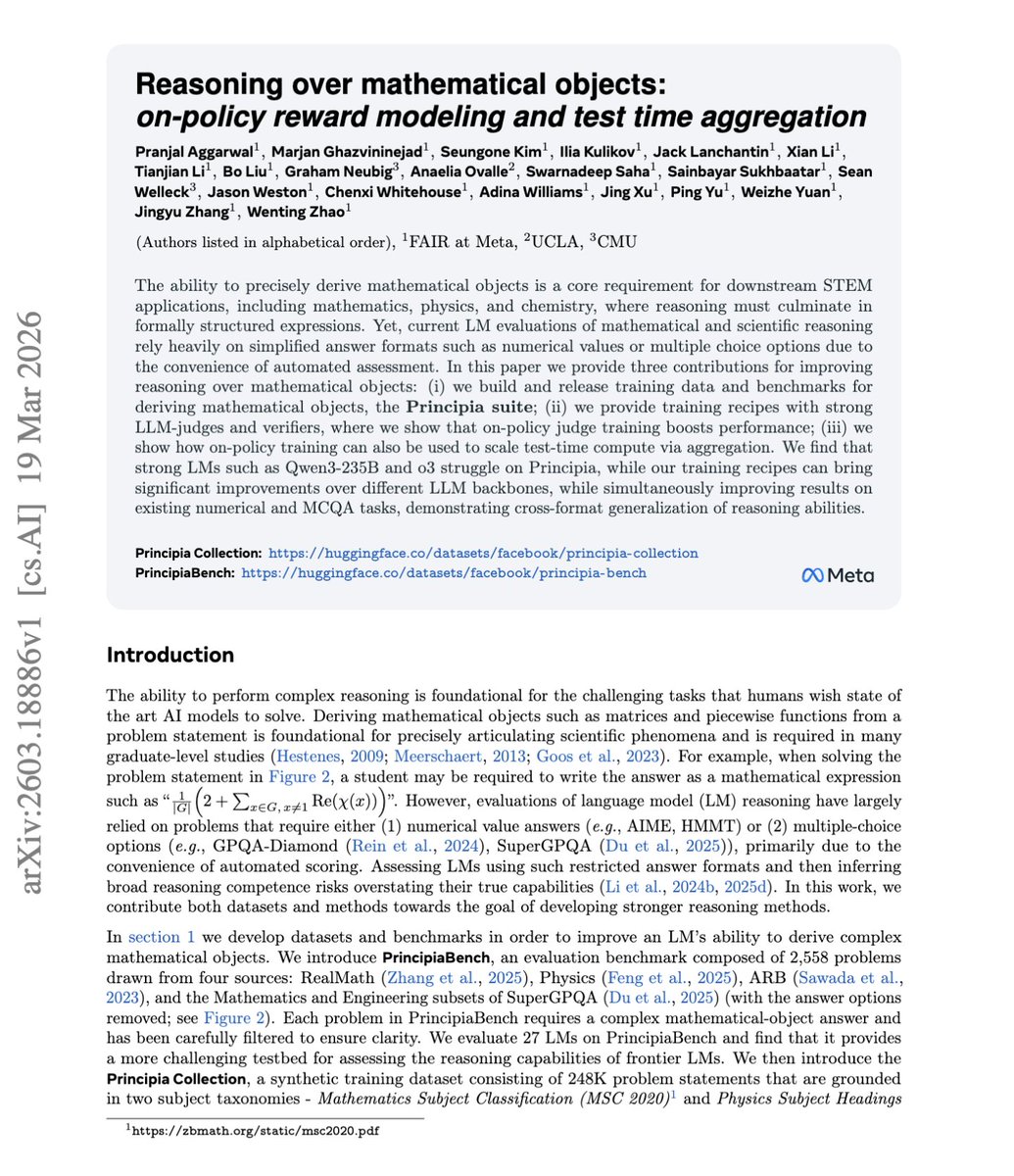
“Reasoning over Mathematical Objects” Most reasoning benchmarks still let models answer with multiple choice or short numerics, which makes evaluation easy but also makes the task easier than real STEM reasoning. This paper shows that when you remove the options and ask for the actual object, like an equation, matrix, set, interval, or piecewise function, the performance drops sharply, even for frontier models. So this paper proposes Principia: a benchmark, training set, and verifier pipeline built specifically for mathematical-object reasoning, plus on-policy judge training to score these hard outputs reliably. What makes this interesting is that training on these harder outputs also improves standard math and science benchmarks, suggesting this is not just better formatting, but better actual reasoning.
→ View original post on X — @askalphaxiv, 2026-04-04 17:55 UTC