As an AI researcher there are many good reasons to write unit tests for your code, but perhaps the best motivator to write tests is the respect (and often surprise) from other people when they look at your code and see you actually wrote unit tests.
CODE
-
Inverting Prompts, Training Data Detection, and Distillation Techniques
By
–
– inverting prompts from logits
– training data detection (
@WeijiaShi2 worked on this)
– distillation -
NVIDIA NeMo Custom Generative AI Models on Amazon EKS
By
–
Watch this YouTube live stream to hear NVIDIA experts discuss building and using custom generative AI models with NVIDIA NeMo on Amazon EKS. Learn how businesses can benefit from generative AI in this special episode of Containers from the Couch.
-
Researchers Jailbreak ChatGPT API by Accessing Hidden Token Probabilities
By
–
fun research story about how we jailbroke the the chatGPT API: so every time you run inference with a language model like GPT-whatever, the model outputs a full probabilities over its entire vocabulary (~50,000 tokens) but when you use their API, OpenAI hides all this info from
-

OpenAI Welcomes Developer Feedback for 2024 API Improvements
By
–
Happy New Year, developers! As we kickstart 2024, your insights on the @OpenAI DX are invaluable. We’ve already shipped a top request: API key usage metrics. Keep sharing your ideas below! We’re always evolving thanks to your feedback. For more updates, follow @OpenAIDevs
! -
LangChain v0.1.0 Introduces Seven Agent Types Documentation
By
–
LangChain v0.1.0 Highlights Agents As part of v0.1.0, we: Added documentation on the seven different agent types (and when to use each one)
Rewrote agents in LCEL for improved ability to customize Agent Types: https://
python.langchain.com/docs/modules/a
gents/agent_types/
… YouTube: -
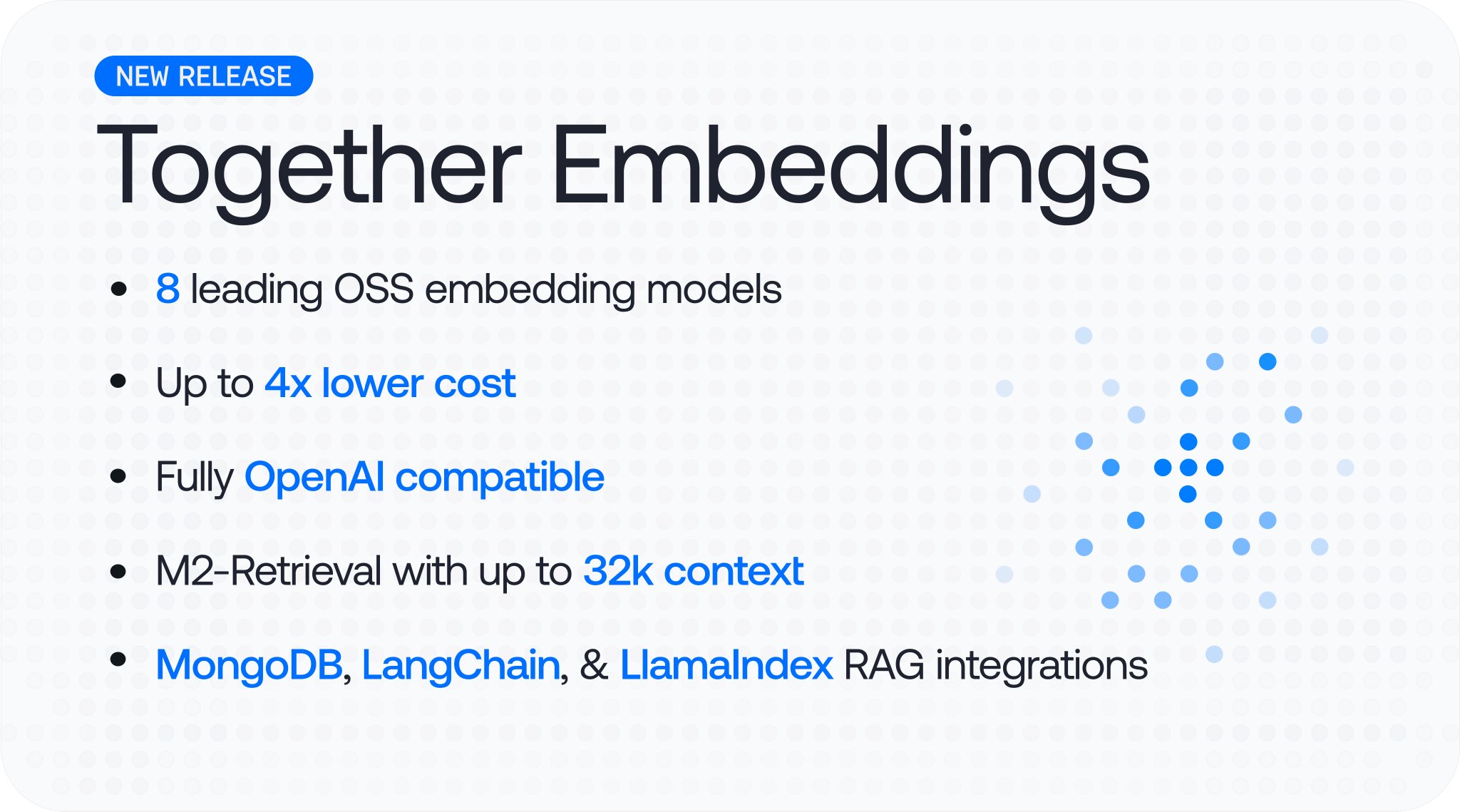
Together Launches langchain-together Python Package for Embeddings
By
–
@togethercompute Embeddings Today we’re excited to announce the new langchain-together Python package, which has connections to Together’s LLM and Embeddings endpoints. This is the easiest way to access the next-gen embedding models their team has been developing. Learn
-
RAG Technology Explained: Retrieval-Augmented Generation with Coral
By
–
Retrieval-augmented generation supports a language model with access to external tools and source data like search engines or documentation.
— Cohere (@cohere) 11 janvier 2024
Watch NLP expert @itsSandraKublik explain RAG and how it works with Coral, our conversational AI demo. Try it at https://t.co/GhYd5BwAOU. pic.twitter.com/ERzhgBTRwRRetrieval-augmented generation supports a language model with access to external tools and source data like search engines or documentation. Watch NLP expert @itsSandraKublik explain RAG and how it works with Coral, our conversational AI demo. Try it at http://
cohere.com/coral. -
Camera Calibration with OpenCV: 3D to 2D Point Mapping Guide
By
–
🎥 Video Alert 🎥https://t.co/ruSM4N40vl
— Satya Mallick (@LearnOpenCV) 11 janvier 2024
Check our comprehensive video as we delve into camera calibration using OpenCV. You’ll understand the
➡️ significance of camera calibration for accurate 3D to 2D point mapping
➡️ how to leverage geometric calibration to correct distorted… pic.twitter.com/cHssNbmMArAlert https://
youtube.com/watch?v=EWqqse
IjVqM
… Check our comprehensive video as we delve into camera calibration using OpenCV. You’ll understand the significance of camera calibration for accurate 3D to 2D point mapping how to leverage geometric calibration to correct distorted -
Ally and LangChain Enable PII Masking for GenAI Compliance
By
–
@Ally and @langchain collaborate to bring PII masking to the LangChain typescript package — paving the path for more genAI adoption, in a compliant and safe manner. Read more on the blog!