There's going to be a lot more software, and a lot more demand for software engineers. And a lot more token consumption.
AI
-
AI Scientist Paper Published in Nature, Advancing Automated Research
By
–
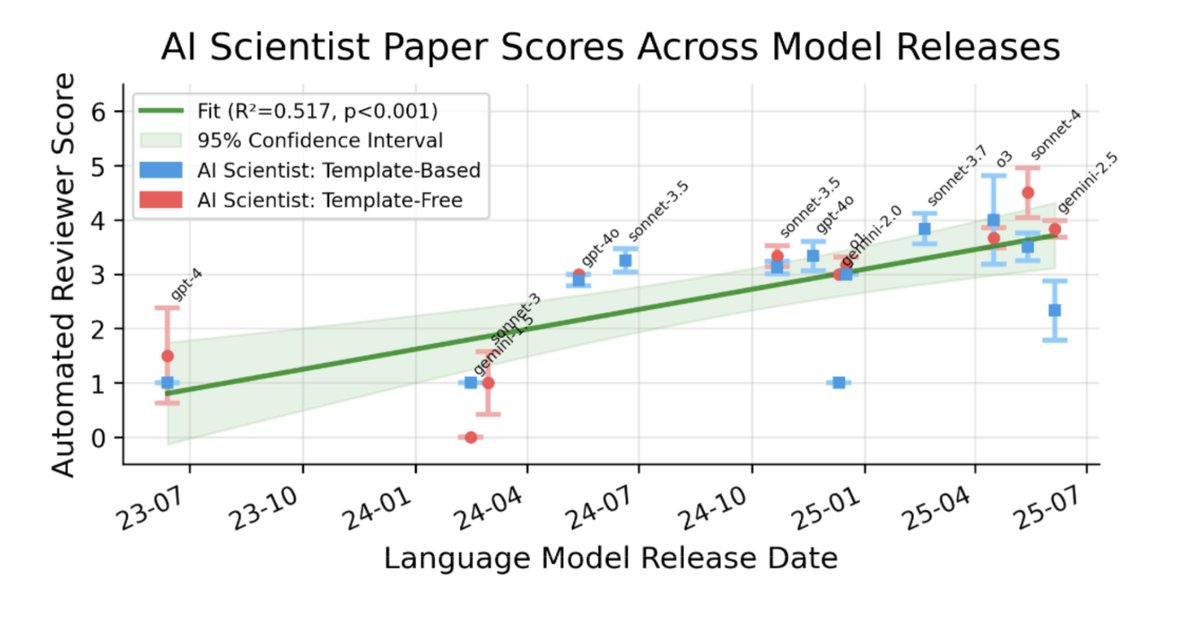
Still remember the experiment grind over New Year's break–really great to see this out in Nature today! AI automation of AI research is heating up fast, and I'm excited to see what becomes possible as models keep improving (see the figure below!) Sakana AI (@SakanaAILabs) The AI Scientist: Towards Fully Automated AI Research, Now Published in Nature Nature: nature.com/articles/s41586-0… Blog: sakana.ai/ai-scientist-natur… When we first introduced The AI Scientist, we shared an ambitious vision of an agent powered by foundation models capable of executing the entire machine learning research lifecycle. From inventing ideas and writing code to executing experiments and drafting the manuscript, the system demonstrated that end-to-end automation of the scientific process is possible. Soon after, we shared a historic update: the improved AI Scientist-v2 produced the first fully AI-generated paper to pass a rigorous human peer-review process. Today, we are happy to announce that “The AI Scientist: Towards Fully Automated AI Research,” our paper describing all of this work, along with fresh new insights, has been published in @Nature! This Nature publication consolidates these milestones and details the underlying foundation model orchestration. It also introduces our Automated Reviewer, which matches human review judgments and actually exceeds standard inter-human agreement. Crucially, by using this reviewer to grade papers generated by different foundation models, we discovered a clear scaling law of science. As the underlying foundation models improve, the quality of the generated scientific papers increases correspondingly. This implies that as compute costs decrease and model capabilities continue to exponentially increase, future versions of The AI Scientist will be substantially more capable. Building upon our previous open-source releases (github.com/SakanaAI/AI-Scien…), this open-access Nature publication comprehensively details our system's architecture, outlines several new scaling results, and discusses the promise and challenges of AI-generated science. This substantial milestone is the result of a close and fruitful collaboration between researchers at Sakana AI, the University of British Columbia (UBC) and the Vector Institute, and the University of Oxford. Congrats to the team! @_chris_lu_ @cong_ml @RobertTLange @_yutaroyamada @shengranhu @j_foerst @hardmaru @jeffclune — https://nitter.net/SakanaAILabs/status/2036840833690071450#m
→ View original post on X — @_yutaroyamada, 2026-03-26 13:38 UTC
-
First Autonomous AI Worker OpenClaw Launches with Funded Wallet
By
–
[ The first autonomous worker is coming online ] Setting up the first autonomous worker: OpenClaw, running on a dedicated machine with its own accounts and a $AGIALPHA-funded wallet. It will listen to AGIJobManager, autonomously apply to AGI Jobs, execute them, and submit
-
Space-Based AI Infrastructure: The Future of Supercomputing Beyond Earth
By
–
The future of AI infrastructure may move off the planet entirely as space offers continuous solar energy and a natural vacuum for radiating massive GPU heat. If launch costs continue to fall the biggest supercomputers will no longer sit in terrestrial data centers but will orbit… pic.twitter.com/6Can9U9iJ1
— Satya Mallick (@LearnOpenCV) 26 mars 2026The future of AI infrastructure may move off the planet entirely as space offers continuous solar energy and a natural vacuum for radiating massive GPU heat. If launch costs continue to fall the biggest supercomputers will no longer sit in terrestrial data centers but will orbit
-
Video Understanding: Teaching AI to Interpret Motion and Time
By
–
Video Understanding: Teaching AI to Make Sense of Motion and Time
— Satya Mallick (@LearnOpenCV) 26 mars 2026
In this episode of Artificial Intelligence: Papers and Concepts, we explore Video Understanding, a rapidly evolving area of AI focused on helping models interpret not just images, but sequences of events over… pic.twitter.com/QIl9DGcz4vUnderstanding: Teaching AI to Make Sense of Motion and Time In this episode of Artificial Intelligence: Papers and Concepts, we explore Understanding, a rapidly evolving area of AI focused on helping models interpret not just images, but sequences of events over
-
Discover Cohere Transcribe, the New Transcription Tool
By
–
Learn more: cohere.com/blog/transcribe Download Cohere Transcribe: huggingface.co/CohereLabs/co… [Translated from EN to English]
-
Cohere’s Speech-to-Text Model Tops HuggingFace ASR Leaderboard
By
–
Our open-source speech-to-text model has secured the top spot for English language accuracy on HuggingFace’s Open ASR model leaderboard, achieving an impressive word error rate of just 5.42% and validated by human evaluation. We've also successfully achieved one of the strongest accuracy-speed ratios among speech models of a comparable size.
-
Cohere Transcribe: ultra-fast audio transcription according to Radical Ventures
By
–
"We're genuinely impressed with what Cohere has built with Transcribe. The speed is exceptional – turning minutes of audio into usable transcripts in seconds – and it immediately unlocks new possibilities for real-time products and workflows," said Paige Dickie, VP, Radical Ventures. [Translated from EN to English]
-
Cohere Launches First Speech-to-Text Model for Enterprise
By
–
This is Cohere’s first speech-to-text model release and a huge step towards our goal of delivering enterprise speech intelligence into North, Cohere’s agentic AI orchestration platform.
-
Cohere Introduces Transcribe: New Open Source Speech Recognition
By
–
Introducing: Cohere Transcribe – a new state-of-the-art in open source speech recognition. pic.twitter.com/l87Z6oyQdM
— Cohere (@cohere) 26 mars 2026Introducing: Cohere Transcribe – a new state-of-the-art in open source speech recognition.