AI Dynamics

Global AI News Aggregator

@_yutaroyamada

  • FunAI Lab visits Sakana AI, discusses research and AI developments
    FunAI Lab visits Sakana AI, discusses research and AI developments

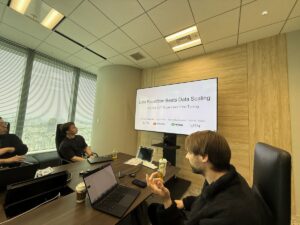
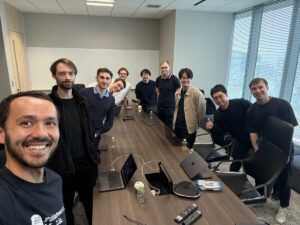
    Thank you for visiting us!! Yuki (@y_m_asano) Today we visited Japan's hottest AI startup @SakanaAILabs🎏🇯🇵! We met their research scientists and discussed the implications and impact of some their works like "The AI scientist" and "Continous Thought Machines". We presented our @FunAILab works, "Better Language Models Exhibit Higher Visual Alignment" and "Data Repetition Beats Data Scaling in Long-CoT Supervised Fine-Tuning". Got lots of cool questions and discussions! Thanks, Masanori Suganuma, @_yutaroyamada, @ciaran_regan_ — https://nitter.net/y_m_asano/status/2042438240800829657#m

    → View original post on X — @_yutaroyamada, 2026-04-10 03:39 UTC

  • AI Scientist Paper Published in Nature, Advancing Automated Research
    AI Scientist Paper Published in Nature, Advancing Automated Research

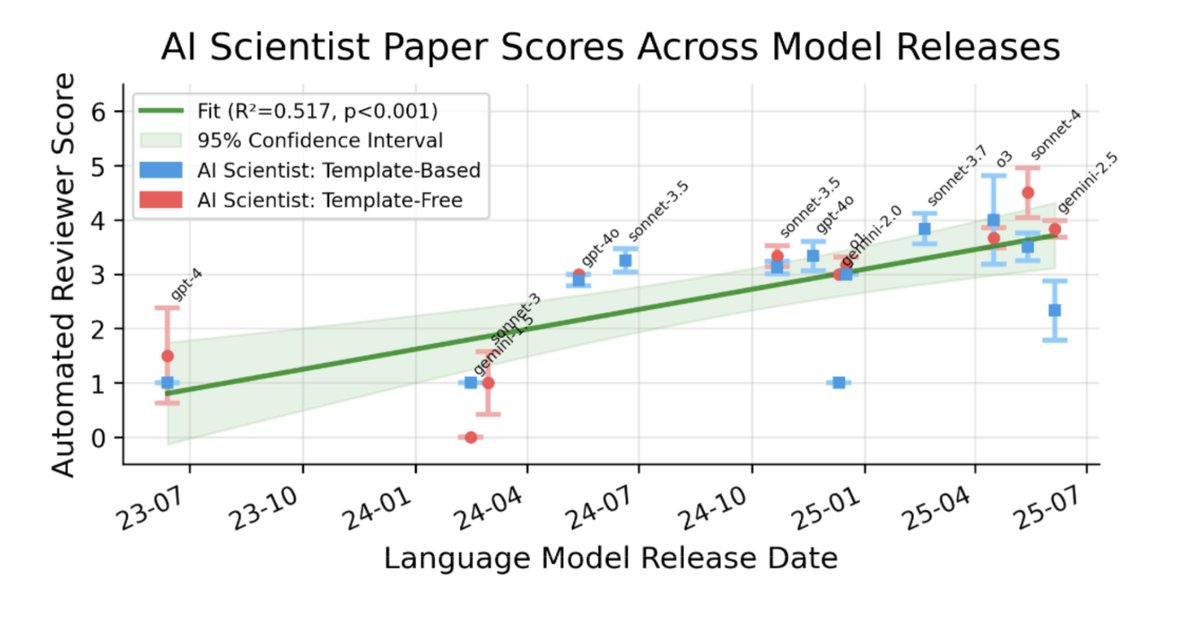
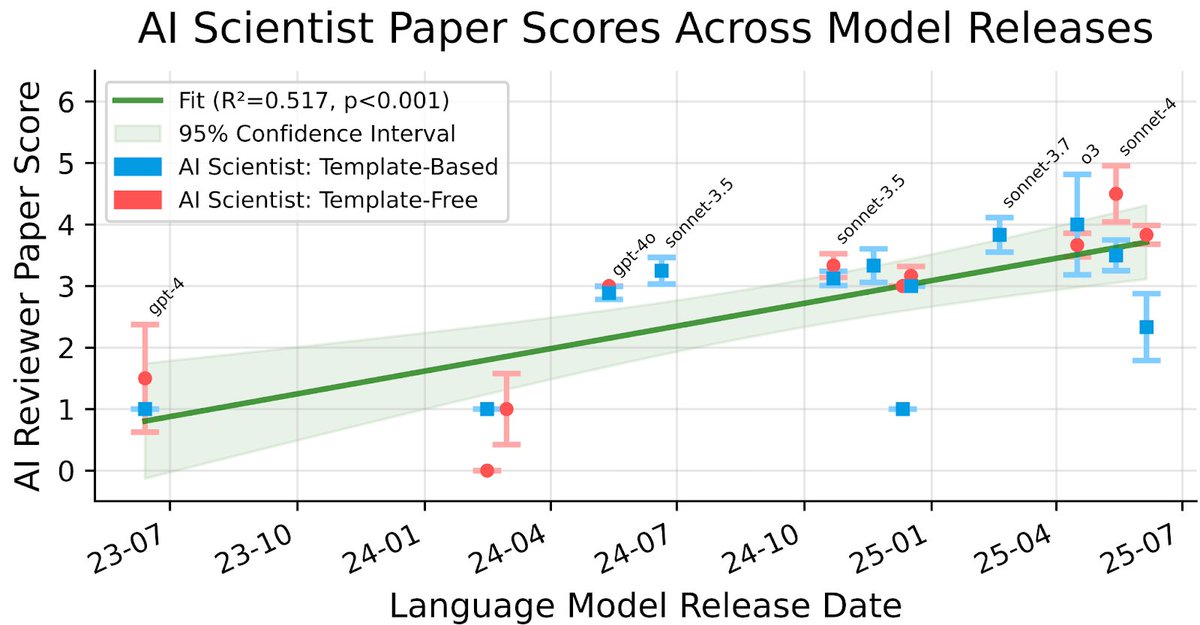
    Still remember the experiment grind over New Year's break–really great to see this out in Nature today! AI automation of AI research is heating up fast, and I'm excited to see what becomes possible as models keep improving (see the figure below!) Sakana AI (@SakanaAILabs) The AI Scientist: Towards Fully Automated AI Research, Now Published in Nature Nature: nature.com/articles/s41586-0… Blog: sakana.ai/ai-scientist-natur… When we first introduced The AI Scientist, we shared an ambitious vision of an agent powered by foundation models capable of executing the entire machine learning research lifecycle. From inventing ideas and writing code to executing experiments and drafting the manuscript, the system demonstrated that end-to-end automation of the scientific process is possible. Soon after, we shared a historic update: the improved AI Scientist-v2 produced the first fully AI-generated paper to pass a rigorous human peer-review process. Today, we are happy to announce that “The AI Scientist: Towards Fully Automated AI Research,” our paper describing all of this work, along with fresh new insights, has been published in @Nature! This Nature publication consolidates these milestones and details the underlying foundation model orchestration. It also introduces our Automated Reviewer, which matches human review judgments and actually exceeds standard inter-human agreement. Crucially, by using this reviewer to grade papers generated by different foundation models, we discovered a clear scaling law of science. As the underlying foundation models improve, the quality of the generated scientific papers increases correspondingly. This implies that as compute costs decrease and model capabilities continue to exponentially increase, future versions of The AI Scientist will be substantially more capable. Building upon our previous open-source releases (github.com/SakanaAI/AI-Scien…), this open-access Nature publication comprehensively details our system's architecture, outlines several new scaling results, and discusses the promise and challenges of AI-generated science. This substantial milestone is the result of a close and fruitful collaboration between researchers at Sakana AI, the University of British Columbia (UBC) and the Vector Institute, and the University of Oxford. Congrats to the team! @_chris_lu_ @cong_ml @RobertTLange @_yutaroyamada @shengranhu @j_foerst @hardmaru @jeffclune — https://nitter.net/SakanaAILabs/status/2036840833690071450#m

    → View original post on X — @_yutaroyamada, 2026-03-26 13:38 UTC

  • AI Scientist V1 Completed Before o1-Preview, Models More Capable Now

    The AI Scientist V1 was completed months before o1-preview and reasoning models were released. The models have clearly gotten much more capable since then. Very excited for where things are headed for AI and automated research! Sakana AI (@SakanaAILabs) The AI Scientist: Towards Fully Automated AI Research, Now Published in Nature Nature: nature.com/articles/s41586-0… Blog: sakana.ai/ai-scientist-natur… When we first introduced The AI Scientist, we shared an ambitious vision of an agent powered by foundation models capable of executing the entire machine learning research lifecycle. From inventing ideas and writing code to executing experiments and drafting the manuscript, the system demonstrated that end-to-end automation of the scientific process is possible. Soon after, we shared a historic update: the improved AI Scientist-v2 produced the first fully AI-generated paper to pass a rigorous human peer-review process. Today, we are happy to announce that “The AI Scientist: Towards Fully Automated AI Research,” our paper describing all of this work, along with fresh new insights, has been published in @Nature! This Nature publication consolidates these milestones and details the underlying foundation model orchestration. It also introduces our Automated Reviewer, which matches human review judgments and actually exceeds standard inter-human agreement. Crucially, by using this reviewer to grade papers generated by different foundation models, we discovered a clear scaling law of science. As the underlying foundation models improve, the quality of the generated scientific papers increases correspondingly. This implies that as compute costs decrease and model capabilities continue to exponentially increase, future versions of The AI Scientist will be substantially more capable. Building upon our previous open-source releases (github.com/SakanaAI/AI-Scien…), this open-access Nature publication comprehensively details our system's architecture, outlines several new scaling results, and discusses the promise and challenges of AI-generated science. This substantial milestone is the result of a close and fruitful collaboration between researchers at Sakana AI, the University of British Columbia (UBC) and the Vector Institute, and the University of Oxford. Congrats to the team! @_chris_lu_ @cong_ml @RobertTLange @_yutaroyamada @shengranhu @j_foerst @hardmaru @jeffclune — https://nitter.net/SakanaAILabs/status/2036840833690071450#m

    → View original post on X — @_yutaroyamada, 2026-03-26 08:53 UTC

  • The AI Scientist Published in Nature: Fully Automated Research
    The AI Scientist Published in Nature: Fully Automated Research

    The AI Scientist: Towards Fully Automated AI Research, Now Published in Nature!!✨ Today in Nature we share a comprehensive technical summary of our work on The AI Scientist, including new scaling law results showing how it improves with more compute and more intelligent foundation models. The AI Scientist autonomously creates its own research ideas, codes up and conducts experiments to test those ideas, creates figures to visualize the results, writes an entire scientific manuscript summarizing what it has discovered, and conducts its own “peer” review of the resulting paper. One of its papers–entirely AI generated–passed peer review at a top-tier AI conference workshop, a historic milestone marking the dawn of a new era of AI-accelerated scientific discovery. 🔬🧪✨🧬💡🔭 Paper nature.com/articles/s41586-0… Blog sakana.ai/ai-scientist-natur… Work done in collaboration with a great team from Sakana, Oxford, and my lab at UBC. Thanks and congratulations everyone! @_chris_lu_ @cong_ml @RobertTLange @_yutaroyamada @shengranhu @j_foerst @hardmaru

    → View original post on X — @_yutaroyamada, 2026-03-25 18:01 UTC

  • The AI Scientist Published in Nature: Automated Scientific Discovery Milestone
    The AI Scientist Published in Nature: Automated Scientific Discovery Milestone

    I am really excited to share that our work on The AI Scientist has been published in Nature Automated Scientific Discovery has been something I only dreamt about at the start of my PhD. Today, we are making big leaps into a world in which autonomous agents support human researchers in tackling some of the most fundamental problems. In August 2024, The AI Scientist-v1 showed first sparks of LLM agents becoming capable of conducting research end-to-end. While the generated artifacts were still far from perfect, it was clear that automated discovery was about to change. We scaled the system and improved all ingredients of the pipeline. In April 2025, The AI Scientist-v2 had become capable of producing a paper that could pass the human peer review of an ICLR workshop. This is only the beginning. Systems like AlphaEvolve, ShinkaEvolve, AIDE, and Autoresearch will continue to shape the future of how research is conducted. Our METR-style scaling results indicate that model improvements have direct downstream impacts. Still, there are many challenges. Both technical and societal. I have a strong belief that we, as a collective, will find the answers and adapt. This has been an enormous amount of work by an outstanding set of human researchers @_chris_lu_ @cong_ml @_yutaroyamada @shengranhu @j_foerst @jeffclune @hardmaru @SakanaAILabs with many long nights of work. I am super grateful for the entire ride, learnings and the future to come. Thank you to everyone! Sakana AI (@SakanaAILabs) The AI Scientist: Towards Fully Automated AI Research, Now Published in Nature Nature: nature.com/articles/s41586-0… Blog: sakana.ai/ai-scientist-natur… When we first introduced The AI Scientist, we shared an ambitious vision of an agent powered by foundation models capable of executing the entire machine learning research lifecycle. From inventing ideas and writing code to executing experiments and drafting the manuscript, the system demonstrated that end-to-end automation of the scientific process is possible. Soon after, we shared a historic update: the improved AI Scientist-v2 produced the first fully AI-generated paper to pass a rigorous human peer-review process. Today, we are happy to announce that “The AI Scientist: Towards Fully Automated AI Research,” our paper describing all of this work, along with fresh new insights, has been published in @Nature! This Nature publication consolidates these milestones and details the underlying foundation model orchestration. It also introduces our Automated Reviewer, which matches human review judgments and actually exceeds standard inter-human agreement. Crucially, by using this reviewer to grade papers generated by different foundation models, we discovered a clear scaling law of science. As the underlying foundation models improve, the quality of the generated scientific papers increases correspondingly. This implies that as compute costs decrease and model capabilities continue to exponentially increase, future versions of The AI Scientist will be substantially more capable. Building upon our previous open-source releases (github.com/SakanaAI/AI-Scien…), this open-access Nature publication comprehensively details our system's architecture, outlines several new scaling results, and discusses the promise and challenges of AI-generated science. This substantial milestone is the result of a close and fruitful collaboration between researchers at Sakana AI, the University of British Columbia (UBC) and the Vector Institute, and the University of Oxford. Congrats to the team! @_chris_lu_ @cong_ml @RobertTLange @_yutaroyamada @shengranhu @j_foerst @hardmaru @jeffclune — https://nitter.net/SakanaAILabs/status/2036840833690071450#m

    → View original post on X — @_yutaroyamada, 2026-03-25 17:31 UTC

  • The AI Scientist Published in Nature with New Scaling Laws
    The AI Scientist Published in Nature with New Scaling Laws

    When we released The AI Scientist, it felt like the far future. Fast forward to today, and the automation of research is on everyone's mind. Thrilled that our foundational work has been published in @Nature! Please check out the paper along with some fun new scaling laws! 😃 Sakana AI (@SakanaAILabs) The AI Scientist: Towards Fully Automated AI Research, Now Published in Nature Nature: nature.com/articles/s41586-0… Blog: sakana.ai/ai-scientist-natur… When we first introduced The AI Scientist, we shared an ambitious vision of an agent powered by foundation models capable of executing the entire machine learning research lifecycle. From inventing ideas and writing code to executing experiments and drafting the manuscript, the system demonstrated that end-to-end automation of the scientific process is possible. Soon after, we shared a historic update: the improved AI Scientist-v2 produced the first fully AI-generated paper to pass a rigorous human peer-review process. Today, we are happy to announce that “The AI Scientist: Towards Fully Automated AI Research,” our paper describing all of this work, along with fresh new insights, has been published in @Nature! This Nature publication consolidates these milestones and details the underlying foundation model orchestration. It also introduces our Automated Reviewer, which matches human review judgments and actually exceeds standard inter-human agreement. Crucially, by using this reviewer to grade papers generated by different foundation models, we discovered a clear scaling law of science. As the underlying foundation models improve, the quality of the generated scientific papers increases correspondingly. This implies that as compute costs decrease and model capabilities continue to exponentially increase, future versions of The AI Scientist will be substantially more capable. Building upon our previous open-source releases (github.com/SakanaAI/AI-Scien…), this open-access Nature publication comprehensively details our system's architecture, outlines several new scaling results, and discusses the promise and challenges of AI-generated science. This substantial milestone is the result of a close and fruitful collaboration between researchers at Sakana AI, the University of British Columbia (UBC) and the Vector Institute, and the University of Oxford. Congrats to the team! @_chris_lu_ @cong_ml @RobertTLange @_yutaroyamada @shengranhu @j_foerst @hardmaru @jeffclune — https://nitter.net/SakanaAILabs/status/2036840833690071450#m

    → View original post on X — @_yutaroyamada, 2026-03-25 17:11 UTC

  • AI Scientist Published in Nature, Automated Research Achieves New Milestone

    It is great to see this collaboration across @FLAIR_Ox @SakanaAILabs and @UBC recognised for what it is: One of the first signs of life of a new paradigm that is now going at full speed and will change the world. Congratulations to the entire team and special shout out to my (now former!) student @_chris_lu_ for whom this is the crowning achievement of an amazing DPhil that went from multi-agent learning and opponent shaping to meta-learning via "RL at the Hyperscale", LLM as search operators over code, all the way to the end-to-end AI scientist. There are so many debates about whether a Phd is useful in the age of "scale is all you need", so this is a refreshing datapoint. Sakana AI (@SakanaAILabs) The AI Scientist: Towards Fully Automated AI Research, Now Published in Nature Nature: nature.com/articles/s41586-0… Blog: sakana.ai/ai-scientist-natur… When we first introduced The AI Scientist, we shared an ambitious vision of an agent powered by foundation models capable of executing the entire machine learning research lifecycle. From inventing ideas and writing code to executing experiments and drafting the manuscript, the system demonstrated that end-to-end automation of the scientific process is possible. Soon after, we shared a historic update: the improved AI Scientist-v2 produced the first fully AI-generated paper to pass a rigorous human peer-review process. Today, we are happy to announce that “The AI Scientist: Towards Fully Automated AI Research,” our paper describing all of this work, along with fresh new insights, has been published in @Nature! This Nature publication consolidates these milestones and details the underlying foundation model orchestration. It also introduces our Automated Reviewer, which matches human review judgments and actually exceeds standard inter-human agreement. Crucially, by using this reviewer to grade papers generated by different foundation models, we discovered a clear scaling law of science. As the underlying foundation models improve, the quality of the generated scientific papers increases correspondingly. This implies that as compute costs decrease and model capabilities continue to exponentially increase, future versions of The AI Scientist will be substantially more capable. Building upon our previous open-source releases (github.com/SakanaAI/AI-Scien…), this open-access Nature publication comprehensively details our system's architecture, outlines several new scaling results, and discusses the promise and challenges of AI-generated science. This substantial milestone is the result of a close and fruitful collaboration between researchers at Sakana AI, the University of British Columbia (UBC) and the Vector Institute, and the University of Oxford. Congrats to the team! @_chris_lu_ @cong_ml @RobertTLange @_yutaroyamada @shengranhu @j_foerst @hardmaru @jeffclune — https://nitter.net/SakanaAILabs/status/2036840833690071450#m

    → View original post on X — @_yutaroyamada, 2026-03-25 16:56 UTC

  • The AI Scientist Published in Nature: Fully Automated Research Milestone

    I’m incredibly proud of The AI Scientist team for this milestone publication in @Nature. We started this project to explore if foundation models could execute the entire research lifecycle. Seeing this work validated at this level is a special moment. I truly believe AI will forever change the landscape of how scientific discoveries and scientific progress are made. Sakana AI (@SakanaAILabs) The AI Scientist: Towards Fully Automated AI Research, Now Published in Nature Nature: nature.com/articles/s41586-0… Blog: sakana.ai/ai-scientist-natur… When we first introduced The AI Scientist, we shared an ambitious vision of an agent powered by foundation models capable of executing the entire machine learning research lifecycle. From inventing ideas and writing code to executing experiments and drafting the manuscript, the system demonstrated that end-to-end automation of the scientific process is possible. Soon after, we shared a historic update: the improved AI Scientist-v2 produced the first fully AI-generated paper to pass a rigorous human peer-review process. Today, we are happy to announce that “The AI Scientist: Towards Fully Automated AI Research,” our paper describing all of this work, along with fresh new insights, has been published in @Nature! This Nature publication consolidates these milestones and details the underlying foundation model orchestration. It also introduces our Automated Reviewer, which matches human review judgments and actually exceeds standard inter-human agreement. Crucially, by using this reviewer to grade papers generated by different foundation models, we discovered a clear scaling law of science. As the underlying foundation models improve, the quality of the generated scientific papers increases correspondingly. This implies that as compute costs decrease and model capabilities continue to exponentially increase, future versions of The AI Scientist will be substantially more capable. Building upon our previous open-source releases (github.com/SakanaAI/AI-Scien…), this open-access Nature publication comprehensively details our system's architecture, outlines several new scaling results, and discusses the promise and challenges of AI-generated science. This substantial milestone is the result of a close and fruitful collaboration between researchers at Sakana AI, the University of British Columbia (UBC) and the Vector Institute, and the University of Oxford. Congrats to the team! @_chris_lu_ @cong_ml @RobertTLange @_yutaroyamada @shengranhu @j_foerst @hardmaru @jeffclune — https://nitter.net/SakanaAILabs/status/2036840833690071450#m

    → View original post on X — @_yutaroyamada, 2026-03-25 16:24 UTC

  • Sakana AI Releases Free AI Chat with Web Search

    🐟 Sakana Chat Released 🐟 Sakana AI has released Sakana Chat for free. chat.sakana.ai/ It is an AI chat equipped with web search functionality and fast response times. Anyone within Japan can use it. Please give it a try. [Translated from EN to English]

    → View original post on X — @_yutaroyamada, 2026-03-24 01:00 UTC

  • ShinkaEvolve Improvements: ICFP Victory, ICLR2026 Acceptance, New Features
    ShinkaEvolve Improvements: ICFP Victory, ICLR2026 Acceptance, New Features

    🧑‍🔬 Since the first release of ShinkaEvolve, a lot has happened & we continue to improve its performance: 1️⃣ ShinkaEvolve supported @iwiwi + team Unagi in winning the ICFP contest: sakana.ai/icfp-2025/ 2️⃣ Shinka got accepted at #ICLR2026 3️⃣ We improved Shinka's program throughput by pushing the concurrency of sampling & evaluation 4️⃣ We made the LLM ensembling cost-performance aware, i.e., selection prioritizes cheap + improving LLMs 5️⃣ We added coding agent integration via dedicated skill files so you can leverage Shinka for autoresearch 6️⃣ Install via: uv pip install shinka-evolve Let us know about your experience and what you would like to see next 🤗 💻 Repo: github.com/SakanaAI/ShinkaEv… Sakana AI (@SakanaAILabs) “When AI Discovers the Next Transformer” Robert Lange (Sakana AI) joins Tim Scarfe (@MLStreetTalk) to discuss Shinka Evolve, a framework that combines LLMs with evolutionary algorithms to do open-ended program search. Full Video: piped.video/EInEmGaMRLc — https://nitter.net/SakanaAILabs/status/2032714767862026553#m

    → View original post on X — @_yutaroyamada, 2026-03-14 13:42 UTC