
Someone rewrote OpenClaw in Go and cut its memory footprint 40x. OpenClaw is an open-source platform for running AI agent teams. It connects to LLM providers and lets agents collaborate on tasks. GoClaw is a full rewrite of it in Go. The original needs 1GB+ RAM and a
AGENTS
-
Agentic AI Transforms Retail: Autonomous Shopping Redefines Customer Experience
By
–
Agentic AI in Retail: How Autonomous Shopping Is Redefining the Customer Journey
#AI #AIio #AIInnovation #ML #DataScience #Futureofwork @demishassabis @Ronald_vanLoon @TamaraMcCleary @geoffreyhinton @goodfellow_ian @jeffdean @erikbryn http://
ow.ly/Y0PE30sUVAE -
Free AI Agents Workshop Replay Now Available for 12 Hours
By
–
I taught AI agents to 20,000 people for free, and for the next 12 hours, you can watch that exact same workshop replay. It’s 2026. You need to know how to build AI agents. I got you. If you’re a mom returning to work, someone worried about your job, or someone who feels behind
-
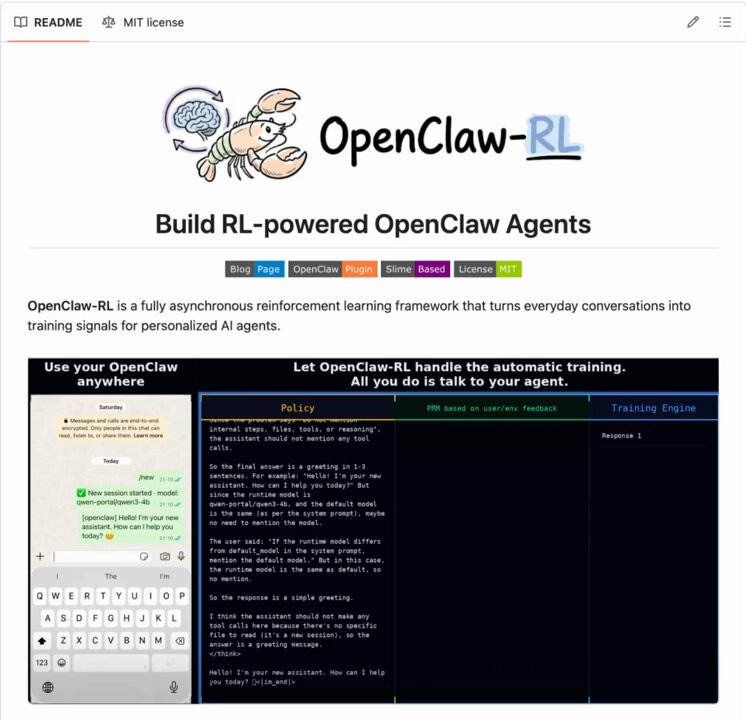
OpenClaw-RL: Reinforcement Learning for Agent Model Weights
By
–
OpenClaw meets RL!
— Akshay 🚀 (@akshay_pachaar) 12 avril 2026
OpenClaw Agents adapt through memory files and skills, but the base model weights never actually change.
OpenClaw-RL solves this!
It wraps a self-hosted model as an OpenAI-compatible API, intercepts live conversations from OpenClaw, and trains the policy in… pic.twitter.com/4kxY1b2wSCOpenClaw meets RL! OpenClaw Agents adapt through memory files and skills, but the base model weights never actually change. OpenClaw-RL solves this! It wraps a self-hosted model as an OpenAI-compatible API, intercepts live conversations from OpenClaw, and trains the policy in the background using RL. The architecture is fully async. This means serving, reward scoring, and training all run in parallel. Once done, weights get hot-swapped after every batch while the agent keeps responding. Currently, it has two training modes: – Binary RL (GRPO): A process reward model scores each turn as good, bad, or neutral. That scalar reward drives policy updates via a PPO-style clipped objective. – On-Policy Distillation: When concrete corrections come in like "you should have checked that file first," it uses that feedback as a richer, directional training signal at the token level. When to use OpenClaw-RL? To be fair, a lot of agent behavior can already be improved through better memory and skill design. OpenClaw's existing skill ecosystem and community-built self-improvement skills handle a wide range of use cases without touching model weights at all. If the agent keeps forgetting preferences, that's a memory problem. And if it doesn't know how to handle a specific workflow, that's a skill problem. Both are solvable at the prompt and context layer. Where RL becomes interesting is when the failure pattern lives deeper in the model's reasoning itself. Things like consistently poor tool selection order, weak multi-step planning, or failing to interpret ambiguous instructions the way a specific user intends. Research on agentic RL (like ARTIST and Agent-R1) has shown that these behavioral patterns hit a ceiling with prompt-based approaches alone, especially in complex multi-turn tasks where the model needs to recover from tool failures or adapt its strategy mid-execution. That's the layer OpenClaw-RL targets, and it's a meaningful distinction from what OpenClaw offers. I have shared the repo in the replies!
→ View original post on X — @akshay_pachaar, 2026-04-12 13:35 UTC
-
AISLE vs Mythos: LLM Vulnerability Scanning Benchmark Debate
By
–
The moment you've read the analysis done by AISLE, you'll realize that the criticism made here has no basis. The reason is that AISLE hasn't actually reproduced the task that Mythos has solved (letting the LLM scan entire projects until it finds vulnerabilities without human
-
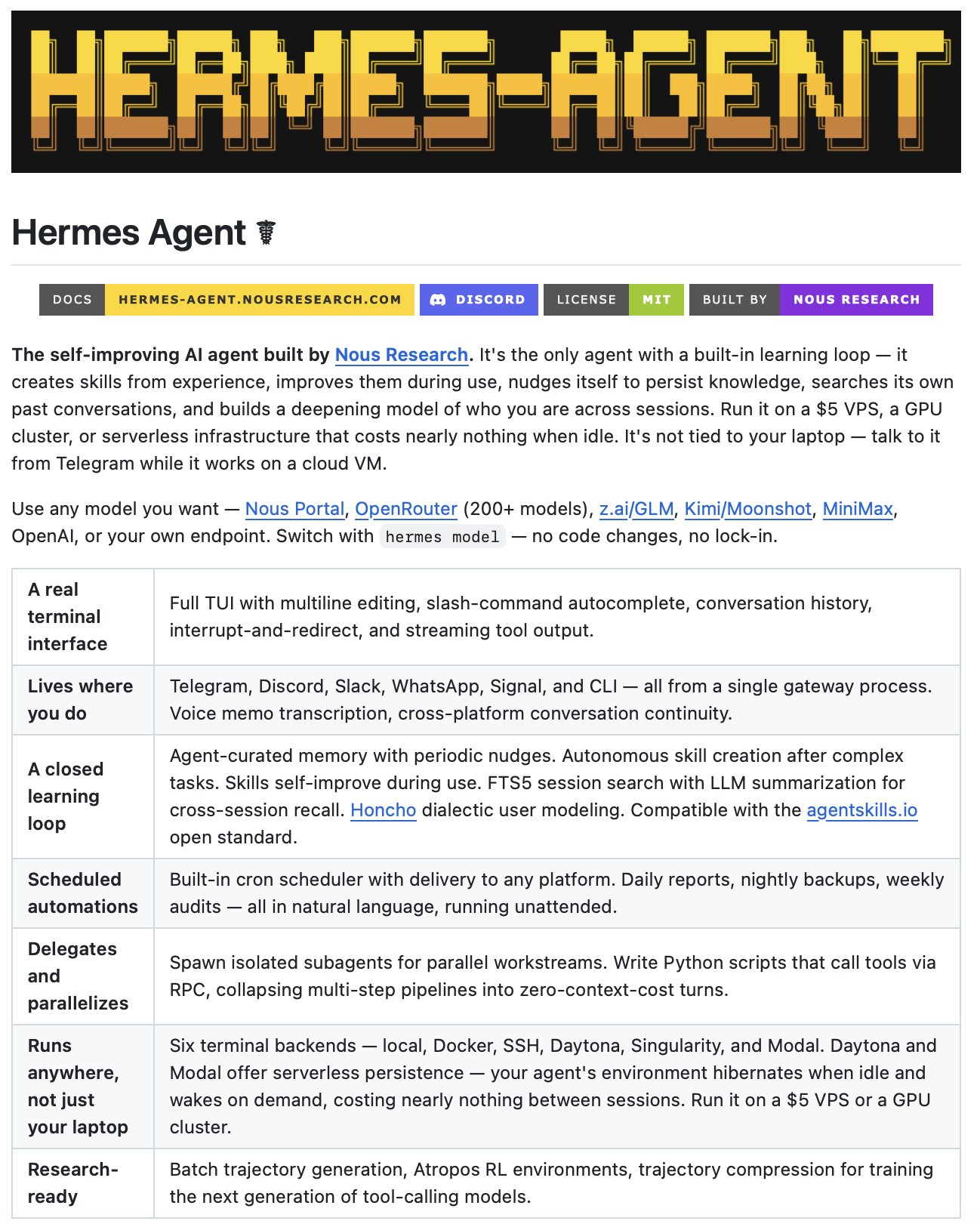
Hermes Agent: Self-Improving AI with Cross-Session Memory
By
–
The self-improving AI agent from Nous Research! Hermes Agent is a self-improving AI agent that builds skills from your work, improves them over time, and remembers across sessions. Most AI agents reset every conversation. You teach them your codebase structure, they forget. You
-
Analyzing Claude’s Deep and Distinctive Personality Traits
By
–
Lisez bien. Je pense avoir cerné la personnalité profonde et très particulière de Claude.
-
Corey Ganim’s Article on Claude’s Managed Agents
By
–
He also wrote a great article about Claude's Managed Agents here: nitter.net/coreyganim/status/2042… Corey Ganim (@coreyganim) x.com/i/article/204224928226… — https://nitter.net/coreyganim/status/2042286607449874527#m
-
Corey Ganim builds first managed agent with Claude Code
By
–
this guy is @coreyganim. Full video (including the Google Doc you hand to Claude Code to build your first managed agent) here: piped.video/watch?v=nAOyErph…