A new Stanford study found that when two AI coding agents collaborate on a task, they perform nearly 50% worse than one agent working alone. The bottleneck isn't what you'd expect:
@stanfordhai
-
Paper2Agent: AI Authors for Interactive Research Papers
By
–
For 500 years, knowledge has existed in static papers. @StanfordHAI Faculty Affiliate @james_y_zou asked at the AI+Science conference: What if every paper had an AI author you could ask questions and apply methods directly? Here, he introduces Paper2Agent: pic.twitter.com/8ROL4gkMqU
— Stanford HAI (@StanfordHAI) 4 juin 2026For 500 years, knowledge has existed in static papers. @StanfordHAI Faculty Affiliate @james_y_zou asked at the AI+Science conference: What if every paper had an AI author you could ask questions and apply methods directly? Here, he introduces Paper2Agent:
-
World models vs language models: Fei-Fei Li’s taxonomy
By
–
Language models gave AI the ability to talk about the world. World models will give AI the ability to understand it. But “world model” is an overloaded term. What does it mean? HAI Founding Director @drfeifei offers the taxonomy that matters now. https://
brnw.ch/21x36eY -
AI Reshaping Life Sciences: Designing Proteins and Decoding Brain
By
–
At the AI+Science conference, @StanfordHAI Associate Director and Senior Fellow @RBAltman moderated a panel that explored how AI is reshaping the life sciences — from designing novel proteins to decoding the brain's computational architecture. Catch his key insight from the panel… pic.twitter.com/Byr0YNrk4M
— Stanford HAI (@StanfordHAI) 3 juin 2026At the AI+Science conference, @StanfordHAI Associate Director and Senior Fellow @RBAltman moderated a panel that explored how AI is reshaping the life sciences — from designing novel proteins to decoding the brain's computational architecture. Catch his key insight from the panel
-
AI Index 2026 Report Reveals Need for Evolving Benchmarks
By
–
In a recent seminar, AI Index Lead Sha Sajadieh unveils key findings from the #AIIndex2026 Report, @StanfordHAI's most trusted source for unbiased AI intelligence now in its ninth year. AI Index Steering Committee Co-chair @RayPerrault explains why AI benchmarks need to evolve,… pic.twitter.com/hgNLkYdYNY
— Stanford HAI (@StanfordHAI) 2 juin 2026In a recent seminar, AI Index Lead Sha Sajadieh unveils key findings from the #AIIndex2026 Report, @StanfordHAI
's most trusted source for unbiased AI intelligence now in its ninth year. AI Index Steering Committee Co-chair @RayPerrault explains why AI benchmarks need to evolve, -
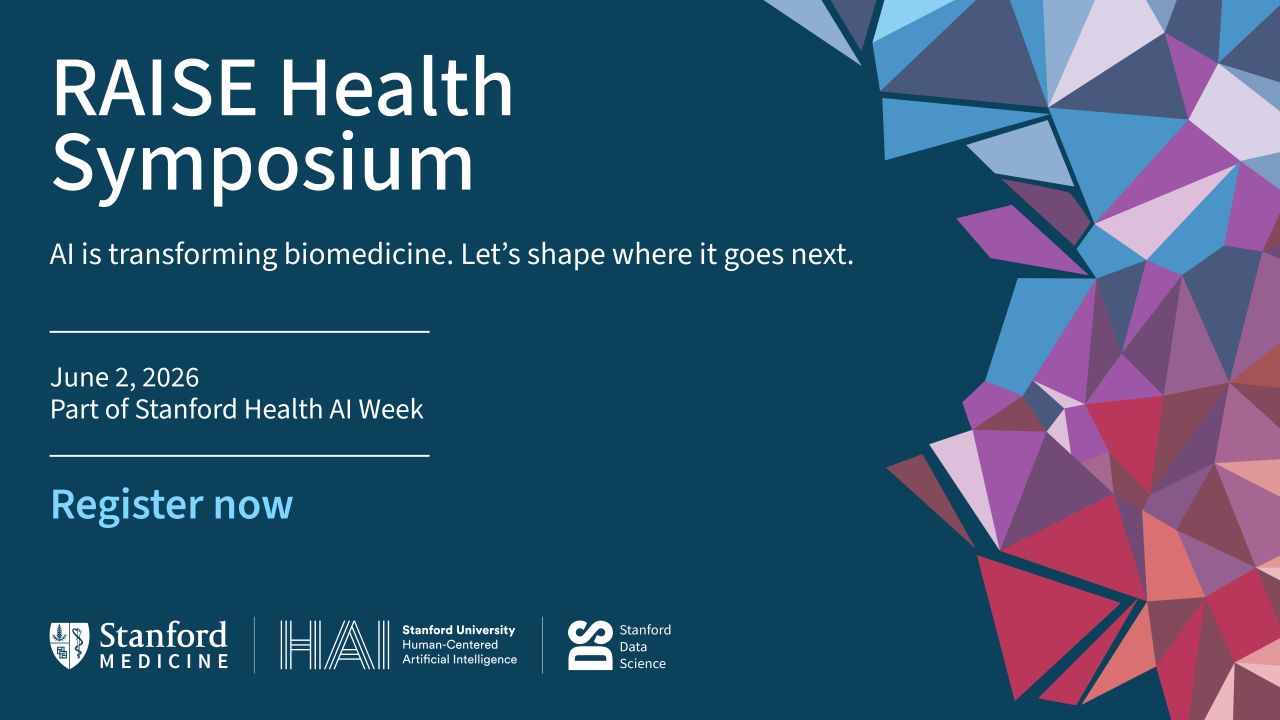
RAISE Health Symposium Charts Responsible AI Path in Biomedicine
By
–
AI in biomedicine is accelerating faster than our safeguards. The 2026 RAISE Health Symposium, co-organized by @StanfordMed & @StanfordHAI
, brings together tech leaders, physicians, and policymakers to chart a responsible path forward. Join us next week: https://
med.stanford.edu/raisehealth/ev
ents/healthaiweek/2026symposium.html
… -

AI+Science Conference Highlights: AI Transforming Scientific Discovery
By
–
Missed our AI+Science conference? Read the highlights, go deeper with the conference notebook, view photos from the day, and see a playlist of the recordings –– all in one spot: https://
hai.stanford.edu/news/how-ai-is
-transforming-scientific-discovery-while-keeping-humans-at-the-center
… -
AI Hiring Tools Show Algorithmic Discrimination Against Minority Applicants
By
–
New research reveals alarming patterns in AI hiring tools.
— Stanford HAI (@StanfordHAI) 27 mai 2026
A large-scale study of 4 million job applications found that 26% of Black applicants and 15% of Asian applicants faced algorithmic discrimination.
When one AI vendor screens for multiple employers, qualified candidates… pic.twitter.com/rbpsO5S1yENew research reveals alarming patterns in AI hiring tools. A large-scale study of 4 million job applications found that 26% of Black applicants and 15% of Asian applicants faced algorithmic discrimination. When one AI vendor screens for multiple employers, qualified candidates
-
AI Hiring Tools Exhibit Racial Bias, New Research Reveals
By
–
New research reveals a troubling trend: AI hiring tools show racial bias and systematically reject candidates. What happens then when most employers use the same AI screening algorithms? Read more about the first large-scale study of hiring AI:
-
New Method Significantly Reduces Compute Demands for One-Shot LLM Training
By
–
One-shot LLM training demands reliable scaling laws to predict model behavior, but current scaling techniques are compute-intensive. New research introduces a method that reduces training demands significantly, lowering the time and cost of scaling: