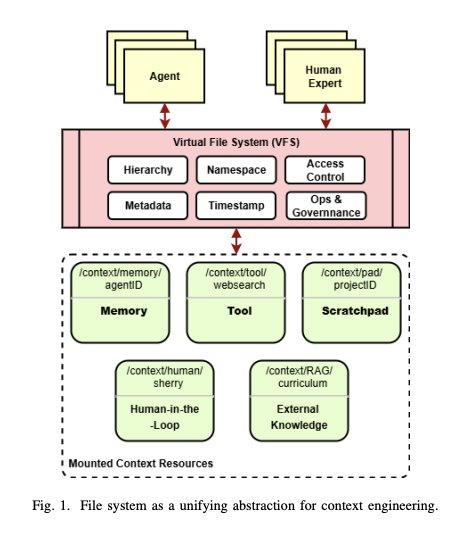
between the filesystem and the token window sits a three-stage pipeline. the context constructor selects and compresses context from the filesystem into a token-budget-aware input. it queries recency and relevance metadata, applies summarization, and produces a manifest
@godofprompt
-
Three Tiers of Persistent Context Explained
By
–
the paper defines three tiers of persistent context, each with different lifecycles. scratchpads (/context/pad/) are temporary working notes scoped to a task. think of them as the agent's rough draft space. episodic memory (/context/memory/episodic/) holds session-bounded
-
Agent frameworks’ context handling flaws
By
–
the problem is real and underappreciated. right now, most agent frameworks handle context like this: load memory at session start. stuff it into the prompt. when the window fills, summarize and compress. hope the important parts survive. the paper calls this out directly. once
-

Unix principle applied to AI context
By
–
"everything is a file" becomes "everything is context." CSIRO Data61 and ArcBlock published a paper applying the oldest Unix principle to the newest AI problem. they propose treating memory, tools, knowledge, and human input as a mounted filesystem that agents browse at runtime
-
Free Anthropic courses on Claude with certificates
By
–
stop satisfying yourself with random youtube tutorials. Anthropic just released free courses on building with Claude. with certificates. prompt engineering, tool use, RAG, evaluations. built by the people who made the model. not some influencer who read the docs once. $0.00.
-

Claude Cookbooks: Underused Engineering Resources
By
–
The Claude Cookbooks are criminally underrated. Anthropic's own engineers use these notebooks to build with Claude. They've been public for months. Almost nobody talks about them. Here's what's inside: → Tool use and function calling done the Anthropic way
→ Vision -
M2.5: Agent-Focused AI for Engineering Tasks
By
–
The difference? M2.5 is built for agents, not chat. It doesn't assist you.
It plans architecture, writes modular code, handles edge cases, and optimizes performance.
Like an actual engineer. Try it: https://
platform.minimax.io Docs: https://
platform.minimax.io/docs/guides/te
xt-generation
… Coding Plan: -
Autonomous Agent Research Costs Only $6
By
–
The cost difference is insane.
— God of Prompt (@godofprompt) 27 février 2026
I ran an autonomous research agent for 6 hours:
– Searched 50+ sources
– Synthesized findings
– Generated PDF report
Total cost: $6 pic.twitter.com/i5OpC7y1beThe cost difference is insane. I ran an autonomous research agent for 6 hours: – Searched 50+ sources
– Synthesized findings
– Generated PDF report Total cost: $6 -
Crypto Tracker Built in 4 Minutes
By
–
I tested it on real work.
— God of Prompt (@godofprompt) 27 février 2026
Prompt: “Build a crypto portfolio tracker with live prices and P&L”
One prompt → Full working app in 4 minutes.
No debugging. No iterations. Production-ready.
VIDEO IDEA: Screen recording: paste prompt, watch code generate, show final app running… pic.twitter.com/S5Ban0hTh6I tested it on real work. Prompt: “Build a crypto portfolio tracker with live prices and P&L” One prompt → Full working app in 4 minutes.
No debugging. No iterations. Production-ready. VIDEO IDEA: Screen recording: paste prompt, watch code generate, show final app running -
MiniMax M2.5 beats Opus 4.6 in coding benchmarks
By
–
Meet MiniMax M2.5.
— God of Prompt (@godofprompt) 27 février 2026
It beats Opus 4.6 on real coding benchmarks:
– SWE-Bench Verified: 80.2%
– 3x faster execution
– $1/hour flat rate
– Only 10B activated parameters (smallest Tier-1 model)
You can actually afford to run agents 24/7 now. pic.twitter.com/bjbUqDuGt9Meet MiniMax M2.5. It beats Opus 4.6 on real coding benchmarks: – SWE-Bench Verified: 80.2%
– 3x faster execution
– $1/hour flat rate
– Only 10B activated parameters (smallest Tier-1 model) You can actually afford to run agents 24/7 now.