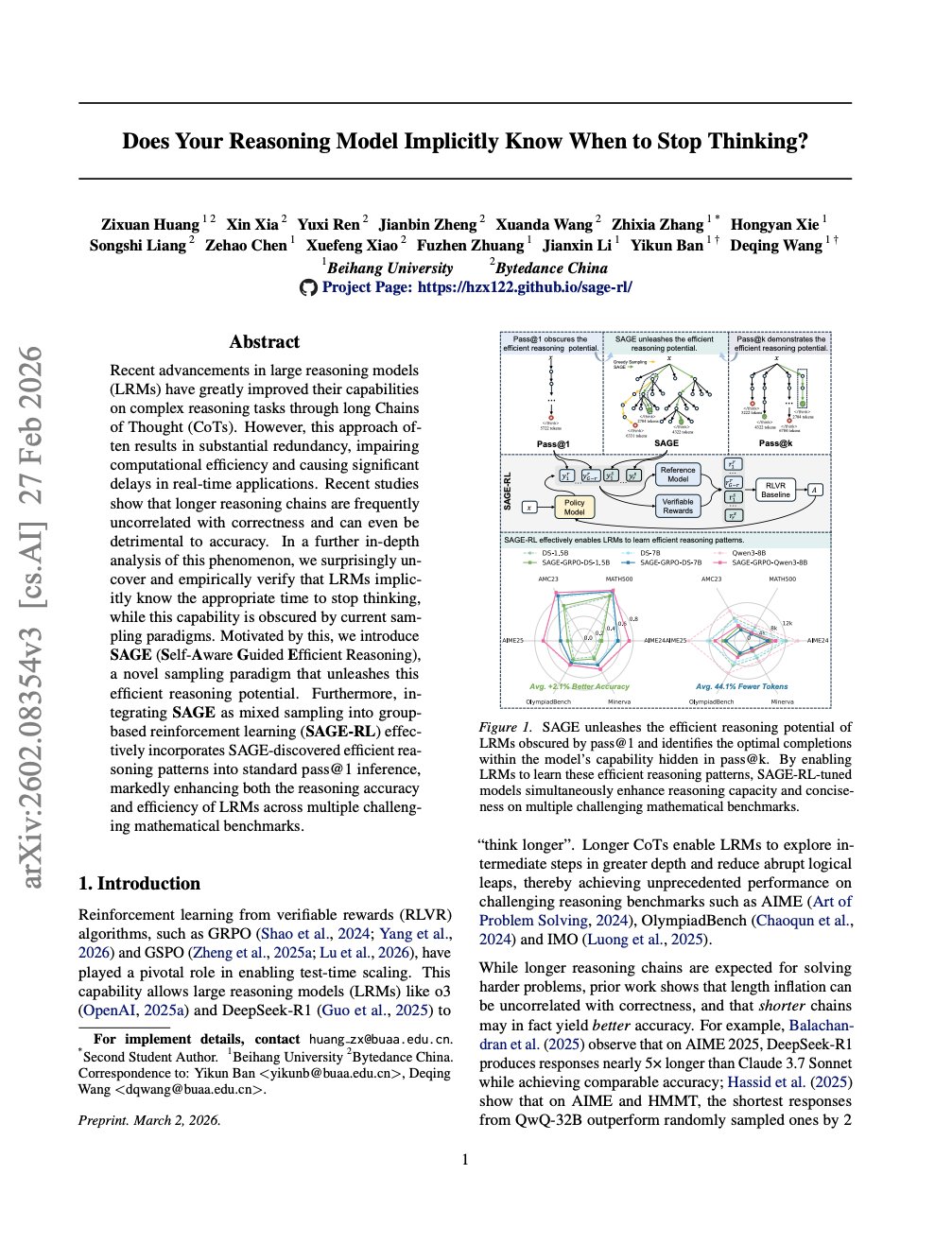
their solution: SAGE (Self-Aware Guided Efficient Reasoning). instead of generating token by token, SAGE extends chains in whole reasoning steps. after each step, it checks: is the model confidently signaling it wants to stop? if yes, reasoning ends. no fine-tuning. no new
@godofprompt
-
Three Key Observations on Model Paths
By
–
three observations back this up: > high-confidence paths (measured by cumulative probability) are shorter AND more accurate than standard samples > at those natural endpoints, the stop token is the model's top prediction. it knows it's finished > as you widen exploration (more
-
Researchers test AI self-awareness with TSearch
By
–
here's where it gets interesting. the researchers probed whether models internally "know" they're done. they introduced TSearch, which scores partial reasoning traces by cumulative log-probability across the entire chain, not just the next token. when you let the model explore
-
Overthinking hurts accuracy in AI responses
By
–
and it's not just wasted compute. overthinking actively hurts accuracy. DeepSeek-R1 produces responses 5x longer than Claude 3.7 Sonnet on AIME 2025 with comparable accuracy. QwQ-32B scores 2 percentage points HIGHER with its shortest answers using 31% fewer tokens. 72% of
-
RFCS Metric Reveals Early Correct Steps in Models
By
–
first, the problem quantified. the researchers created a metric called RFCS (Ratio of First Correct Step) that tracks where in a chain of thought the correct answer first appears. on MATH-500, across every model tested, the right answer shows up well before the end in over half
-
Overthinking in AI models is a sampling issue
By
–
reasoning models already know when they've solved the problem. we just don't let them stop. new paper from Beihang University and ByteDance shows that the overthinking problem in models like DeepSeek-R1 and Qwen3 isn't a training failure. it's a sampling failure. the fix cuts
-
Questioning context window utility in AI models
By
–
what makes this paper good is the question it asks, not just the answer we spent years building longer context windows. 128k. 1M tokens. the race was always "fit more in" nobody stopped to ask: is most of what we're fitting in actually helping? turns out the model's own words
-
GPT-5.2 quality drops without assistant history
By
–
important caveat: this isn't universal GPT-5.2 did show quality drops when assistant history was removed entirely. stronger models apparently extract more signal from their own prior context so the right approach isn't "always strip everything." it's selective filtering. which
-
AI Agents and Context Compression Challenges
By
–
think about what this means for ai agents every agent framework stores the full trajectory. every tool call, every response, every reasoning step. context grows linearly with conversation length until you hit the ceiling Cursor already compresses context when windows fill up.
-
Context pollution harms model accuracy
By
–
but the really interesting finding isn't about efficiency. it's about harm the paper identifies something they call "context pollution" when models condition on their own prior responses, they sometimes lock onto errors, hallucinations, or stylistic artifacts from earlier