Jeopardy is of the same nature as most of these exams, and arguably harder. I have no doubt that a program specifically trained to pass any of these exams could have been developed as early as 2011. To note, the economic impact of that particular program was ~0.
@fchollet
-
AI’s Unfulfilled Promises on Employment Since Jeopardy
By
–
An AI program became Jeopardy world champion in February 2011, 12 years ago. According to its creators, it was supposed to replace most doctors. Many interpreted the milestone as meaning that we were close to AI that would render tens of millions of people jobless.
-
Keras abstractions enable seamless knowledge transfer across problems
By
–
For me, that's the really neat thing about these new Keras features: because they're all based on the same abstractions, they all work smoothly together. What you've learned on one problem can be easily reinvested in the next problem.
-
Using Pretrained BERT Embeddings with Structured Data Features
By
–
So if you have a set of structured data features that you want to process, and it includes a text paragraph, you just need 2 additional lines to say "I want to embed this paragraph with a pretrained Bert and concatenate the embeddings to the rest of my encoded features"
-
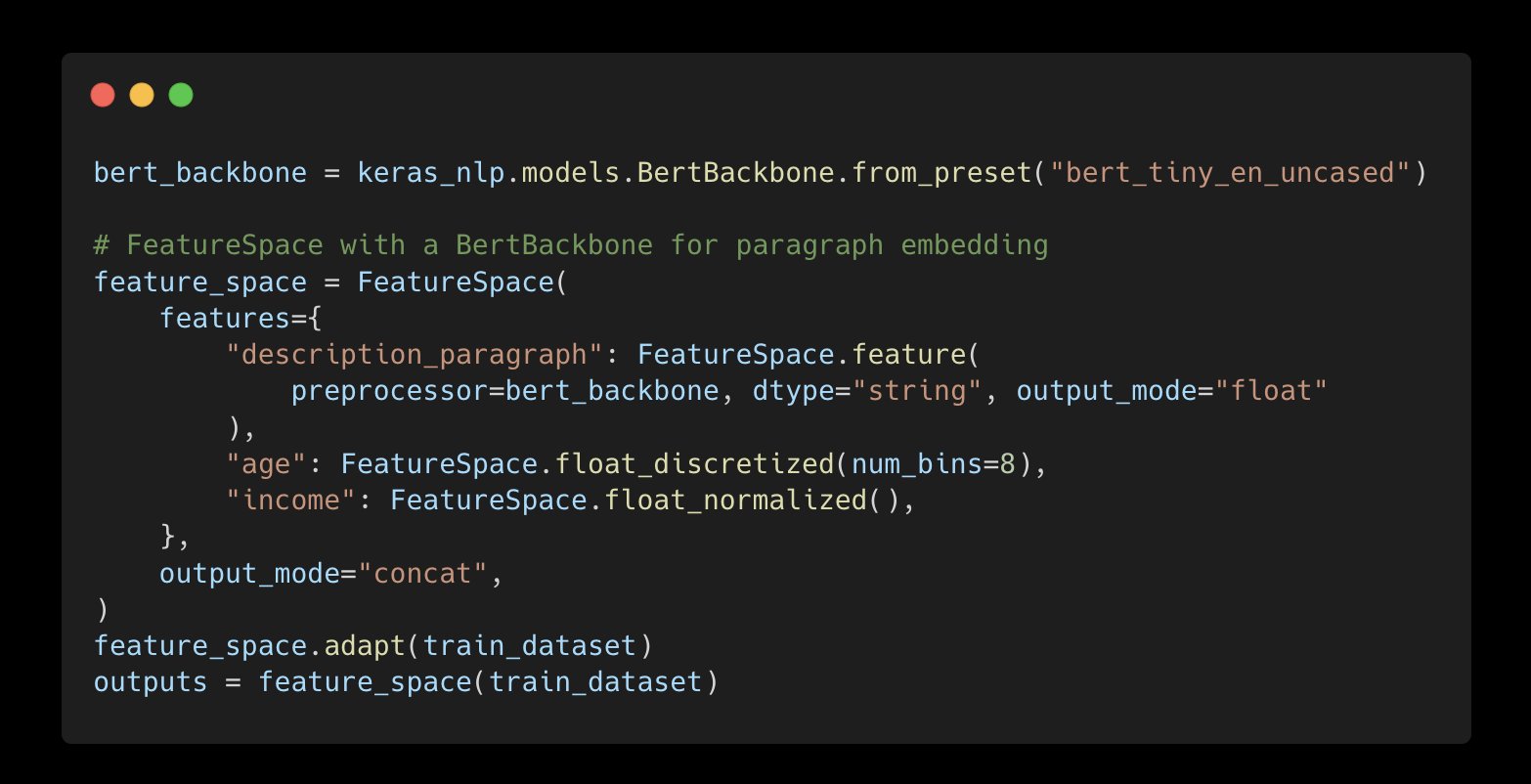
BertBackbone and FeatureSpace Integration for Text and Structured Data
By
–
Take the new BertBackone in KerasNLP. You can use it to embed a text paragraph in 2 lines of code. And take the new FeatureSpace utility for structured data processing… You can use them together — if your data includes a text paragraph, you can use BertBackone *in* the FS
-

Keras Downloads Reach Record Highs After Eight Years
By
–
Keras downloads — making new highs regularly for nearly 8 years
-
TensorFlow Usage Exceeds PyTorch by 1.5x According to Metrics
By
–
Every metric (downloads, StackOverflow, GCP usage, etc.) + large-scale user surveys (the SO survey, the Kaggle survey) shows TF/Keras usage is >1.5x that of PT. Just saying. LeCun loves to send press releases to journalists saying "TF is dead!" but that doesn't make it true.
-
Keras reaches record single-day download count of 447,000
By
–
On Thursday, Keras had its highest single-day download count so far (447,000 downloads in a day).
-
Keras Reaches 2.5 Million Users After 8 Years of Growth
By
–
Kind of insane that I've been working on Keras for nearly 8 years and it's still growing at ~30% per year. Never thought it would ever get to 1M users, much less the ~2.5M users we have currently (and growing)
-
AI Progress Hype: Gap Between Expectations and Actual Capabilities
By
–
Recall that circa 2015-2016 AI was about to replace half of all jobs, including all drivers, most doctors, etc. People's perception of AI progress is rarely grounded in actual capabilities — people are always projecting their hopes on the latest hype trend (e.g. deep RL)