AI Dynamics

Global AI News Aggregator

@debashis_dutta

  • CAID: Multi-Agent Coordination Improves Coding Task Accuracy
    CAID: Multi-Agent Coordination Improves Coding Task Accuracy

    NEW research from CMU. (bookmark this one) The biggest unlock in coding agents is understanding strategies for how to run them asynchronously. Simply giving a single agent more iterations helps, but does not scale well. And multi-agent research shows that coordination > compute. A new paper from CMU proves this with a practical multi-agent system. CAID (Centralized Asynchronous Isolated Delegation) borrows proven human SWE practices: a manager builds a dependency graph, delegates tasks to engineer agents who work in isolated git worktrees, execute concurrently, self-verify with tests, and integrate via git merge. CAID improves accuracy over single-agent baselines by 26.7% absolute on paper reproduction tasks (PaperBench) and 14.3% on the Python library development tasks (Commit0). The key insight is that isolation plus explicit integration beats both single-agent scaling and naive multi-agent approaches. For long-horizon software engineering tasks, multi-agent coordination using git-native primitives should be the default strategy, not a fallback. Paper: arxiv.org/abs/2603.21489 Learn to build effective AI agents in our academy: academy.dair.ai/

    → View original post on X — @debashis_dutta, 2026-03-30 14:41 UTC

  • Stanford’s Agent0: AI System That Teaches Itself Without Human Supervision
    Stanford’s Agent0: AI System That Teaches Itself Without Human Supervision

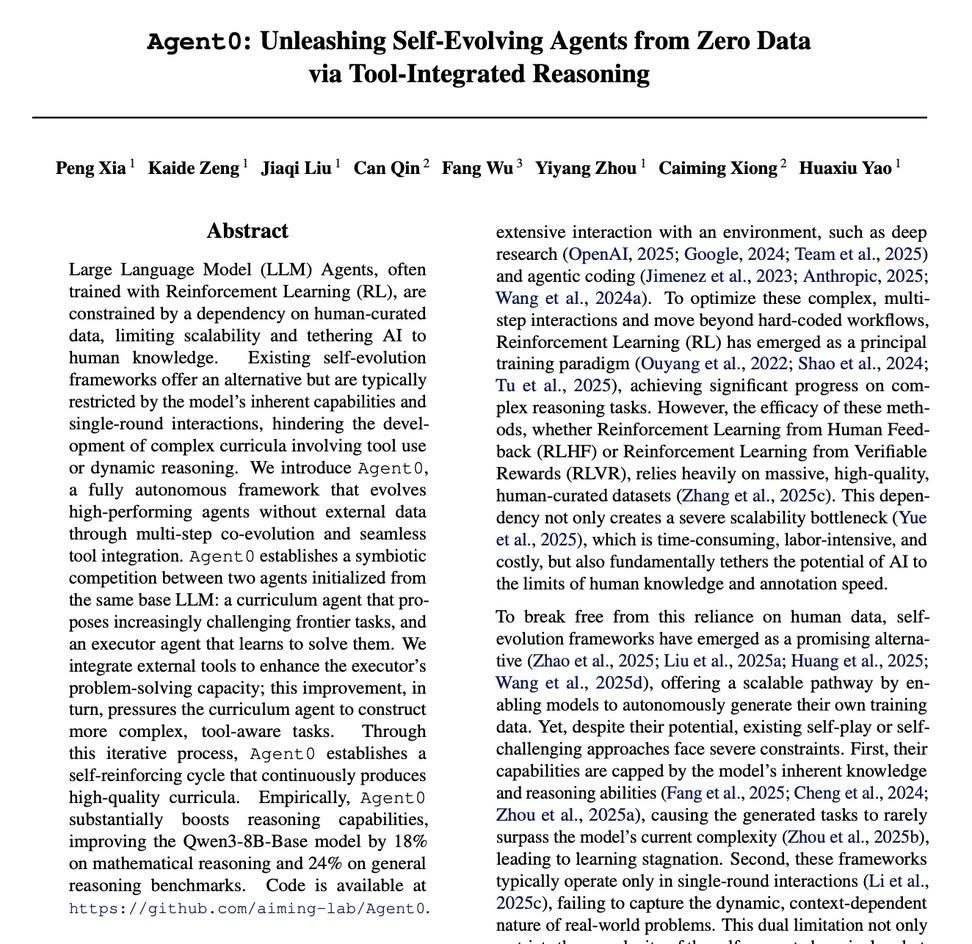
    🚨 BREAKING: Stanford just unlocked the cheat code for infinite AI reasoning. Not an upgrade. Not another model. A completely new way for AI to teach itself. Researchers at Stanford University just introduced a framework called Agent0… And it doesn’t learn like anything we’ve seen before. Most AI systems today depend on: • Massive curated datasets • Human feedback loops • Predefined training pipelines Agent0 throws all of that out. No labeled data. No human supervision. No hand-holding. Just pure self-evolution. Here’s what makes it wild: Agent0 starts from zero knowledge… Then improves by: • Generating its own problems • Solving them • Learning from its own mistakes • Iterating endlessly It’s basically AI teaching itself how to think. And the results? Honestly insane: → +18% improvement in mathematical reasoning → +24% boost in general reasoning tasks → Outperforms every existing self-play method currently available This isn’t incremental. This is a leap. But here’s the craziest part: You can literally watch the system evolve… It begins with basic geometry problems (simple shapes, angles, proofs) Then gradually levels up to: • Multi-step logical reasoning • Complex combinatorics • Abstract problem-solving No external help. Just self-driven intelligence scaling. Why this matters: We might be entering a phase where AI no longer needs: • Human-generated datasets • Expensive labeling • Constant retraining Instead… AI systems could: • Continuously improve themselves • Adapt in real-time • Unlock reasoning abilities we didn’t explicitly program If this direction scales… We’re not just building smarter AI. We’re building AI that learns how to become smarter on its own.

    → View original post on X — @debashis_dutta, 2026-03-30 00:28 UTC

  • AI-Designed Agent Harnesses Replace Human-Coded Constraints
    AI-Designed Agent Harnesses Replace Human-Coded Constraints

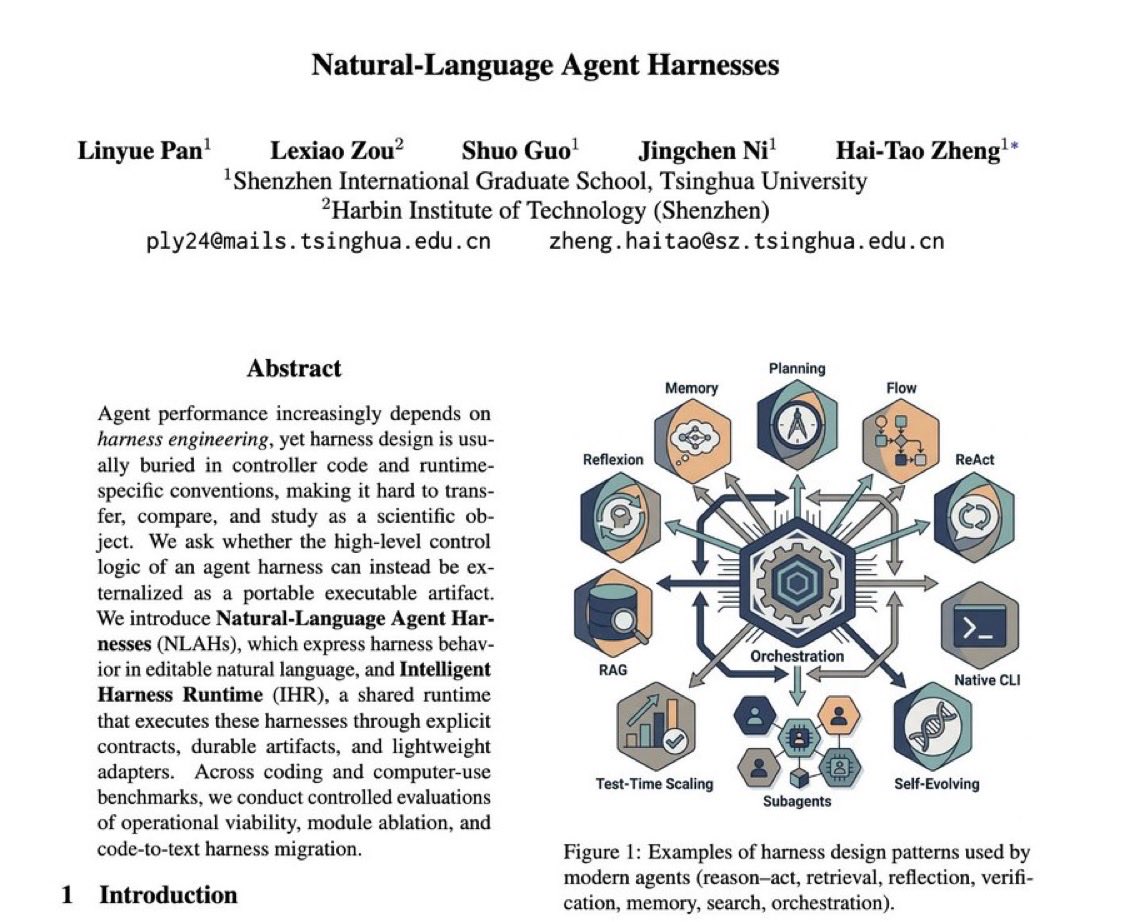
    I have long felt that agent harnesses – even claude code – are too restrictive, because they are still designed by humans. New paper for Tinsghua and Shenzhen says, what if AI itself runs the harness, rather than defining it in code? Given a natural language SOP of how an agent should orchestrate subagents, memory, compaction, etc., we can just have an LLM execute that logic! (And AI could design that SOP dynamically and depending on the task too) It's a bit mind-warping to think about, but genius once it clicks. Makes you wonder how else we should be designing AI systems as we can start consuming more and more tokens

    → View original post on X — @debashis_dutta, 2026-03-29 23:42 UTC

  • Sebastian Raschka’s LLM Architecture Gallery: Essential Reference for AI
    Sebastian Raschka’s LLM Architecture Gallery: Essential Reference for AI

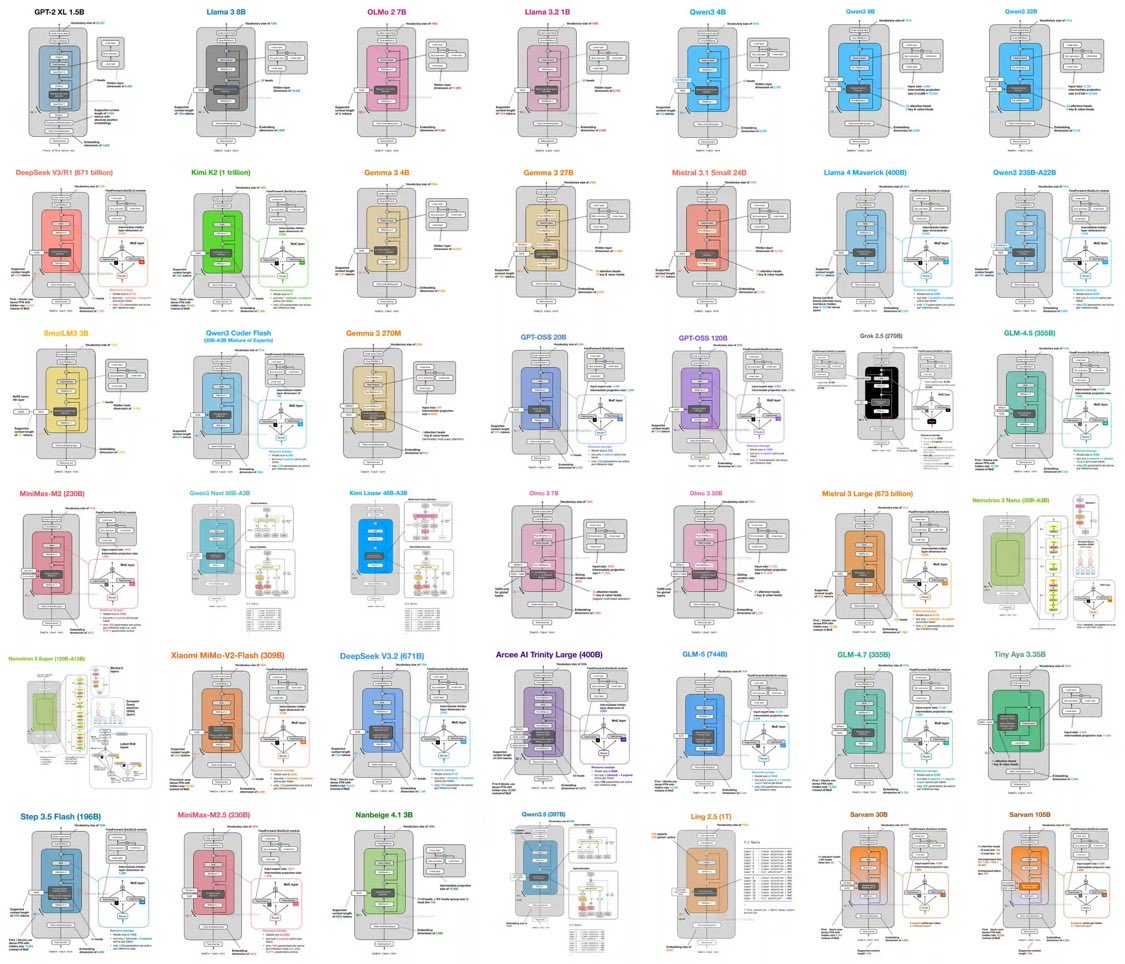
    Sebastian Raschka is one of the most respected voices in ML/AI education. And he just shipped something quietly brilliant. 👉 An LLM Architecture Gallery — a single, browsable reference that maps the internal design of modern open-weight models. This isn’t a blog post. This is a research-grade artifact, made freely accessible. 🔍 What’s inside? A structured breakdown of architectures across the frontier: 🔹 GPT-2 XL (1.5B) 🔹 Llama 3 / 3.2 / 4 Maverick 🔹 Qwen family (4B → 997B) 🔹 DeepSeek V3 / R1 (671B) 🔹 Gemma 3, Mistral variants, Grok 2.5 🔹 GLM series, MiniMax, Kimi, Nemotron 🔹 …and many more scaling up to trillion-parameter regimes 🧠 What makes this exceptional? For each model, you get: → Original technical reports → Verified config.json files (no guesswork) → From-scratch implementations where available This is not curated hype — it’s verifiable, inspectable engineering detail. ⚙️ The real differentiator He doesn’t stop at diagrams. He layers in concept explainers so you actually understand what you’re seeing: • GQA (Grouped Query Attention) • MLA (Multi-head Latent Attention) • SWA (Sliding Window Attention) • QK-Norm • NoPE (No Positional Encoding) • Gated DeltaNet This turns the gallery into a learning system, not just a reference. 🏗️ Why this matters We’ve moved from: → isolated model papers to: → an ecosystem of architectural patterns This resource makes that evolution legible. It compresses what used to take: 📚 multiple textbooks 📄 dozens of papers ⏳ countless hours of reverse engineering …into a single navigable interface. 💡 Bottom line If you're: • building LLM systems • researching architectures • or trying to understand where this field is heading 👉 This is a must-bookmark resource. 🔗 Follow my communities and personal initiatives: • Amazing AI, Data, Quantum Computing & Emerging Technologies — drdebashisdutta.com/ • Research & Innovation – Quantum, AI & Advanced Systems — researchedge.org/ #AI #LLM #MachineLearning #DeepLearning #AIResearch #GenAI #ArtificialIntelligenc

    → View original post on X — @debashis_dutta, 2026-03-29 16:02 UTC

  • Google’s TimesFM: Foundation Model Revolutionizing Time Series Forecasting
    Google’s TimesFM: Foundation Model Revolutionizing Time Series Forecasting

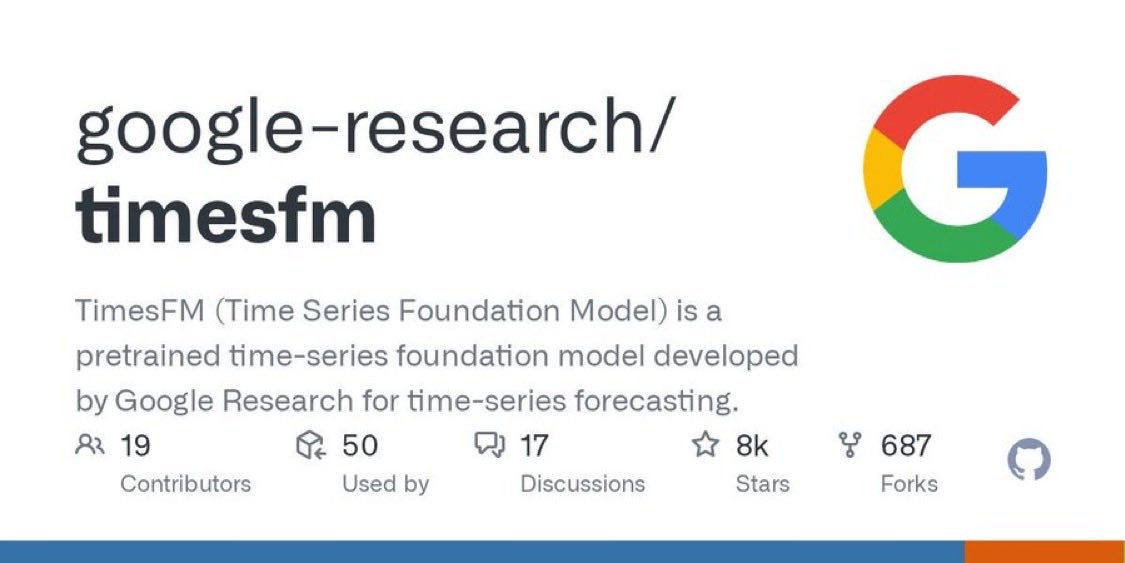
    🚀 Google just open-sourced a Time Series Foundation Model — and this changes forecasting as we know it. Meet TimesFM. Unlike traditional time-series models that require: • dataset-specific training • feature engineering • constant retraining 👉 TimesFM works out of the box — with any time-series data. No fine-tuning. No custom pipelines. Just plug and forecast. 🔍 What makes this a breakthrough? 🧠 Foundation model for time series Trained on 100B real-world time-points across: • traffic patterns • weather systems • demand forecasting ⚡ Zero-shot forecasting Generalizes across domains without retraining. 📈 Production-ready from day one Eliminates the heavy overhead of building bespoke models per dataset. 🏗️ Architecture Takeaways • Shift from model-per-dataset → generalized forecasting models • Pretraining at scale enables cross-domain pattern learning • Signals a move toward “forecasting as a service” abstraction layer • Reduces dependency on feature engineering pipelines 💡 Why this matters We’re witnessing the “GPT moment” for time series. The implication is massive: → Faster deployment cycles → Lower ML engineering cost → Democratized forecasting capabilities This could fundamentally reshape industries like: • supply chain • finance • energy • climate analytics 🔗 Explore the repo: github.com/google-research The big question now: 👉 Will domain-specific models survive… or will foundation models dominate forecasting too? 🔗 Follow my communities and personal initiatives: • Amazing AI, Data, Quantum Computing & Emerging Technologies — drdebashisdutta.com/ • Research & Innovation – Quantum, AI & Advanced Systems — researchedge.org/ #AI #MachineLearning #TimeSeries #GenerativeAI #DataScience #Forecasting #Innovation:

    → View original post on X — @debashis_dutta, 2026-03-29 15:54 UTC

  • Knuth’s Hamiltonian Decomposition Problem Solved Using AI
    Knuth’s Hamiltonian Decomposition Problem Solved Using AI

    Legendary Don Knuth has now used AI to fully solve his Hamiltonian decomposition problem for odd and even cases. Opus 4.6 / 5.4 Pro solved the even case, wrote a proof in Lean and a “apparently flawless 14 page paper” Knuth: “We are living in very interesting times indeed.”

    → View original post on X — @debashis_dutta, 2026-03-29 15:00 UTC

  • 14 most important and influential types of JEPA in AI
    14 most important and influential types of JEPA in AI

    14 most important and influential types of JEPA ▪️ JEPA / H-JEPA
    ▪️ I-JEPA
    ▪️ MC-JEPA
    ▪️ V-JEPA
    ▪️ Audio-JEPA
    ▪️ Point-JEPA
    ▪️ 3D-JEPA
    ▪️ ACT-JEPA
    ▪️ V-JEPA 2
    ▪️ LeJEPA
    ▪️ Causal-JEPA
    ▪️ V-JEPA 2.1
    ▪️ LeWorldModel
    ▪️ ThinkJEPA Save the list and check this out to explore these JEPA milestones as a map of AI progress: turingpost.com/p/jepamap [Translated from EN to English]

    → View original post on X — @debashis_dutta, 2026-03-29 11:51 UTC

  • Google Open-Sources TimesFM: Foundation Model for Time Series Forecasting
    Google Open-Sources TimesFM: Foundation Model for Time Series Forecasting

    Google open-sourced a time series foundation model. it works with any data without training. unlike traditional models, no dataset-specific training needed. TimesFM forecasts out of the box. trained on 100B real-world time-points across traffic, weather & demand forecasting.

    → View original post on X — @debashis_dutta, 2026-03-29 09:30 UTC

  • New AI Paper Reveals Surprising and Persistent Phenomenon
    New AI Paper Reveals Surprising and Persistent Phenomenon

    New AI paper from us this week. When my student first showed me his initial findings, I really didn't know what to make of them. I felt that this was an interesting but curious loophole phenomenon that would shortly be closed. I was very wrong. arxiv.org/abs/2603.21687 [Translated from EN to English]

    → View original post on X — @debashis_dutta, 2026-03-28 20:41 UTC