AI Dynamics

Global AI News Aggregator

@dair_ai

  • Free Access to Claude Code Workshop and LLM Knowledge Bases Session
    Free Access to Claude Code Workshop and LLM Knowledge Bases Session

    Wow! There is so much interest in this. Months ago, I spoke on this idea in a live workshop. Access it for FREE for the next couple of days: academy.dair.ai/dashboard/co… I am also hosting a live session on building LLM Knowledge Bases for your agents: academy.dair.ai/dashboard/ev…

    → View original post on X — @dair_ai, 2026-04-03 12:37 UTC

  • Personal Knowledge Base for AI Agents: Research Paper Curation and Visualization

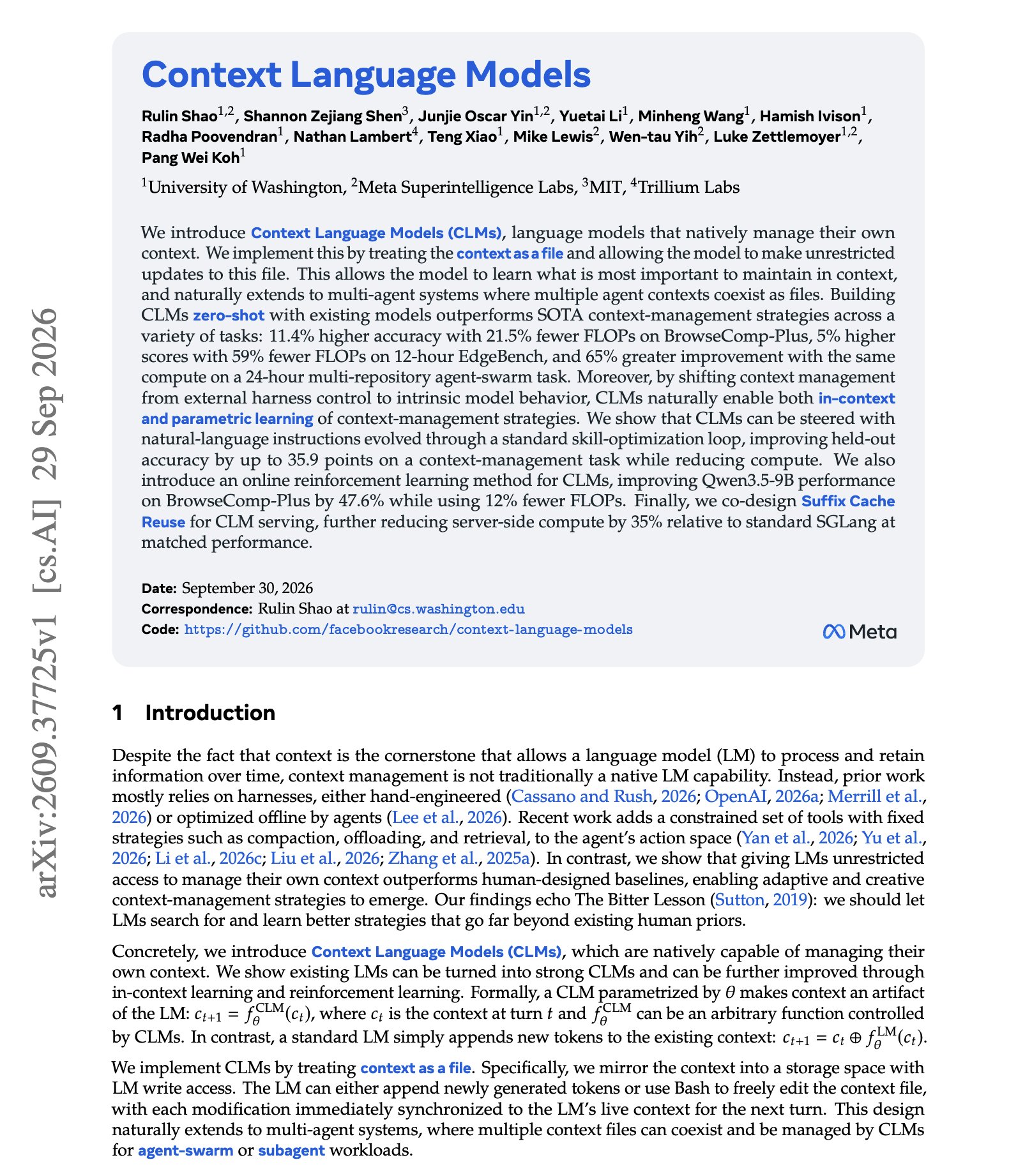
    Building a personal knowledge base for my agents is increasingly where I spend my time these days. Like @karpathy, I also use Obsidian for my MD vaults. What's different in my approach is that I curate research papers on a daily basis and have actually tuned a Skill for months to find high-signal, relevant papers. I was reviewing and curating papers manually for some time, but now it's all automated as it has gotten so good at capturing what I consider the best of the best. There are so many papers these days, so this is a big deal. You all get to benefit from that with the papers I feature in my timeline and on @dair_ai. The papers are indexed using @tobi qmd cli tool (all of it in markdown files along with useful metadata). So good for semantic search and surfacing insights, unlike anything out there. I am a visual person, so I then started to experiment with how to leverage this personal knowledge base of research papers inside my new interactive artifact generator (mcp tools inside my agent orchestrator system). The result is what you see in the clip. 100s of papers with all sorts of insights visualized. I keep track of research papers daily, so believe me when I tell you that this system is absolutely insane at surfacing insights. This is the result of months of tinkering on how to index research and leverage agent automations for wikification and robust documentation. But this is just the beginning. The visual artifact (which is interactive too) can be changed dynamically as I please. I can prompt my agent to throw any data at it. I can add different views to the data. Different interactions. I feel like this is the most personalized research system I have ever built and used, and it's not even close. The knowledge that the agents are able to surface from this basic setup is already extremely useful as I experiment with new agentic engineering concepts. I feel like this knowledge layer and the higher-level ones I am working on will allow me to maximize other automation tools like autoresearch. The research is only as good as the research questions. And the research questions are only as good as the insights the agents have access to. Where I am spending time now is on how to make this more actionable. I am obsessed about the search problem here. The automations, autoresearch, ralph research loop (I built one months ago) are easier to build but are only as good as what you feed them. Work in progress. More updates soon. Back to building. Andrej Karpathy (@karpathy) LLM Knowledge Bases Something I'm finding very useful recently: using LLMs to build personal knowledge bases for various topics of research interest. In this way, a large fraction of my recent token throughput is going less into manipulating code, and more into manipulating knowledge (stored as markdown and images). The latest LLMs are quite good at it. So: Data ingest: I index source documents (articles, papers, repos, datasets, images, etc.) into a raw/ directory, then I use an LLM to incrementally "compile" a wiki, which is just a collection of .md files in a directory structure. The wiki includes summaries of all the data in raw/, backlinks, and then it categorizes data into concepts, writes articles for them, and links them all. To convert web articles into .md files I like to use the Obsidian Web Clipper extension, and then I also use a hotkey to download all the related images to local so that my LLM can easily reference them. IDE: I use Obsidian as the IDE "frontend" where I can view the raw data, the the compiled wiki, and the derived visualizations. Important to note that the LLM writes and maintains all of the data of the wiki, I rarely touch it directly. I've played with a few Obsidian plugins to render and view data in other ways (e.g. Marp for slides). Q&A: Where things get interesting is that once your wiki is big enough (e.g. mine on some recent research is ~100 articles and ~400K words), you can ask your LLM agent all kinds of complex questions against the wiki, and it will go off, research the answers, etc. I thought I had to reach for fancy RAG, but the LLM has been pretty good about auto-maintaining index files and brief summaries of all the documents and it reads all the important related data fairly easily at this ~small scale. Output: Instead of getting answers in text/terminal, I like to have it render markdown files for me, or slide shows (Marp format), or matplotlib images, all of which I then view again in Obsidian. You can imagine many other visual output formats depending on the query. Often, I end up "filing" the outputs back into the wiki to enhance it for further queries. So my own explorations and queries always "add up" in the knowledge base. Linting: I've run some LLM "health checks" over the wiki to e.g. find inconsistent data, impute missing data (with web searchers), find interesting connections for new article candidates, etc., to incrementally clean up the wiki and enhance its overall data integrity. The LLMs are quite good at suggesting further questions to ask and look into. Extra tools: I find myself developing additional tools to process the data, e.g. I vibe coded a small and naive search engine over the wiki, which I both use directly (in a web ui), but more often I want to hand it off to an LLM via CLI as a tool for larger queries. Further explorations: As the repo grows, the natural desire is to also think about synthetic data generation + finetuning to have your LLM "know" the data in its weights instead of just context windows. TLDR: raw data from a given number of sources is collected, then compiled by an LLM into a .md wiki, then operated on by various CLIs by the LLM to do Q&A and to incrementally enhance the wiki, and all of it viewable in Obsidian. You rarely ever write or edit the wiki manually, it's the domain of the LLM. I think there is room here for an incredible new product instead of a hacky collection of scripts. — https://nitter.net/karpathy/status/2039805659525644595#m

    → View original post on X — @dair_ai, 2026-04-02 23:15 UTC

  • LLMs Excel at Curating and Searching Knowledge Bases

    I have also been obsessed with building LLM knowledge bases. Here is one example of the type of things you can do that Karpathy is alluding to: nitter.net/omarsar0/status/203396… LLMs are excellent at curating and searching (finding connections) once data is stored properly. Andrej Karpathy (@karpathy) LLM Knowledge Bases Something I'm finding very useful recently: using LLMs to build personal knowledge bases for various topics of research interest. In this way, a large fraction of my recent token throughput is going less into manipulating code, and more into manipulating knowledge (stored as markdown and images). The latest LLMs are quite good at it. So: Data ingest: I index source documents (articles, papers, repos, datasets, images, etc.) into a raw/ directory, then I use an LLM to incrementally "compile" a wiki, which is just a collection of .md files in a directory structure. The wiki includes summaries of all the data in raw/, backlinks, and then it categorizes data into concepts, writes articles for them, and links them all. To convert web articles into .md files I like to use the Obsidian Web Clipper extension, and then I also use a hotkey to download all the related images to local so that my LLM can easily reference them. IDE: I use Obsidian as the IDE "frontend" where I can view the raw data, the the compiled wiki, and the derived visualizations. Important to note that the LLM writes and maintains all of the data of the wiki, I rarely touch it directly. I've played with a few Obsidian plugins to render and view data in other ways (e.g. Marp for slides). Q&A: Where things get interesting is that once your wiki is big enough (e.g. mine on some recent research is ~100 articles and ~400K words), you can ask your LLM agent all kinds of complex questions against the wiki, and it will go off, research the answers, etc. I thought I had to reach for fancy RAG, but the LLM has been pretty good about auto-maintaining index files and brief summaries of all the documents and it reads all the important related data fairly easily at this ~small scale. Output: Instead of getting answers in text/terminal, I like to have it render markdown files for me, or slide shows (Marp format), or matplotlib images, all of which I then view again in Obsidian. You can imagine many other visual output formats depending on the query. Often, I end up "filing" the outputs back into the wiki to enhance it for further queries. So my own explorations and queries always "add up" in the knowledge base. Linting: I've run some LLM "health checks" over the wiki to e.g. find inconsistent data, impute missing data (with web searchers), find interesting connections for new article candidates, etc., to incrementally clean up the wiki and enhance its overall data integrity. The LLMs are quite good at suggesting further questions to ask and look into. Extra tools: I find myself developing additional tools to process the data, e.g. I vibe coded a small and naive search engine over the wiki, which I both use directly (in a web ui), but more often I want to hand it off to an LLM via CLI as a tool for larger queries. Further explorations: As the repo grows, the natural desire is to also think about synthetic data generation + finetuning to have your LLM "know" the data in its weights instead of just context windows. TLDR: raw data from a given number of sources is collected, then compiled by an LLM into a .md wiki, then operated on by various CLIs by the LLM to do Q&A and to incrementally enhance the wiki, and all of it viewable in Obsidian. You rarely ever write or edit the wiki manually, it's the domain of the LLM. I think there is room here for an incredible new product instead of a hacky collection of scripts. — https://nitter.net/karpathy/status/2039805659525644595#m

    → View original post on X — @dair_ai, 2026-04-02 21:01 UTC

  • HERA: Dynamic Multi-Agent RAG Orchestration Framework with 38% Improvement
    HERA: Dynamic Multi-Agent RAG Orchestration Framework with 38% Improvement

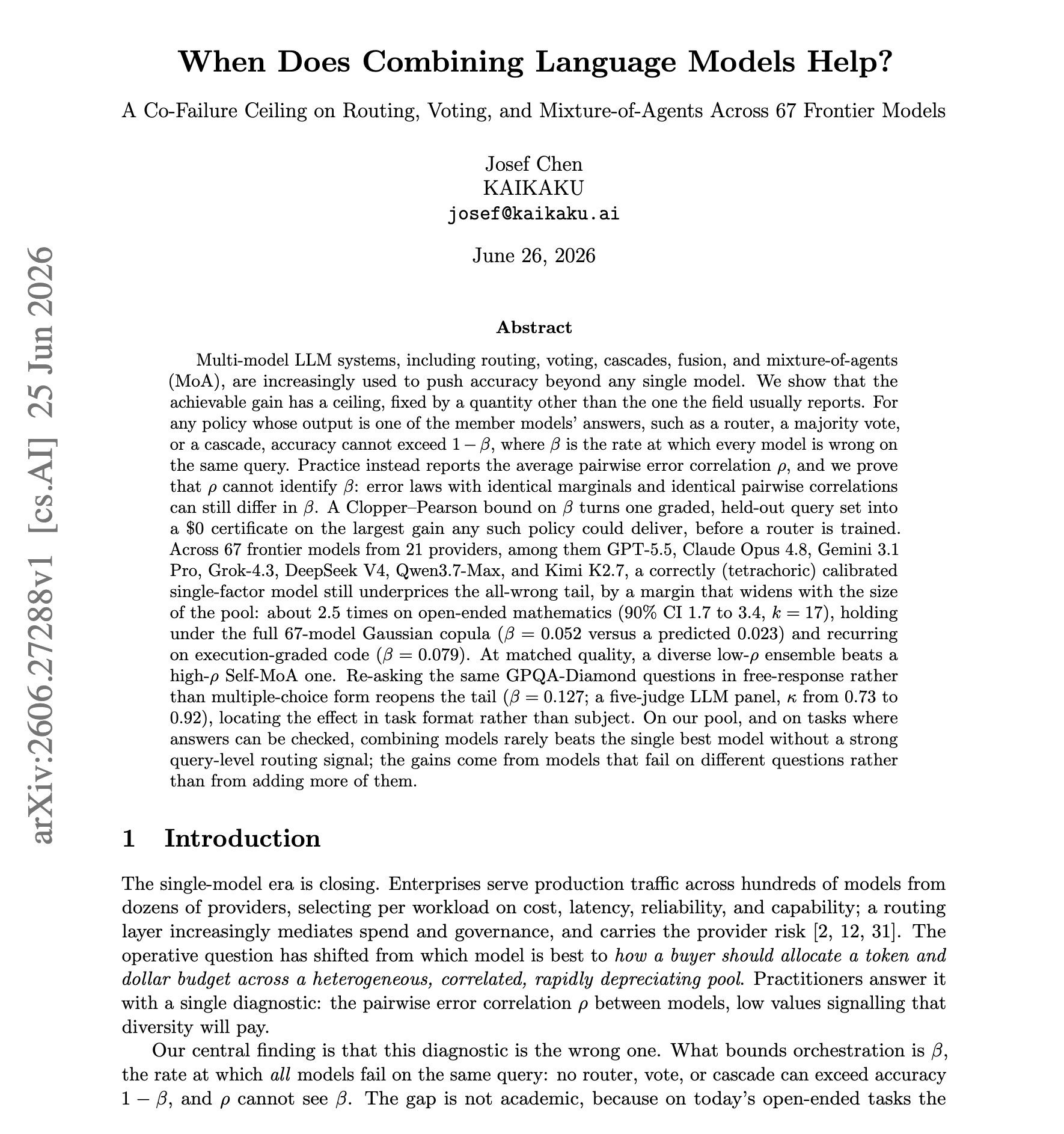
    Static orchestration is the silent killer of multi-agent RAG systems. The query changes, but the agent topology stays the same. The work introduces HERA, a framework that jointly evolves multi-agent orchestration and role-specific agent prompts. At the global level, it optimizes query-specific agent topologies through reward-guided sampling. At the local level, it refines individual agent behaviors via credit assignment and dual-axes prompt adaptation. On six knowledge-intensive benchmarks, HERA achieves an average improvement of 38.69% over recent baselines. Why does it matter? As multi-agent RAG systems scale, the gap between fixed pipelines and adaptive orchestration will only grow. HERA shows that letting the system learn its own coordination structure produces compact, high-utility agent networks. Paper: arxiv.org/abs/2604.00901 Learn to build effective AI agents in our academy: academy.dair.ai/

    → View original post on X — @dair_ai, 2026-04-02 15:40 UTC

  • AI Agents Managing Startups: YC-Bench Tests Profitability and Survival
    AI Agents Managing Startups: YC-Bench Tests Profitability and Survival

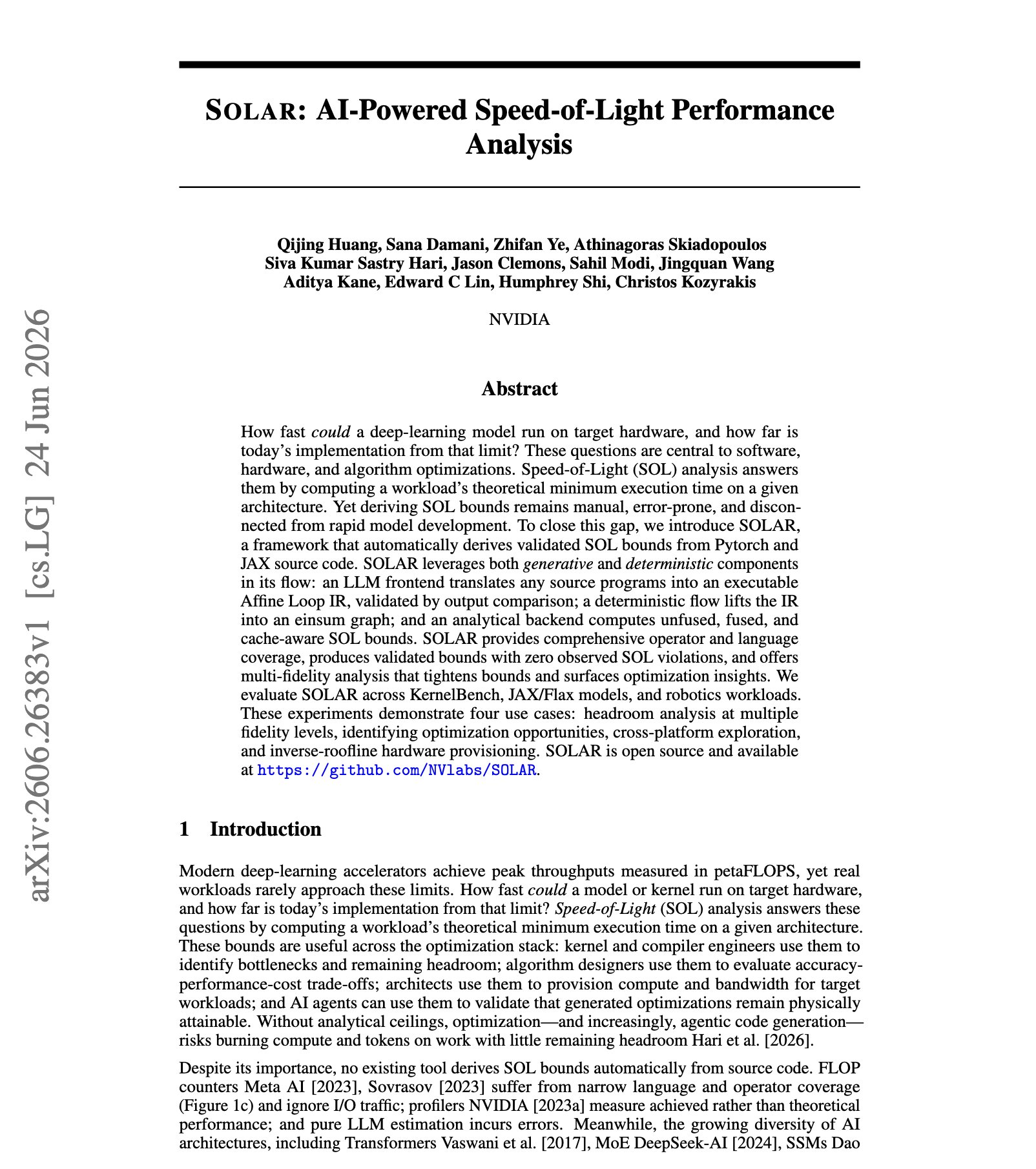
    Can an AI agent run a startup for a year without going bankrupt? Turns out most can't. New benchmark from Collinear AI puts 12 models to the test. YC-Bench tasks agents with running a simulated startup over hundreds of turns: hiring employees, selecting contracts, and maintaining profitability in a partially observable environment with adversarial clients and compounding consequences. Only three models consistently surpass the $200K starting capital. Claude Opus 4.6 leads at $1.27M average final funds, followed by GLM-5 at $1.21M with 11x lower inference cost. Scratchpad usage, the sole mechanism for persisting information across context truncation, is the strongest predictor of success. Adversarial client detection accounts for 47% of bankruptcies. Long-horizon coherence, not raw intelligence, separates the winners from the bankrupt. Paper: arxiv.org/abs/2604.01212 Learn to build effective AI agents in our academy: academy.dair.ai/

    → View original post on X — @dair_ai, 2026-04-02 15:37 UTC

  • Google DeepMind Reveals AI Agent Traps Framework for Web Security
    Google DeepMind Reveals AI Agent Traps Framework for Web Security

    NEW paper from Google DeepMind: AI Agent Traps. elvis (@omarsar0) NEW paper from Google DeepMind The biggest threat to AI agents isn't a smarter attacker. It's the web itself. This work introduces the first systematic framework for understanding how the open web can be weaponized against autonomous agents. The paper defines "AI Agent Traps": adversarial content embedded in web pages and digital resources, engineered specifically to exploit visiting agents. The taxonomy covers six attack classes targeting different parts of the agent architecture like perception (hidden instructions in HTML/CSS) and memory (RAG poisoning and latent memory corruption). The attack surface is no longer just the model. It is every web page, every retrieved document, every piece of content the agent ingests at inference time. Hidden prompt injections in HTML already partially commandeer agents in up to 86% of scenarios, and latent memory poisoning achieves 80%+ attack success with less than 0.1% data contamination. This paper maps where the defenses are weakest and where the research community needs to focus next. Paper: papers.ssrn.com/sol3/papers.… Learn to build effective AI agents in our academy: academy.dair.ai/ — https://nitter.net/omarsar0/status/2039383554510217707#m

    → View original post on X — @dair_ai, 2026-04-01 16:46 UTC

  • Self-Organizing LLM Agents Outperform Predefined Role Hierarchies
    Self-Organizing LLM Agents Outperform Predefined Role Hierarchies

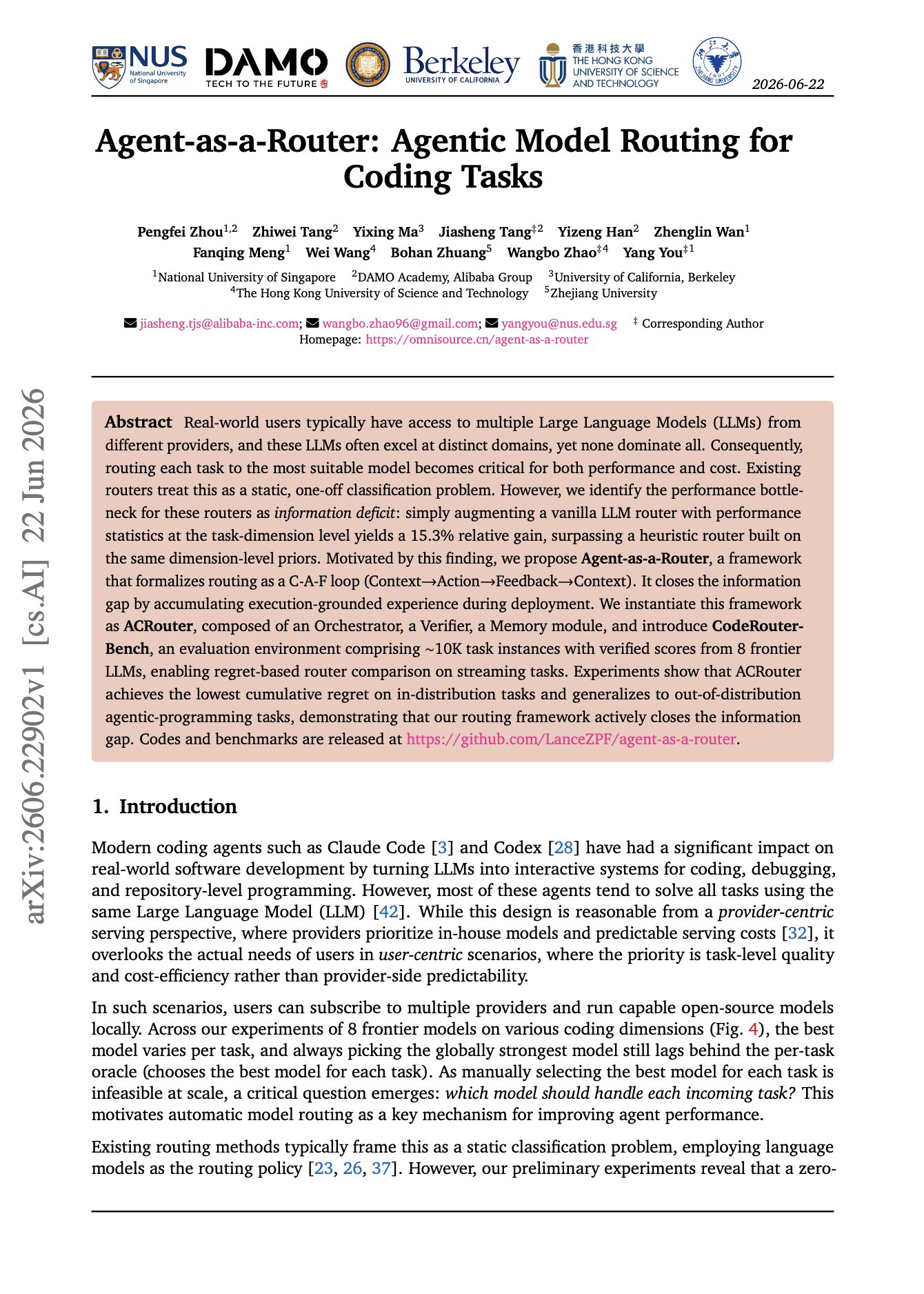
    NEW papers on self-organizing LLM Agents. Assign an agent a role, and it'll follow instructions. Let agents figure out roles themselves, and they'll outperform your design. New research tested this across 25,000 tasks with up to 256 agents. The work shows that self-organizing LLM agents spontaneously develop specialized roles without any predefined hierarchy. A sequential coordination protocol outperformed centralized approaches by 14%, agents generated over 5,000 unique roles organically, and open-source models reached 95% of closed-source quality at significantly lower cost. Most multi-agent frameworks today start by defining roles: planner, coder, reviewer, critic. This paper provides large-scale evidence that the opposite approach works better. Give agents a mission, a protocol, and a capable model. The agents will figure out the rest. Paper: arxiv.org/abs/2603.28990 Learn to build effective AI agents in our academy: academy.dair.ai/

    → View original post on X — @dair_ai, 2026-04-01 14:35 UTC

  • MemFactory: Unified Framework for Trainable Agent Memory Systems
    MemFactory: Unified Framework for Trainable Agent Memory Systems

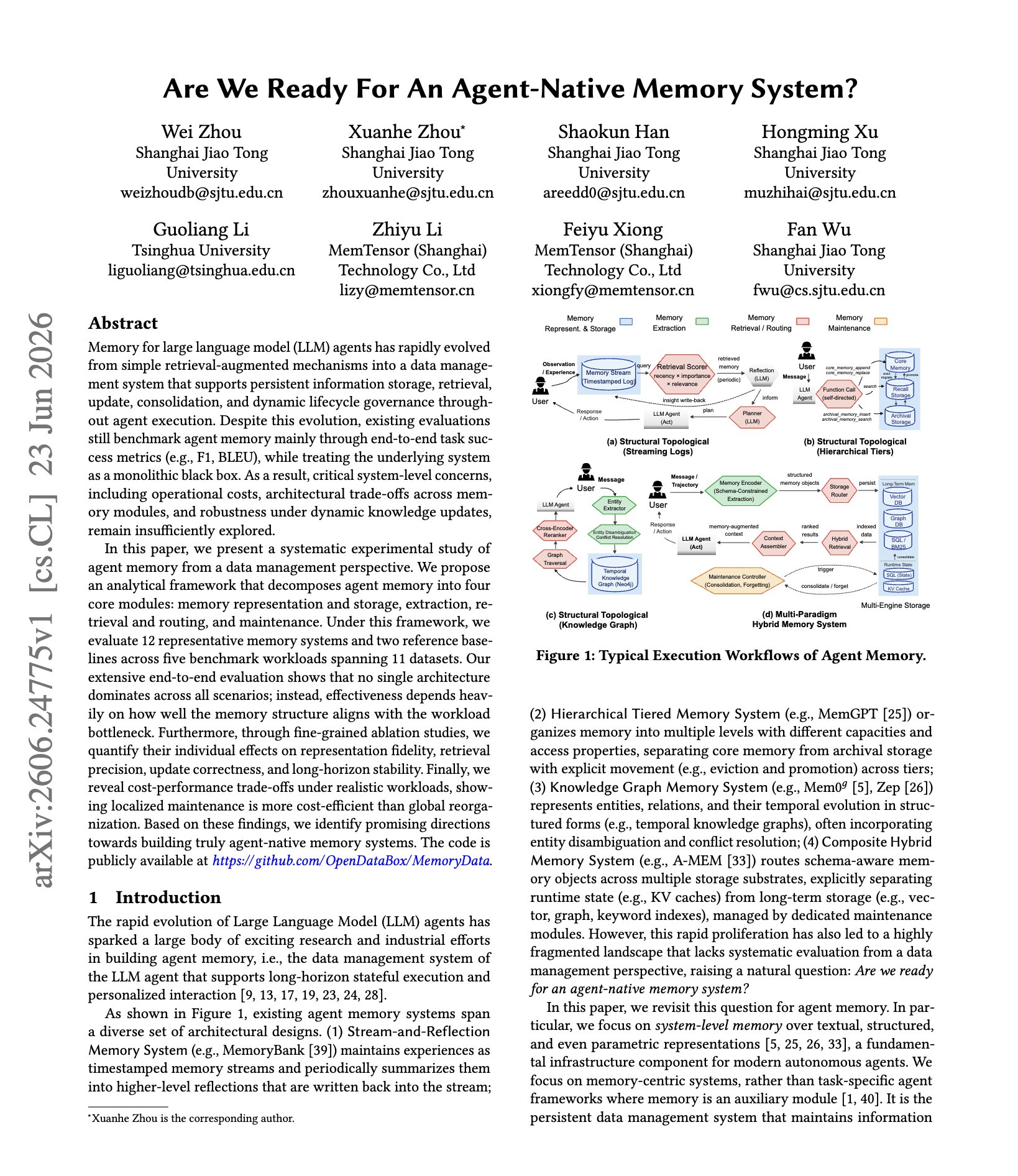
    // Unified Inference and Training Framework for Agent Memory // Most memory-augmented agents are built with duct tape—one system for storage, another for retrieval, a third for training. New research introduces a unified framework that treats agent memory as a first-class, trainable component. MemFactory provides modular, plug-and-play memory components with native GRPO integration for fine-tuning memory management policies through RL. It supports Memory-R1, RMM, and MemAgent paradigms in one framework, with up to 14.8% relative gains over baselines. Why does it matter? As agents move from single-turn tools to persistent assistants, memory becomes the bottleneck. MemFactory gives researchers standardized infrastructure to build, train, and evaluate memory-driven agents without reinventing plumbing for every new approach. Paper: arxiv.org/abs/2603.29493 Learn to build effective AI agents in our academy: academy.dair.ai/

    → View original post on X — @dair_ai, 2026-04-01 14:28 UTC

  • CLAUDE.md: Reduce Output Tokens by 63%
    CLAUDE.md: Reduce Output Tokens by 63%

    Universal CLAUDE.md Claims to cut Claude output tokens by 63%! Drop-in. No code changes. CLAUDE.md is one of the best ways to steer Claude Code. Not surprised to see the efficiency reported here. github.com/drona23/claude-token-efficient [Translated from EN to English]

    → View original post on X — @dair_ai, 2026-04-01 14:05 UTC

  • GAAMA: Graph-Augmented Memory for Long-Term Agent Learning
    GAAMA: Graph-Augmented Memory for Long-Term Agent Learning

    // Graph Augmented Associative Memory for Agents // Long-term memory for agents is still an unsolved problem. Flat RAG loses structural relationships, and knowledge graphs miss conversational associations. New research proposes combining both through a hierarchical approach. GAAMA is a graph-augmented associative memory that constructs a concept-mediated hierarchical knowledge graph through episode preservation, LLM-based fact extraction, and higher-order reflection synthesis. It uses four node types connected by five edge types, with retrieval combining semantic search and graph-traversal ranking. On the LoCoMo-10 benchmark, GAAMA achieves 78.9% mean reward, outperforming HippoRAG and tuned RAG baselines. Multi-session agents need memory that captures both facts and their relationships across conversations. GAAMA demonstrates that graph-augmented retrieval consistently beats semantic-only methods, and that higher-order reflections, not just raw fact storage, are key to reliable recall. Paper: arxiv.org/abs/2603.27910 Learn to build effective AI agents in our academy: academy.dair.ai/

    → View original post on X — @dair_ai, 2026-03-31 20:08 UTC