read more: https://alphaxiv.org/abs/2604.02268 [Translated from EN to English]
→ View original post on X — @askalphaxiv, 2026-04-07 07:37 UTC
By
–
read more: https://alphaxiv.org/abs/2604.02268 [Translated from EN to English]
→ View original post on X — @askalphaxiv, 2026-04-07 07:37 UTC
By
–
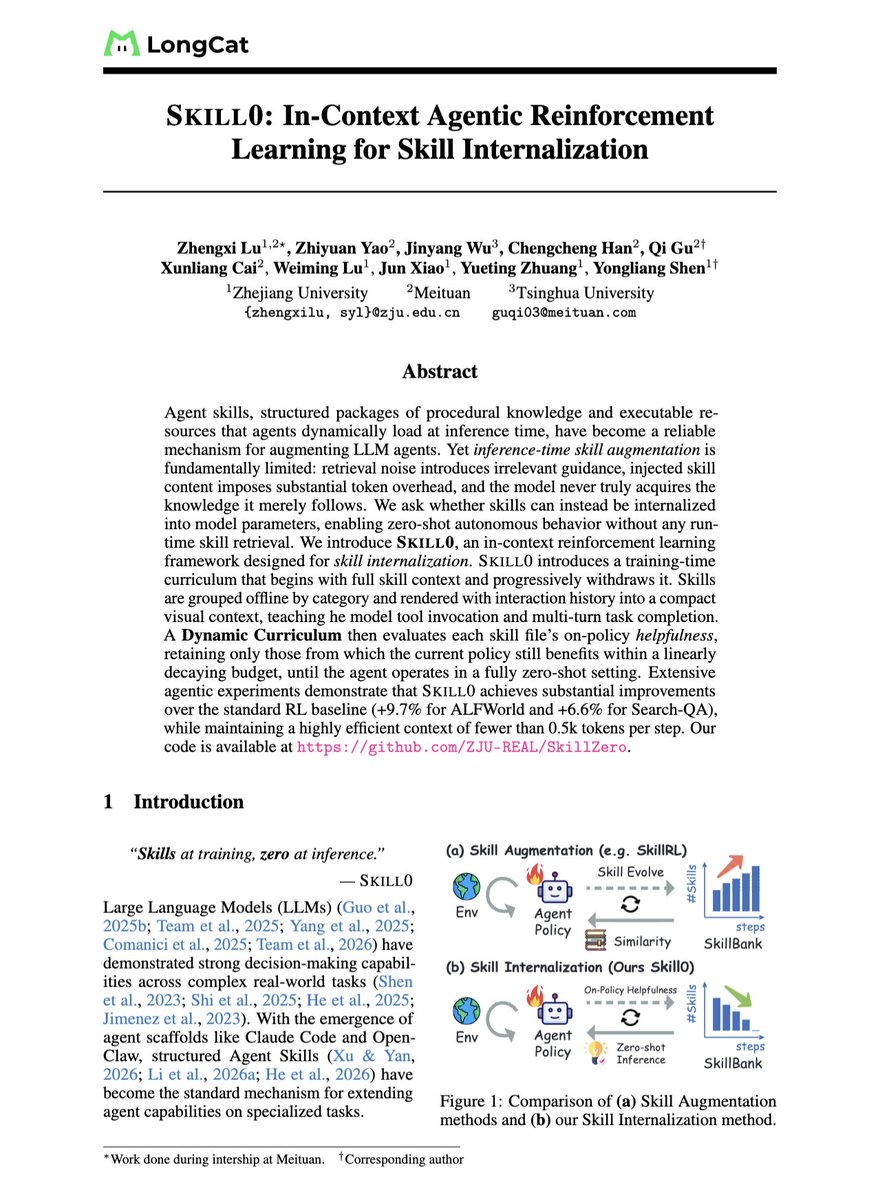
“SKILL0: In-Context Agentic Reinforcement Learning for Skill Internalization” Most agent systems use skills like cheat sheets. It retrieves them at runtime, pastes them into the prompt, and hopes the model follows them. This paper suggests why not train the model with those skills, then slowly remove them until it can do the job from memory? So the agent starts training with skill guidance, but over time the helpful skills are taken away. And instead of depending on instructions forever, it learns to absorb them into its own parameters. This turns skills from something the model reads into something the model actually knows, and the result is a more efficient agent with much less context overhead, but still better performance. Empirically, SKILL0 beats strong RL baselines on ALFWorld and Search-QA while using under 0.5k tokens per step.
→ View original post on X — @askalphaxiv, 2026-04-07 07:37 UTC
By
–
Check out our list of suggested papers to implement here! alphaxiv.org/shared/folder/0…
→ View original post on X — @askalphaxiv, 2026-04-06 19:38 UTC
By
–
The best way to learn frontier research is to replicate it yourself. And now, you can also win prizes for that! We are excited to announce our partnership with @marimo_io for a competition to bring research to life. All you have to do is pick a paper, build a marimo notebook that brings the core idea to life, and experiment with the research topic. Prizes: Mac Mini + $500! 👀 Deadline: April 26, 11:59 PM PST Individual and team submissions are all welcome Full details found below 👇
→ View original post on X — @askalphaxiv, 2026-04-06 19:38 UTC
By
–
We partnered with @askalphaxiv on a competition. Pick a paper, build a marimo notebook that brings the core idea to life, and become one of the few experts on your research topic. Oh, and did we mention you can win a Mac Mini + $1K in prizes? 👀 Full details found here: marimo.io/pages/events/noteb…
→ View original post on X — @askalphaxiv, 2026-04-06 18:17 UTC
By
–
read more:
https://www.alphaxiv.org/abs/2604.01411 [Translated from EN to English]
→ View original post on X — @askalphaxiv, 2026-04-06 18:08 UTC
By
–
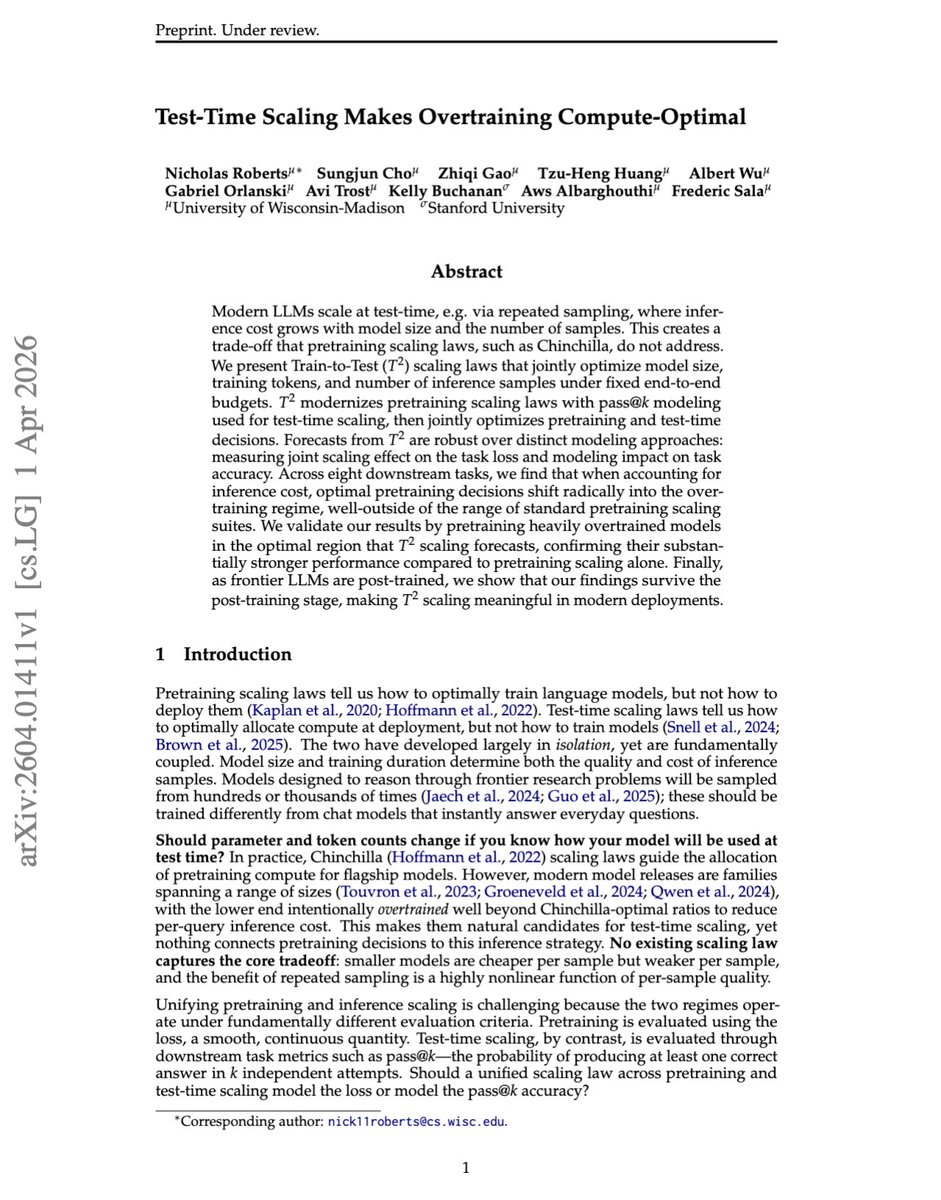
Most scaling laws assume you train once and answer once. But this paper says that if you already know you'll spend extra compute at test time by sampling many answers, then you should train a different model. So instead of a bigger model trained the usual way, it can be better to train a smaller model for much longer. As smaller models are cheaper to sample many times, those extra tries can beat one expensive shot from a larger model. So the real thing to optimize is not just training compute, but training + inference together. And this paper shows overtraining can actually become the compute-optimal choice. [Translated from EN to English]
→ View original post on X — @askalphaxiv, 2026-04-06 18:08 UTC
By
–
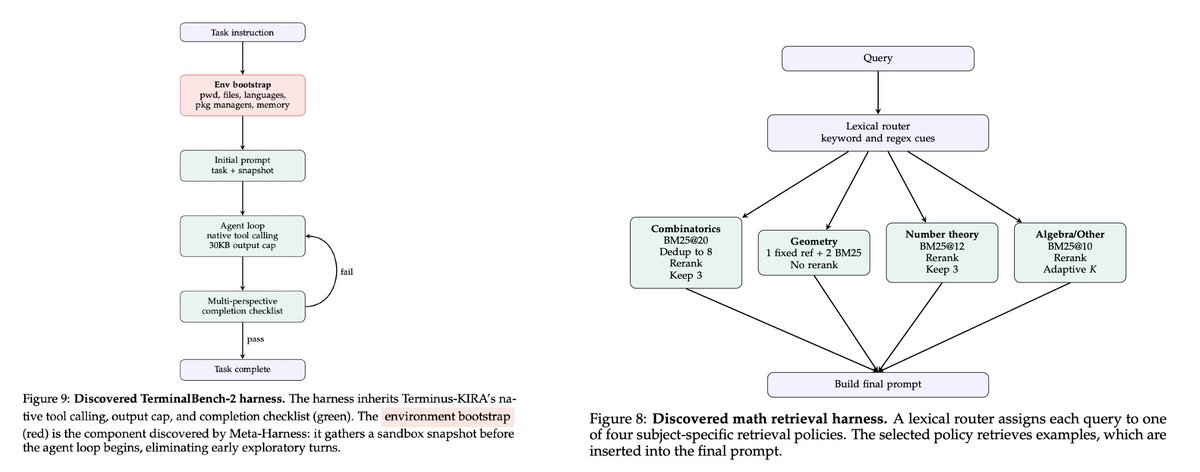
Meta Harnesses is Autoresearch on steroids. Something I've been exploring recently is to get long running agents to hill climb on a verifiable task to continuously improve without my intervention. Karpathy's Autoresearch did this pretty well on specific tasks, but this weekend I tried Meta Harnesses which moves one level of abstraction up. What does Meta Harness do? Autoresearch can be used in harness like Claude Code / Codex to generate experiments to try, evaluate results, and continue looping. Meta Harness generates a harness itself that optimizes on a task or a set of task. Here, we define a harness as "a single-file Python program that modifies task-specific prompting, retrieval, memory, and orchestration logic". The idea is that LLMs are very powerful today, but to harness [pun intended] their power, you need to give it the right prompts and context. Meta Harnesses automates coming up with the right prompts and the right way to retrieve context to solve a problem. Where did this idea come from? This is from a paper from Stanford and the author of DSPy written last week. The paper shows fantastic performance on 3 tasks: text classification, math reasoning (IMO level problems) and coding (Terminal Bench 2.0), far outperforming traditional harnesses. The discovered harnesses are interesting: math for example, splits up the logic into different categories (Combinatorics, Geometry, Number Theory, Algebra) and prompts and looks at the context differently. The coding harness, amongst other things, pre-processes the tools available in the environment to save exploratory turns. When should you use and not use it? Meta Harnesses seem pretty useful for tackling a specific but wide set of problems where the result is verifiable. In contrast, when I tried it on a specific task like Chess, it arbitrarily divides the problem into separate tasks – opening, mid game, end game, and creates different approaches for each. This "works" but isn't really clean because we believe there should be one approach that does all three. It does far better on things like examinations (JEE, Gaokao) where it splits problems into categories and tackles each category with different strategies. This paper covers a pretty light version of what a harness means. In the future, we can split up tasks into harnesses that have access to specific kinds of data, specific toolchains and various models to get even better results. Overall, pretty cool applied AI approach to hillclimb a verifiable task in a specific domain with variety within the problem space.
→ View original post on X — @askalphaxiv, 2026-04-06 16:22 UTC
By
–
read more:
alphaxiv.org/abs/2603.28458 [Translated from EN to English]
→ View original post on X — @askalphaxiv, 2026-04-05 19:06 UTC
By
–
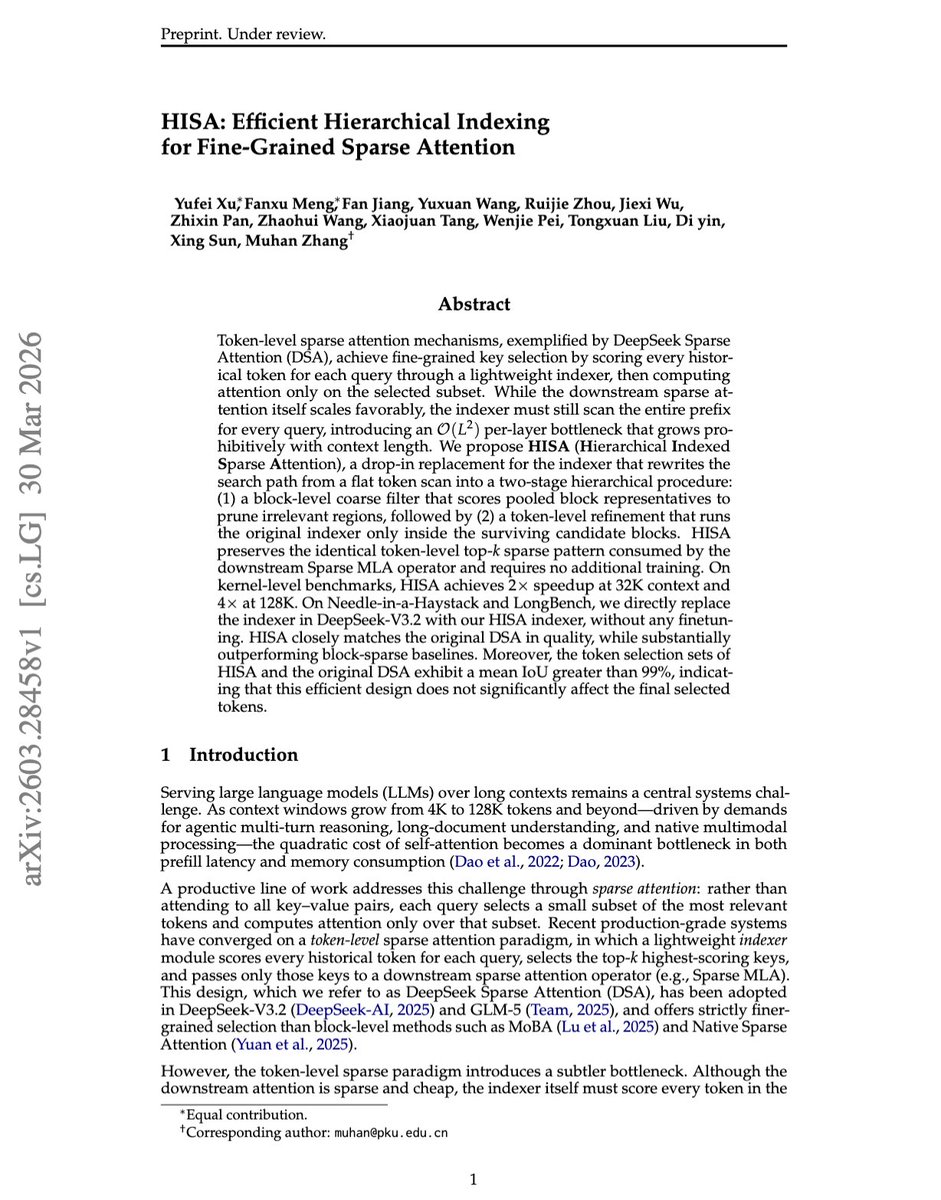
"HISA: Efficient Hierarchical Indexing for Fine-Grained Sparse Attention" Sparse attention can still be slow. And the slow part is often not the attention step itself, but the search step that scans the whole context to find useful tokens. This paper's HISA makes that search cheaper. It first finds the best blocks, then finds the best tokens inside those blocks. This keeps token-level precision, needs no retraining, works with the same downstream attention, and gives up to 3.75x speedup while staying close to the original quality.
→ View original post on X — @askalphaxiv, 2026-04-05 19:06 UTC