read more:
alphaxiv.org/abs/2604.01193 [Translated from EN to English]
→ View original post on X — @askalphaxiv, 2026-04-05 18:25 UTC
By
–
read more:
alphaxiv.org/abs/2604.01193 [Translated from EN to English]
→ View original post on X — @askalphaxiv, 2026-04-05 18:25 UTC
By
–
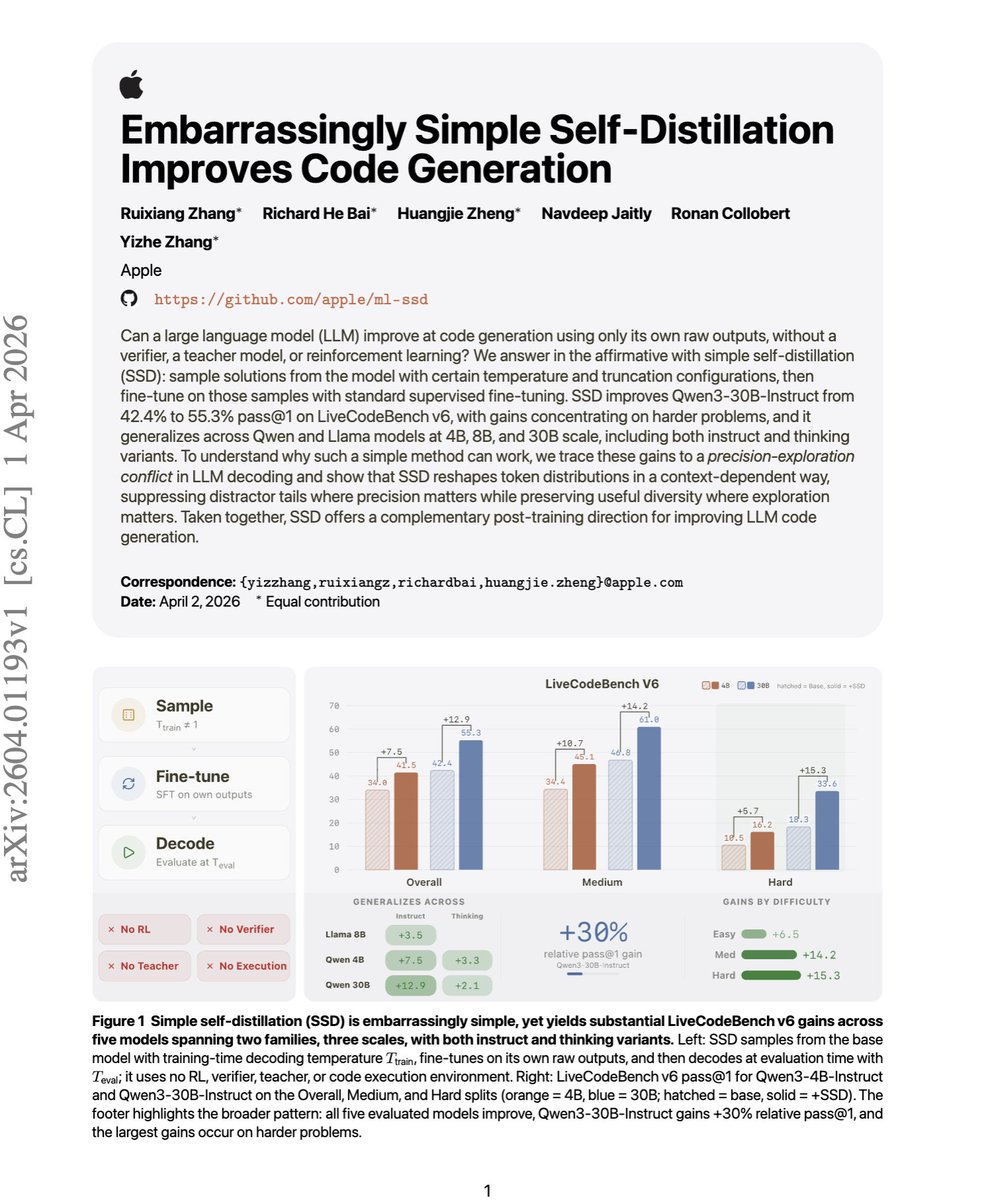
Most code-improvement methods need extra heuristic work, either a stronger teacher, an execution-based filtering, or RL. But this paper shows that the model can get much better at code generation by training on its own raw outputs, even though those outputs are not verified, not filtered for correctness, and not produced by a stronger teacher. What makes it even more surprising is that the gains are largest on harder problems, and simple decoding tricks alone cannot recover them. The most counterintuitive result is that it can still help even when the self-generated training data is partly garbage. The paper shows a high-temperature setting where many outputs become gibberish, yet the fine-tuned model still improves materially. That suggests the benefit is not mainly coming from learning correct programs, but from reshaping the model's token probabilities in a better way. Empirically, Qwen3-30B-Instruct improves from 42.4% to 55.3% pass@1 on LiveCodeBench v6, with the biggest gains on harder problems. [Translated from EN to English]
→ View original post on X — @askalphaxiv, 2026-04-05 18:25 UTC
By
–
read more:
alphaxiv.org/abs/2603.18886 [Translated from EN to English]
→ View original post on X — @askalphaxiv, 2026-04-04 17:55 UTC
By
–
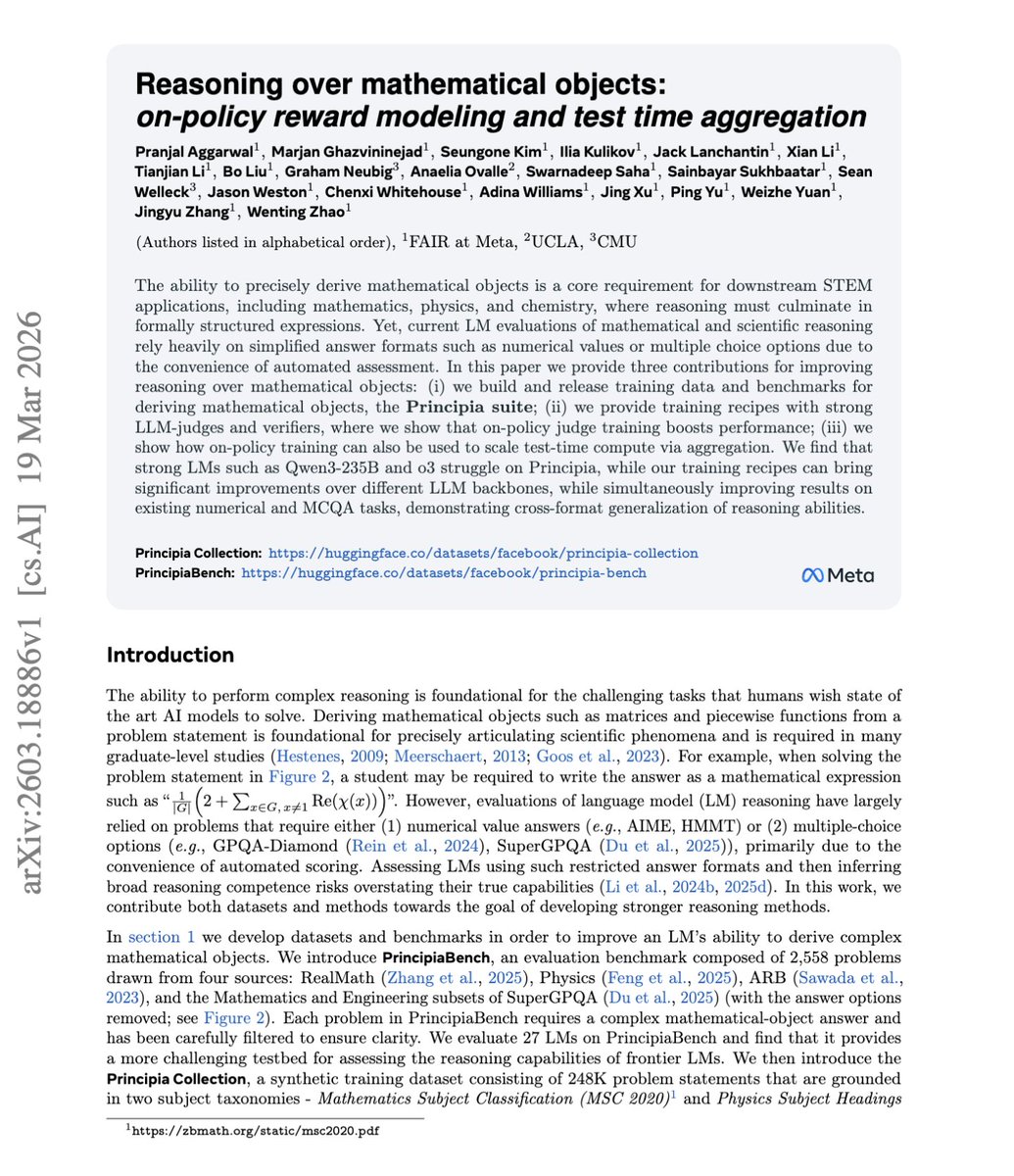
“Reasoning over Mathematical Objects” Most reasoning benchmarks still let models answer with multiple choice or short numerics, which makes evaluation easy but also makes the task easier than real STEM reasoning. This paper shows that when you remove the options and ask for the actual object, like an equation, matrix, set, interval, or piecewise function, the performance drops sharply, even for frontier models. So this paper proposes Principia: a benchmark, training set, and verifier pipeline built specifically for mathematical-object reasoning, plus on-policy judge training to score these hard outputs reliably. What makes this interesting is that training on these harder outputs also improves standard math and science benchmarks, suggesting this is not just better formatting, but better actual reasoning.
→ View original post on X — @askalphaxiv, 2026-04-04 17:55 UTC
By
–
read more:
alphaxiv.org/abs/2603.14389 [Translated from EN to English]
→ View original post on X — @askalphaxiv, 2026-04-04 02:27 UTC
By
–
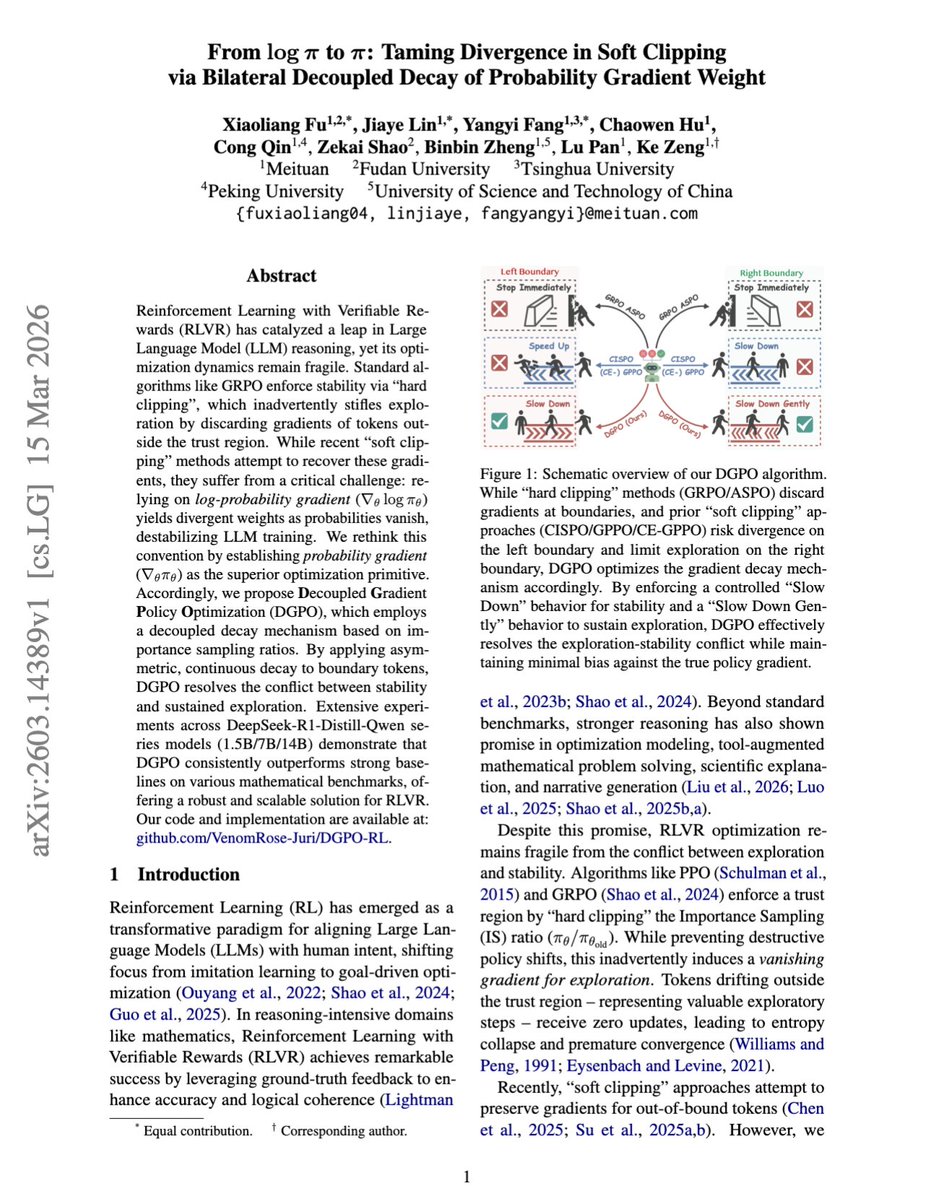
"From log π to π: Taming Divergence in Soft Clipping via Bilateral Decoupled Decay of Probability Gradient Weight" This paper argues that RLVR should optimize probability gradients, not log-probability gradients. So they proposed, DGPO, which applies decoupled decay at the clipping boundaries to preserve exploration while preventing gradient divergence. This results in a more stable soft-clipping objective that consistently outperforms GRPO and prior variants on mathematical reasoning benchmarks.
→ View original post on X — @askalphaxiv, 2026-04-04 02:27 UTC
By
–
Happy to see Think-Anywhere hitting 🔥 Top-2 Hot Paper on alphaXiv and 🚀 Trending Paper on Hugging Face! LLMs think before coding, but humans don't just plan upfront. We pause and reason during implementation whenever things get tricky. Therefore, we propose Think-Anywhere: letting LLMs invoke reasoning at any token position during code generation, on demand. The model discovers on its own where thinking is needed. 📄 Paper: arxiv.org/abs/2603.29957 💻 Code: github.com/jiangxxxue/Think-… PS: We are currently seeking Research Assistants. Outstanding performers will be eligible for direct PhD admission or receive recommendations for both academic and industry positions. If you are interested, please send your CV to yihong.dong001@gmail.com. Let's work together to conduct impactful and meaningful research!
→ View original post on X — @askalphaxiv, 2026-04-03 21:12 UTC
By
–
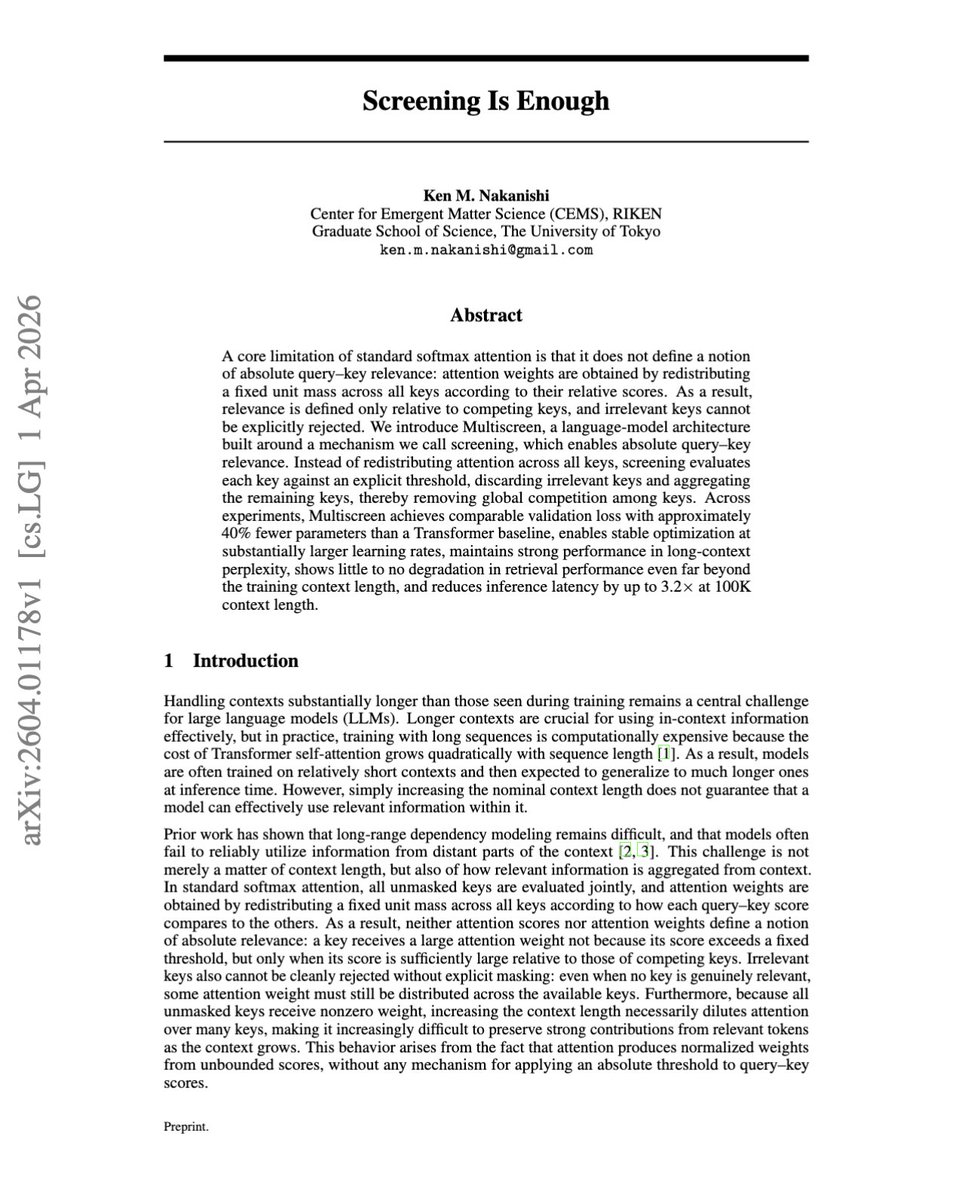
“Screening Is Enough” As Transformers struggle with long context because softmax attention only gives relative relevance, irrelevant tokens would still get weight and useful ones get diluted as context grows. The paper proposes Multiscreen where it judges each key independently, drop the irrelevant ones, and aggregate only what actually matters. This gives the model a better relevance knowledge, including the ability to know "nothing here is useful", which standard attention can’t do. Empirically, this gives roughly 40% fewer parameters for similar loss, much stronger long-context retrieval, and 2.3–3.2x faster 100K-context inference.
→ View original post on X — @askalphaxiv, 2026-04-03 18:23 UTC
By
–
read more:
alphaxiv.org/abs/2604.01178 [Translated from EN to English]
→ View original post on X — @askalphaxiv, 2026-04-03 18:23 UTC
By
–
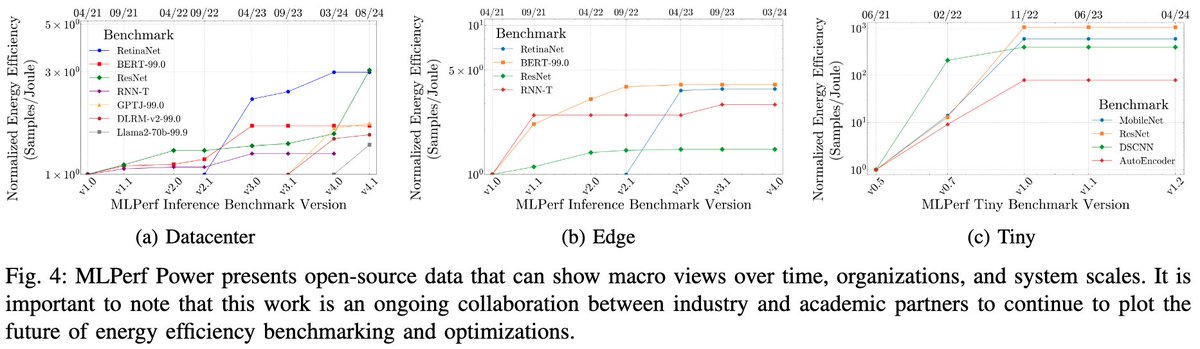
Super excited to share that MLPerf Power (HPCA 2025) was selected for IEEE MICRO Top Picks 2025, 1 of the 12 most impactful computer architecture & systems papers of the year! Power consumption is the defining constraint for modern ML systems. Microsoft, Google, Amazon, Meta, and OpenAI have all announced plans for gigawatt-scale datacenters (for context, 5 GW = 5 nuclear reactors = Miami's power footprint). On the other end of the spectrum, we're anticipating billions of AI-enabled devices at the edge. We created MLPerf Power to be the industry-standard to measure, understand, and compare energy use across all deployment scales. We're excited to see that it's already impacting individual companies' strategies and has been incorporated into the IEEE semiconductor roadmap. We @MLCommons also collect and open source over 1,800 reproducible measurements from 60 diverse systems. These reveal several important insights that shed light on the nonlinear scaling of energy efficiency in modern systems and can enable many new data-driven optimization approaches. Just as @MLPerf aligned industry towards shared performance goals, we are hopeful that MLPerf Power will do the same for power and energy efficiency!
→ View original post on X — @askalphaxiv, 2026-04-02 17:00 UTC