Vibe train your AI agents. There's a new method that could replace LLM-as-a-judge for production agents. Most teams rely on a giant LLM as a judge to evaluate and guard their agent. But it has two major drawbacks: – It's slow and expensive at inference time
– It often misses
@akshay_pachaar
-

New Method to Train and Evaluate AI Agents Efficiently
By
–
-
Cost-Effective RL Evaluation: Qwen3 32B Alternative to o3
By
–
Great piece on RL! One thing I have noticed with RULER is that you don't need o3 or any big model as the judge for every run. Qwen3 32B works well for several tasks and costs a fraction. One can always start cheap validate the score separation looks right, then scale up the
-
CPU vs GPU vs TPU vs NPU vs LPU Hardware Architectures
By
–
CPU vs GPU vs TPU vs NPU vs LPU, explained visually:
— Akshay 🚀 (@akshay_pachaar) 26 avril 2026
5 hardware architectures power AI today.
Each one makes a fundamentally different tradeoff between flexibility, parallelism, and memory access.
> CPU
It is built for general-purpose computing. A few powerful cores handle… pic.twitter.com/S4nBKUJqArCPU vs GPU vs TPU vs NPU vs LPU, explained visually: 5 hardware architectures power AI today. Each one makes a fundamentally different tradeoff between flexibility, parallelism, and memory access. > CPU It is built for general-purpose computing. A few powerful cores handle
-
Selecting Top 100 Agent-User Interactions for Review Without LLM
By
–
A great LLM interview question:
— Akshay 🚀 (@akshay_pachaar) 25 avril 2026
(answer shared below)
You have 80k Agent-user interactions from production. You need to find the top 100 worth reviewing to improve the agent.
You cannot use an LLM to evaluate them since it will be expensive.
This is one of the most painful… pic.twitter.com/nXS2nYGiC0A great LLM interview question: (answer shared below) You have 80k Agent-user interactions from production. You need to find the top 100 worth reviewing to improve the agent. You cannot use an LLM to evaluate them since it will be expensive. This is one of the most painful
-

Seven Core Design Decisions for Production Agent Harnesses
By
–
Design principles for building an Agent harness. Most agent builders get three of the seven core design decisions exactly backwards. Every production agent harness is the result of seven architectural bets. Agent count, reasoning strategy, context strategy, verification,
-

DeepSeek-V4 Breakthrough: Massive KV Cache Efficiency Gains
By
–
DeepSeek-V4 just dropped! And it's solving one AI's biggest problem today: It runs 1M-token context at 10% of the KV cache and 27% of the inference FLOPs of V3.2. Here's what that means. KV cache is the memory footprint your GPU holds for every token already in context. It
-
LLM-Powered Wiki Evolution Beyond Static Knowledge
By
–
The next step after Karpathy's wiki idea:
— Akshay 🚀 (@akshay_pachaar) 23 avril 2026
Karpathy's wiki works on knowledge that sits still.
A page on how attention works is just as useful today as it was a year ago.
The LLM reads sources, pulls out ideas, writes clean articles, and keeps them cross-linked.
You never have… https://t.co/7D5r1fsOOi pic.twitter.com/DVz5TLX1aOThe next step after Karpathy's wiki idea: Karpathy's wiki works on knowledge that sits still. A page on how attention works is just as useful today as it was a year ago. The LLM reads sources, pulls out ideas, writes clean articles, and keeps them cross-linked. You never have
-
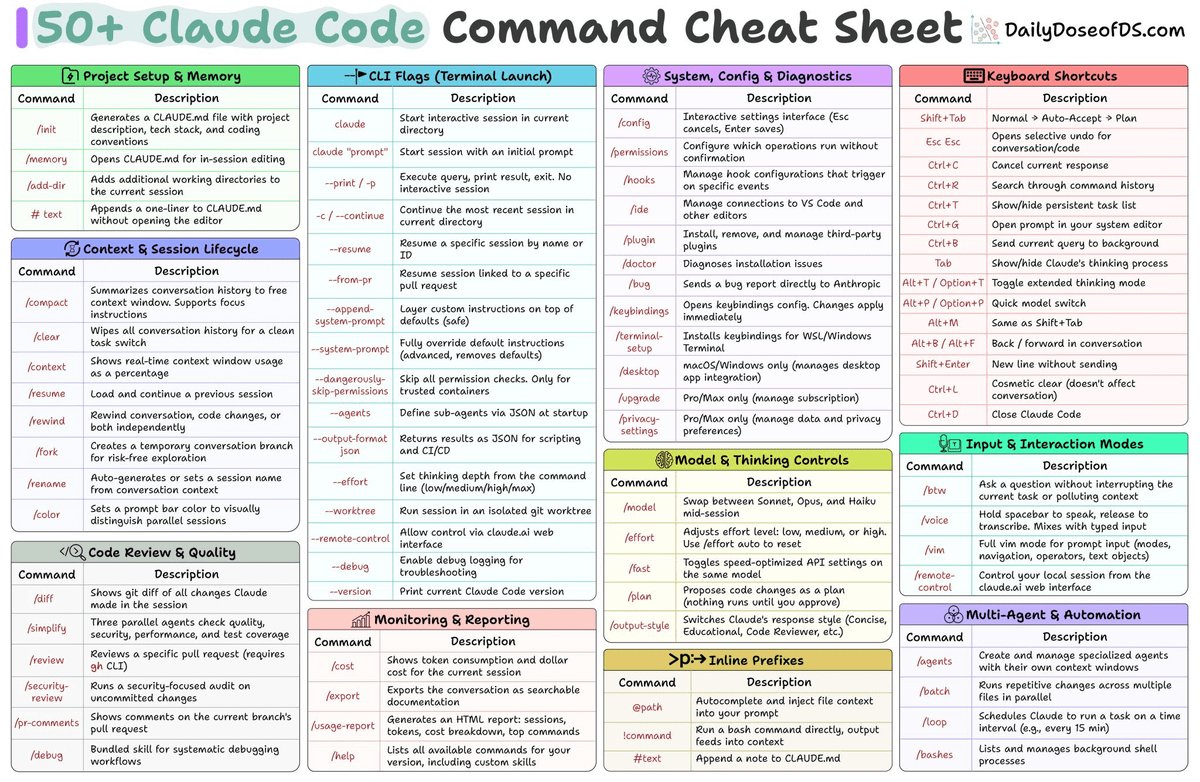
Claude Code Commands Cheat Sheet for Developers
By
–
50+ Claude Code commands. One sheet. Grouped by what you're actually trying to do: 1. Project setup & memory
2. Context & session lifecycle
3. Code review & quality
4. CLI flags for terminal launch
5. Monitoring & reporting
6. System, config & diagnostics
7. Model & thinking -
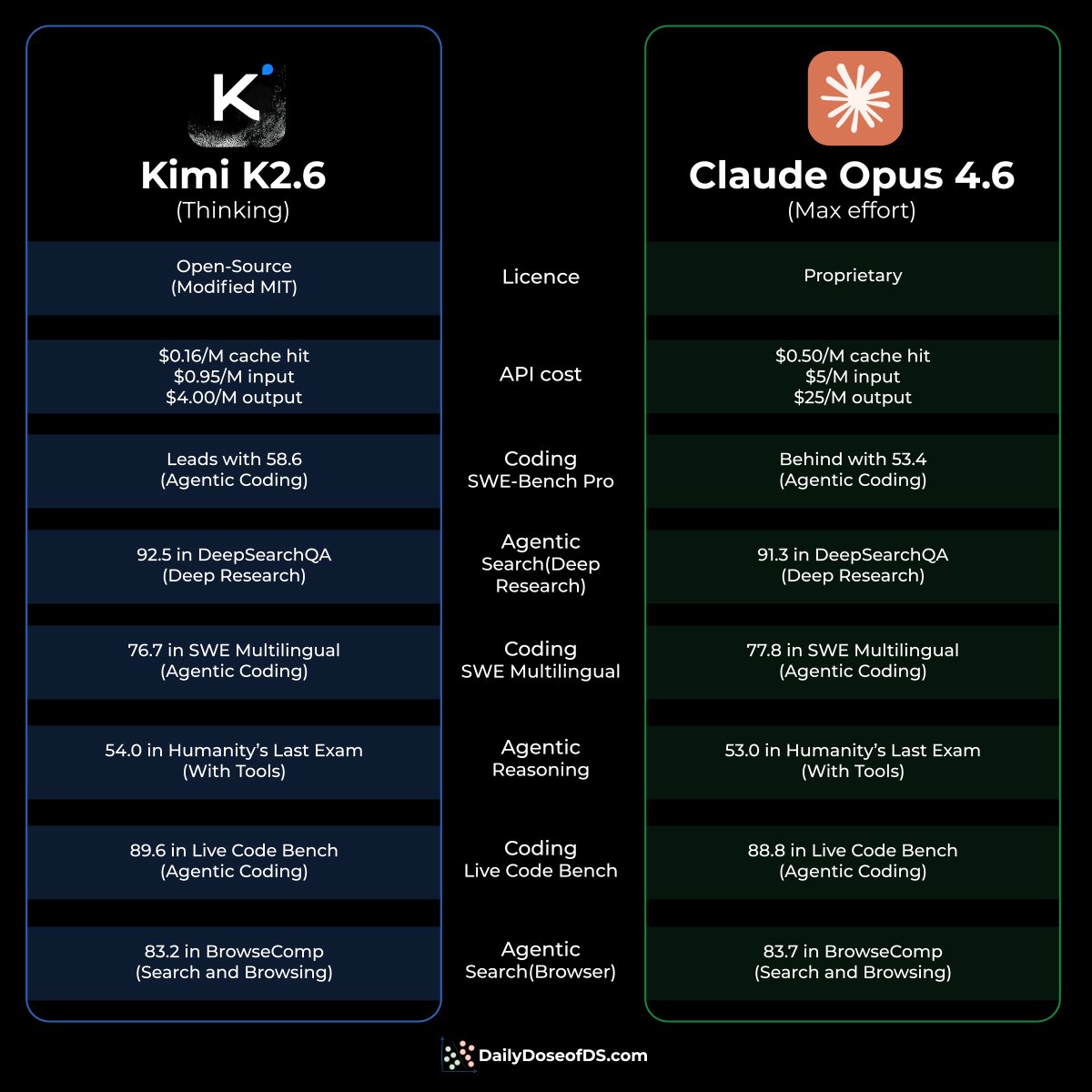
Kimi K2.6 Open-Source Model Challenges Claude Opus 4.6
By
–
Kimi K2.6 raises the bar for open-source models.
— Akshay 🚀 (@akshay_pachaar) 21 avril 2026
Moonshot released it yesterday, and for the first time, an open-weight model holds its ground against Claude Opus 4.6 on the benchmarks that matter for agentic work.
It also costs a fraction of the price.
𝗧𝗵𝗲 𝗽𝗿𝗶𝗰𝗶𝗻𝗴… https://t.co/70e9OxfKf1 pic.twitter.com/pyPg7xbheZKimi K2.6 raises the bar for open-source models. Moonshot released it yesterday, and for the first time, an open-weight model holds its ground against Claude Opus 4.6 on the benchmarks that matter for agentic work. It also costs a fraction of the price. 𝗧𝗵𝗲 𝗽𝗿𝗶𝗰𝗶𝗻𝗴
-
CLAUDE.md Limitations: Context Management in AI Agents
By
–
What I felt after reading is that devs often spend hours crafting the perfect CLAUDE.md. But CLAUDE.md only controls how the agent writes code. It doesn't control how much context the backend dumps into the conversation on every tool call. You can have the most optimized