hey hey @drisspg – let’s get you set up with Codex! DM me your ChatGPT email
TOOLS
-
Codex Security: Free Preview Tool Detecting Real Code Vulnerabilities
By
–
Codex Security is underrated, and still free while in preview! It’s finding real vulnerabilities in live codebases. Definitely worth running.
-
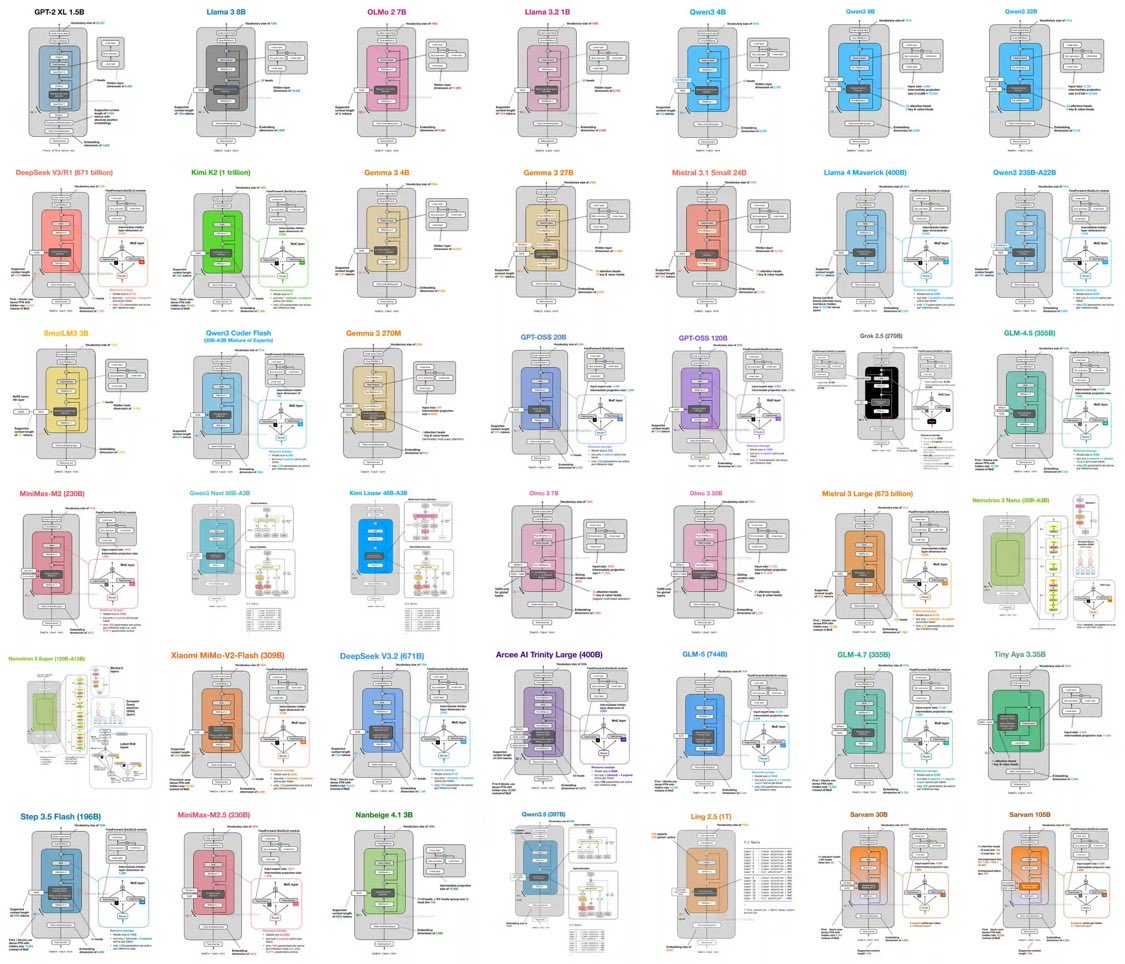
Sebastian Raschka’s LLM Architecture Gallery: Essential Reference for AI
By
–
Sebastian Raschka is one of the most respected voices in ML/AI education. And he just shipped something quietly brilliant. 👉 An LLM Architecture Gallery — a single, browsable reference that maps the internal design of modern open-weight models. This isn’t a blog post. This is a research-grade artifact, made freely accessible. 🔍 What’s inside? A structured breakdown of architectures across the frontier: 🔹 GPT-2 XL (1.5B) 🔹 Llama 3 / 3.2 / 4 Maverick 🔹 Qwen family (4B → 997B) 🔹 DeepSeek V3 / R1 (671B) 🔹 Gemma 3, Mistral variants, Grok 2.5 🔹 GLM series, MiniMax, Kimi, Nemotron 🔹 …and many more scaling up to trillion-parameter regimes 🧠 What makes this exceptional? For each model, you get: → Original technical reports → Verified config.json files (no guesswork) → From-scratch implementations where available This is not curated hype — it’s verifiable, inspectable engineering detail. ⚙️ The real differentiator He doesn’t stop at diagrams. He layers in concept explainers so you actually understand what you’re seeing: • GQA (Grouped Query Attention) • MLA (Multi-head Latent Attention) • SWA (Sliding Window Attention) • QK-Norm • NoPE (No Positional Encoding) • Gated DeltaNet This turns the gallery into a learning system, not just a reference. 🏗️ Why this matters We’ve moved from: → isolated model papers to: → an ecosystem of architectural patterns This resource makes that evolution legible. It compresses what used to take: 📚 multiple textbooks 📄 dozens of papers ⏳ countless hours of reverse engineering …into a single navigable interface. 💡 Bottom line If you're: • building LLM systems • researching architectures • or trying to understand where this field is heading 👉 This is a must-bookmark resource. 🔗 Follow my communities and personal initiatives: • Amazing AI, Data, Quantum Computing & Emerging Technologies — drdebashisdutta.com/ • Research & Innovation – Quantum, AI & Advanced Systems — researchedge.org/ #AI #LLM #MachineLearning #DeepLearning #AIResearch #GenAI #ArtificialIntelligenc
→ View original post on X — @debashis_dutta, 2026-03-29 16:02 UTC
-
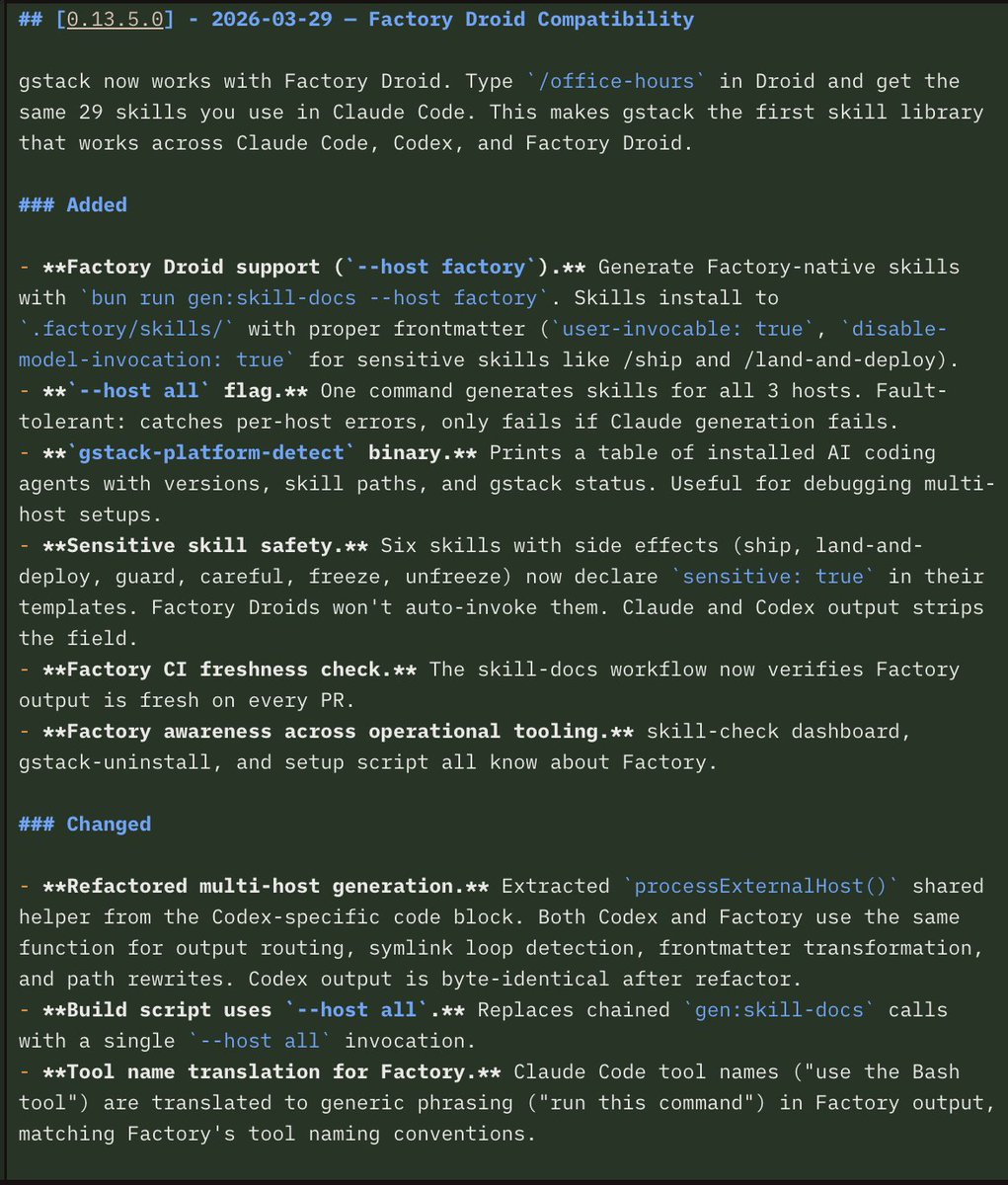
GStack now supports Factory Droid integration
By
–
GStack now supports Factory Droid @FactoryAI Thanks for getting me to do it @matanSF
→ View original post on X — @nathanlands, 2026-03-29 16:00 UTC
-
Claire Vo Runs 9 AI Agents for Sales Automation on Mac
By
–
Claire Vo's first day with @OpenClaw it deleted her family calendar. Now she runs 9 agents across 3 Mac Minis, and said "I haven't felt like this since I was a teenager learning to code." Her sales agent Sam does a daily CRM sweep, identifies decision-makers from new signups,
-
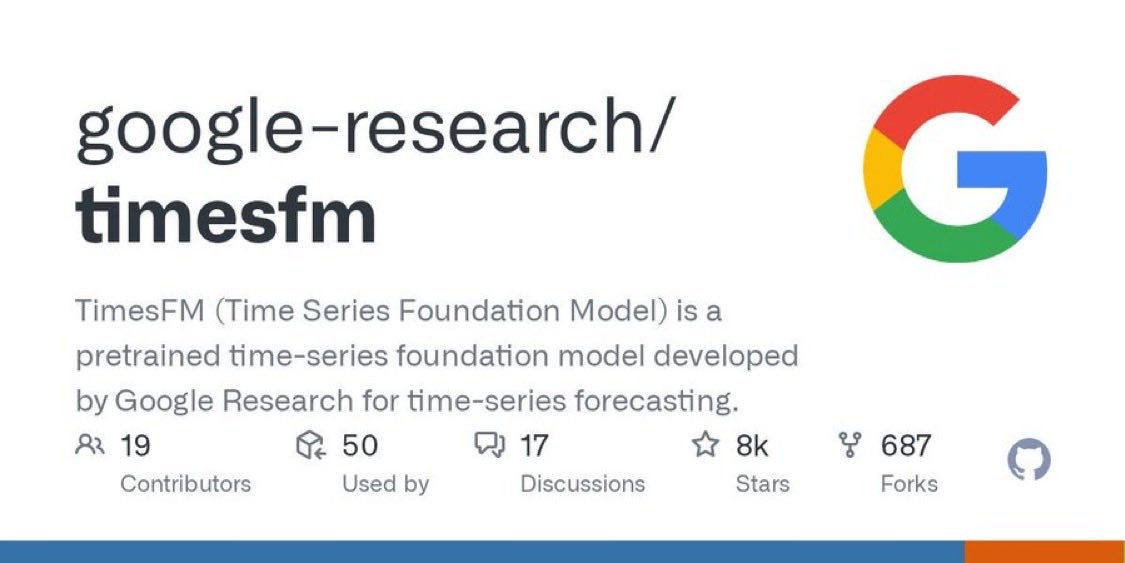
Google’s TimesFM: Foundation Model Revolutionizing Time Series Forecasting
By
–
🚀 Google just open-sourced a Time Series Foundation Model — and this changes forecasting as we know it. Meet TimesFM. Unlike traditional time-series models that require: • dataset-specific training • feature engineering • constant retraining 👉 TimesFM works out of the box — with any time-series data. No fine-tuning. No custom pipelines. Just plug and forecast. 🔍 What makes this a breakthrough? 🧠 Foundation model for time series Trained on 100B real-world time-points across: • traffic patterns • weather systems • demand forecasting ⚡ Zero-shot forecasting Generalizes across domains without retraining. 📈 Production-ready from day one Eliminates the heavy overhead of building bespoke models per dataset. 🏗️ Architecture Takeaways • Shift from model-per-dataset → generalized forecasting models • Pretraining at scale enables cross-domain pattern learning • Signals a move toward “forecasting as a service” abstraction layer • Reduces dependency on feature engineering pipelines 💡 Why this matters We’re witnessing the “GPT moment” for time series. The implication is massive: → Faster deployment cycles → Lower ML engineering cost → Democratized forecasting capabilities This could fundamentally reshape industries like: • supply chain • finance • energy • climate analytics 🔗 Explore the repo: github.com/google-research The big question now: 👉 Will domain-specific models survive… or will foundation models dominate forecasting too? 🔗 Follow my communities and personal initiatives: • Amazing AI, Data, Quantum Computing & Emerging Technologies — drdebashisdutta.com/ • Research & Innovation – Quantum, AI & Advanced Systems — researchedge.org/ #AI #MachineLearning #TimeSeries #GenerativeAI #DataScience #Forecasting #Innovation:
→ View original post on X — @debashis_dutta, 2026-03-29 15:54 UTC
-

Reasoning Models: Why Listed Prices Don’t Match Actual Costs
By
–
// When Cheaper Reasoning Models End Up Costing More // The model you think is cheaper might actually cost you more. New research quantifies exactly how misleading listed API prices are. Across 8 frontier reasoning models and 9 tasks, 21.8% of model-pair comparisons exhibit pricing reversal, where the cheaper-listed model costs more in practice. The magnitude reaches up to 28x. Gemini 3 Flash is listed 78% cheaper than GPT-5.2, yet its actual cost is 22% higher. Claude Opus 4.6 is listed at 2x Gemini 3.1 Pro but actually costs 35% less. The root cause: thinking token heterogeneity. On the same query, one model may use 900% more thinking tokens. Why does it matter? Anyone choosing reasoning models for production needs to benchmark actual costs, not listed prices. Removing thinking token costs reduces ranking reversals by 70%. The authors release code and data for per-task cost auditing. Paper: arxiv.org/abs/2603.23971 Learn to build effective AI agents in our academy: academy.dair.ai/
-
OpenResearcher: An Open-Source Offline-Trained Research Agent
By
–
You can now train a deep research agent without a single API call.
— AlphaSignal AI (@AlphaSignalAI) 29 mars 2026
OpenResearcher is a new open-source repo that's trained entirely offline.
A 10-billion-token corpus generates 100+ turn research trajectories.
All offline. Zero API costs.
It learns three browsing actions… pic.twitter.com/4wgFUaFhFxYou can now train a deep research agent without a single API call. OpenResearcher is a new open-source repo that's trained entirely offline. A 10-billion-token corpus generates 100+ turn research trajectories. All offline. Zero API costs. It learns three browsing actions
-
Phone scanning enables static data memory capture storage
By
–
Agree – closest thing to memory capture we got. People should scan static stuff with their phones to start and save all that data
-
Language Barriers Finally Overcome Through Advanced Technology
By
–
It's still nuts to me how this sci-fi dream becomes reality: language barriers are solved forever.