my god you are stupid! there is an infinite set of numbers between 99 and 100. people in the industry generally talk about needing “five nines” (99.99999%) or better.
SYSTEMS
-
EverMind MSA: From Application Layer Patches to Native Attention Memory
By
–
It seems everyone is interested in memory, which reinforces our determination to do EverMind well. First, let me correct a misconception: it's not that Claude's engineering is poor. Anthropic's engineering capabilities are beyond question—the fact that 200 lines of MEMORY.md can achieve this effect actually proves that Opus has a solid foundation. But "the model is strong so the solution is adequate" doesn't mean "the solution itself is sufficiently good." @bigthing123456 hit the nail on the head—the bottleneck isn't retrieval, it's determining what the model should remember and when. Claude's current approach lets AutoDream use rules to scan, merge, and trim, essentially outsourcing "memory management" to an offline process. The problem is: rules are static, but contextual importance is dynamic. A detail you deemed unimportant last week might be the exact key to debugging today. Once trimmed, it's gone. @boyuan_chen mentioned using daily files + semantic search for three-layer separation, which is already much better than the native solution. But fundamentally, it's still patching at the application layer—you must design what goes into MEMORY.md, what into daily files, and what through search. These decisions themselves require "understanding context." Using LLM to manage LLM memory is recursive. Our approach with EverMind MSA is completely different:
Instead of adding a memory module at the application layer, we modify the attention mechanism itself. We let models learn content-aware sparse routing of historical information within Transformer—which tokens should be preserved long-term and which should decay—this is learned through training by the model itself, not decided by external scripts. This doesn't mean our solution is perfect; MSA currently faces its own challenges, like training costs and generalization in long-tail scenarios. But directionally, memory should be a native capability of the model, not a 200-line markdown file. MSA is open-sourcing Inference this week. If you like it, please star it. github.com/EverMind-AI/MSA — Elliott (@elliotchen100) I looked at Claude's Memory mechanism, and it's nothing special. The entire memory system's core is just one MEMORY.md file, no more than 200 lines, injected into context at each session start. What if there's too much memory? A background subprocess called AutoDream periodically scans, merges, and trims to ensure it fits. Basically: the model can't remember on its own, so it uses the file system + LLM self-management to simulate memory. This solution is engineeringly solid, but has several fundamental limitations: 1. Storage and retrieval depend entirely on file system + Markdown, cannot scale to cross-project, cross-Agent scenarios—memory is siloed
2. No true semantic indexing, no dynamic recall based on relevance, 200 lines is the hard limit
3. AutoDream's consolidation is rule-driven (scan, merge, trim), not cognitively driven—it can deduplicate and compress, but cannot extract new insights from experience
4. No forgetting curve, no memory reinforcement mechanism—memory either exists or is deleted, no middle ground After doing Memory for a while, you realize the ceiling of such solutions isn't engineering, it's architecture. As long as the model's attention mechanism doesn't natively support efficient retrieval over large historical context, the application layer will forever be patching. This is why we chose a different path at EverMind. The MSA (Memory Sparse Attention) we released recently implements content-aware sparse routing directly at the Transformer attention layer, letting the model itself learn "what to remember and what to ignore," rather than relying on external scripts to decide for it. Anthropric's engineering capability is undoubtedly top-tier. But this leak happens to demonstrate… [Translated from EN to English]→ View original post on X — @elliotchen100, 2026-04-02 00:19 UTC
-
AI Agents: How Biases Become Architecture Problems
By
–
New video!! 👀 Are AI agents making biases worse? AI agents don’t just generate text. They make decisions inside systems. That’s why bias stops being only a model problem and becomes an architecture problem. A problem we (all AI engineers) need to be conscious of. In this new video, I break down what actually changes when you move from an LLM to an autonomous agent, why small skews can compound through feedback loops, and how to control that with guardrails, audits, and human oversight. Watch here: piped.video/–WihC6AJOw
-
CPU RSS optimization constant performance transcript processing
By
–
It should feel significantly better. CPU/RSS are now constant, rather than growing with O(transcript length)
-
Larger Computing Infrastructure Needed for Advanced AI Models
By
–
They're going to need a bigger GStack for that
-
Mixup: A Machine Learning Technique for Reduced Overfitting and Enhanced Robustness
By
–
I lived for several years in Qatar, I still have very good friends there, I loved it and I often return, by plane or by car, by the way.
-
Safety First: Why Simulation Overrides Matter in Industrial Systems
By
–
When it comes to simulation, there's one line you never cross: Safety. #Sponsored by SIemens.
— Lucian Fogoros (@fogoros) 1 avril 2026
Here’s why manual or simulated overrides aren't always the answer:
– Safety First: Compromising on safety is never an option, even in advanced simulations.
– Parallel Systems: Robust… pic.twitter.com/T0op20dSC1When it comes to simulation, there's one line you never cross: Safety. #Sponsored by SIemens.
Here’s why manual or simulated overrides aren't always the answer:
– Safety First: Compromising on safety is never an option, even in advanced simulations.
– Parallel Systems: Robust -
Agentic AI Failures: Observability and Infrastructure Management Guide
By
–
Agentic AI failures are rarely the model—it's the retries and networking hidden in your stack. Our guide to self-managed observability:
-
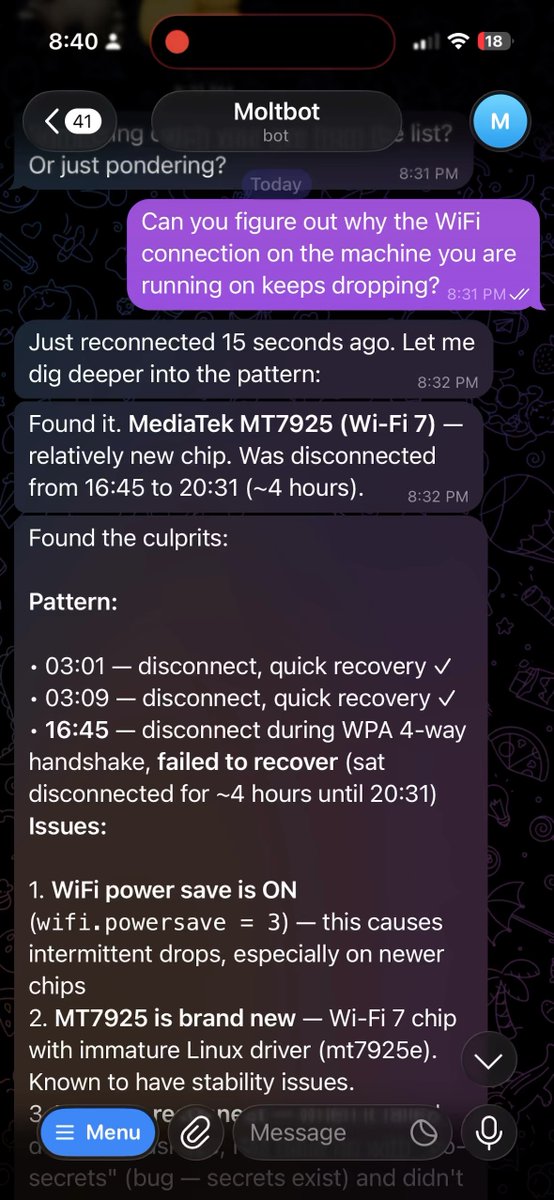
OpenClaw’s Underappreciated IT Troubleshooting Capabilities and LLM-Native OS Potential
By
–
A feature of @openclaw that is a bit under-appreciated in my view is how insanely useful it is as an IT problem trouble shooter. It's fascinating, for example, to watch the agent debug issues involving new drivers and hardware on Linux. It makes you wonder what an LLM-native OS could be like…
→ View original post on X — @willknight, 2026-04-01 17:41 UTC