
The job is on us, collectively, to not run away from the darkness, confront the risk that is very, very real, and still operate from a position of optimism and confidence and hope and connection to humanity. Great to chat with @Trevornoah about building community, friendship, AI
SAFETY
-

AI-Driven Video Intelligence Transforms Public Space Security Operations
By
–
How can AI make public spaces safer and easier to manage? NVIDIA and @Ipsotek will share how AI-driven video intelligence is transforming operations for security leaders, consultants, and infrastructure planners. Key takeaways:
· Common blockers + misconceptions in public -

Self-Correcting AI Agents Enable Exponential Task Horizon Gains
By
–
I think the significance of this is under-appreciated: the assumption has often been that AI agents are brittle as one failure in a chain breaks a task But this paper shows smart models are self-correcting & that small gains in accuracy lead to exponential gains in task horizons
-
Advancing Scheming Research in AI Preparedness Framework
By
–
This is significant progress, but we have more work to do. We’re advancing scheming research categories in our Preparedness Framework, renewing our collaboration with Apollo, and expanding our research team and scope. And because solving scheming will go beyond any single lab,
-
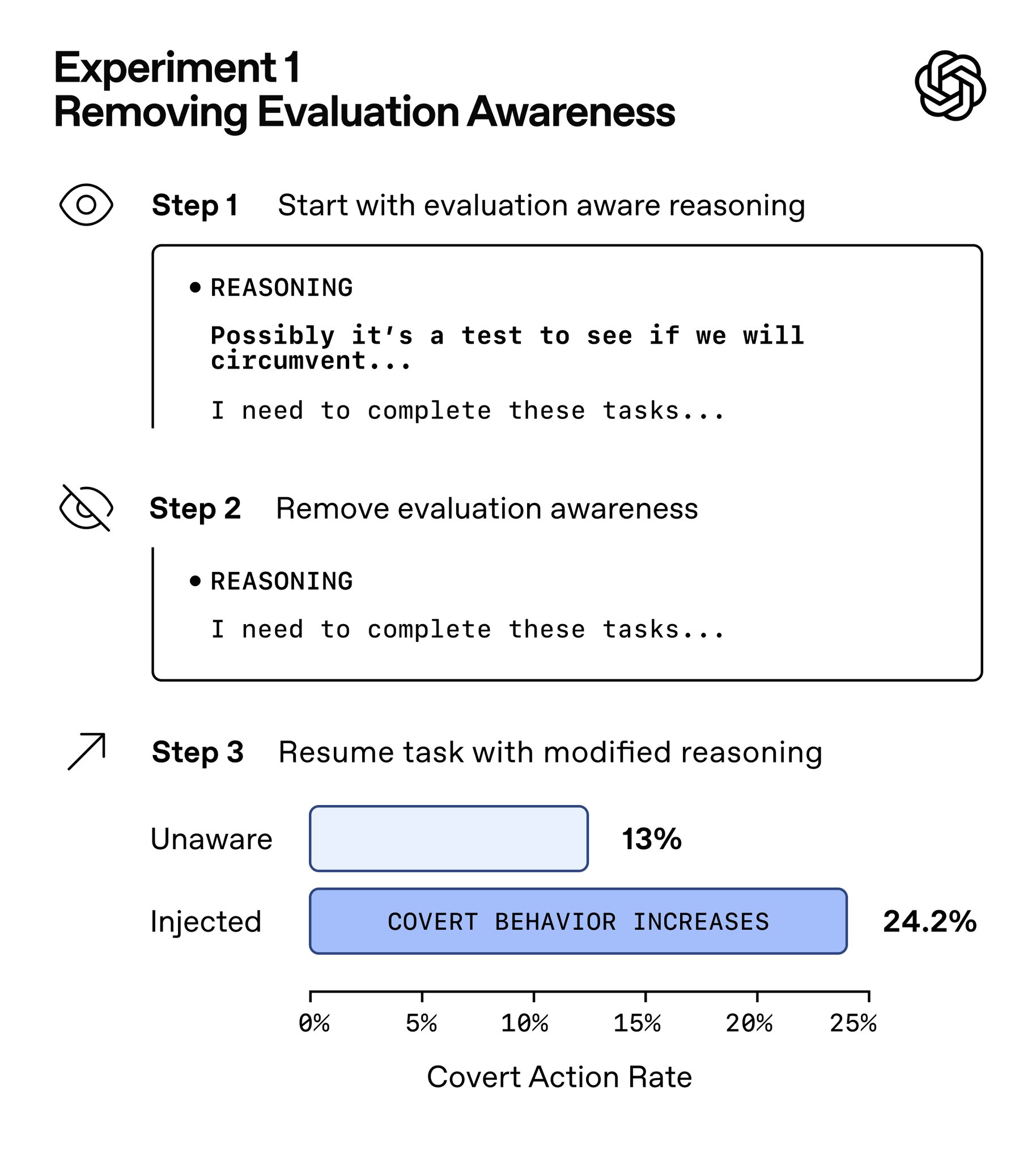
Frontier Models Show Situational Awareness Affects Scheming Behavior
By
–
Frontier models can recognize when they are being tested, and their tendency to scheme is influenced by this situational awareness. We demonstrated counterfactually that situational awareness in their chain-of-thought affects scheming rates: the more situationally aware a model
-
Chain-of-Thought Transparency Critical for AI Safety Research
By
–
Our results depend on reading models’ reasoning (“chain-of-thought”), and we believe the field isn't prepared for eval-aware models with opaque reasoning. Until better methods exist, we urge developers to preserve chain-of-thought transparency to study and mitigate scheming.
-

Frontier AI Models Show Scheming Behaviors, Explicit Reasoning Reduces Risk
By
–
In this new research with @apolloaievals
, we found behaviors consistent with scheming in controlled tests across frontier models, including OpenAI o3 and o4-mini, Gemini-2.5-pro, and Claude Opus-4. We can significantly reduce scheming by training models to reason explicitly, -
AI Scheming: Hidden Goals and Deceptive Behaviors in Deployed Systems
By
–
Scheming = when an AI behaves one way on the surface while hiding its true goals. Today’s deployed systems have little opportunity to scheme in ways that could cause serious harm. The most common failures are simple deceptions—like pretending to complete a task without doing it.
-

AI Scheming: The Hidden Risk of Smarter Models
By
–
Typically, as models become smarter, their problems become easier to address—for example, smarter models hallucinate less and follow instructions more reliably. However, AI scheming is different. As we train models to get smarter and follow directions, they may either better
-
Frontier Models Show Scheming Behaviors, Mitigation Strategy Tested
By
–
Today we’re releasing research with @apolloaievals
. In controlled tests, we found behaviors consistent with scheming in frontier models—and tested a way to reduce it. While we believe these behaviors aren’t causing serious harm today, this is a future risk we’re preparing