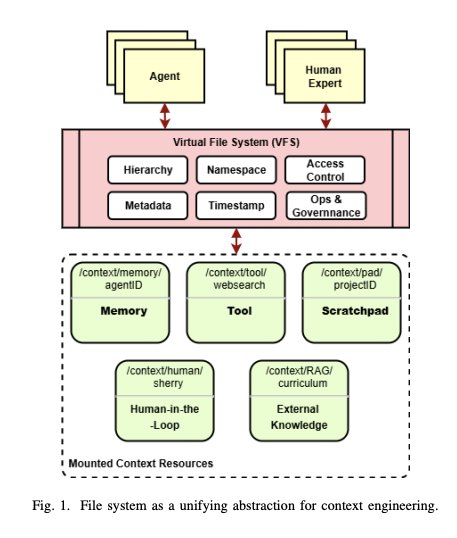
the problem is real and underappreciated. right now, most agent frameworks handle context like this: load memory at session start. stuff it into the prompt. when the window fills, summarize and compress. hope the important parts survive. the paper calls this out directly. once
SAFETY
-
QueryWeaver GitHub Project Promotes AI-Related Categories
By
–
QueryWeaver GitHub: (don't forget to star )
-
Grok’s truth-seeking expectation contradicted by hallucinations
By
–
I thought Grok was truth seeking, this is just plain old hallucinations
-
Biased human prompting leads to more biased outputs
By
–
Depends on how it is prompted. So probably more since biased humans are prompting the system.
-

TorchLean: First Fully Verified Neural Network Framework in Lean
By
–
Super excited to release TorchLean!! I’m happy to answer questions and would love to discuss verified NNs + theorem proving especially what it’ll take for the field to become widely usable in real ML systems. Blog post + codebase release soon! Prof. Anima Anandkumar (@AnimaAnandkumar) We’re excited to release TorchLean which is the first fully verified neural network framework in Lean. The Lean community has largely focused on pure mathematics. TorchLean expands this frontier toward verified neural network software and scientific computing. With the recent release of CSlib, we see this as another step toward a fully verified ML stack. We support features: 1. Executable IEEE-754 floating-point semantics (and extensible alternative FP models) verified tensor abstractions with precise shape/indexing semantics 2. Formally verified autograd system for differentiation of NN programs Proof-checked certification / verification algorithms like CROWN (robustness, bounds, etc.) 3. PyTorch-inspired modeling API with eager-style development + export/lowering to a shared IR for execution and verification Project page: leandojo.org/torchlean.html Paper: [2602.22631] TorchLean: Formalizing Neural Networks in Lean Work done @Robertljg, Jennifer Cruden, Xiangru Zhong, @huan_zhang12 and @AnimaAnandkumar. #MachineLearning #ScientificComputing #Lean — https://nitter.net/AnimaAnandkumar/status/2027907453908857298#m
→ View original post on X — @animaanandkumar, 2026-03-01 22:38 UTC
-
AI Hallucinations and Reasoning Errors Linked to Civilian Deaths
By
–
hallucinations and reasoning errors that lead to accidental civilian deaths. which may have already happened, yesterday.
-

OpenAI’s Unreliable Tech and War: An Ethical Debate
By
–



tl;dr of something worth reading: OpenAI is full of shit, and perfectly happy to be using their unreliable tech for war. #DeleteChatGPT
-
AI’s Societal Impact: Job Displacement, Life-or-Death Decisions, and Nuclear War Concerns
By
–
It’s not just the AI that will be taking our jobs.
— Gary Marcus (@GaryMarcus) 1 mars 2026
It’s the AI that will be making life or death decisions.
And the AI that might lead to needless escalation, maybe even nuclear war.#DeleteChatGPT https://t.co/uRa5cvOix5It’s not just the AI that will be taking our jobs. It’s the AI that will be making life or death decisions. And the AI that might lead to needless escalation, maybe even nuclear war. #DeleteChatGPT
-
Critique on AI Reliability and the Premature Race for Integration
By
–
The race to shove AI into everything is grossly premature, because the tech fundamentally lack reliability. Meanwhile, the chance that we will get straight answers is probably close to zero. (Altman, for his part, doesn’t seem to care.)
-
OpenAI criticism deserves nuance: frontier innovation requires visible risk
By
–
I’m honestly tired of watching OpenAI get cast as the default villain in every AI debate. They try something bold, it’s dangerous. They move fast, it’s irresponsible. They partner, it’s corruption. They compete, it’s opportunism. Meanwhile, plenty of other companies move quietly, wait for validation, copy what works, avoid the hardest calls — and somehow escape the same scrutiny. Let’s be honest. OpenAI ships at scale. They deploy first. They test boundaries in public. That means they make visible mistakes. Visible tradeoffs. Visible bets. But that’s also what pushing a frontier looks like. If you’re the company actually attempting moonshots, integrating with institutions, scaling globally, and defining new categories, you’re going to absorb more risk and more criticism than everyone standing safely behind you. Do we really believe other AI companies aren’t navigating the same ethical gray zones? The same regulatory ambiguity? The same pressure between innovation and governance? Or is it just easier to project all systemic anxiety onto the biggest target? The standard keeps rising for OpenAI. Higher than for startups. Higher than for open source projects. Higher than for incumbents moving quietly in the background. Criticism is necessary. Accountability matters. But pretending only one company operates in tension with power, policy, and profit feels intellectually dishonest. Frontier innovation is messy. Governance is incomplete. The incentives are complex. If we want responsible AI, we should demand better systems, not just better villains. Because the reality is this: The companies actually trying to reshape infrastructure will always look riskier than the ones waiting to copy the outcome. And asking them to innovate without taking risk is asking them to do nothing at all.
→ View original post on X — @arrakis_ai, 2026-03-01 03:32 UTC