Cost of 1 #MIPS (Million Instructions Per Second) 1975: ~$1M 1980: ~$180K 1985: ~$2.5K 1990: ~$100 1995: ~$1 2000: ~$0.10 2005: ~$0.02 2010: ~$0.04 2015: ~$0.005 2020: ~$0.002 2025: ~$0.0015 $1M to ~Zero in 45 years #AI #MooresLaw #Computing
RESEARCH
-
CycleQD: Evolving LLM Agent Swarms for Complex Workflows
By
–
Agent Skill Acquisition for Large Language Models via CycleQDhttps://t.co/RjtXE3hiKw
— hardmaru (@hardmaru) 3 décembre 2024
CycleQD is able to evolve a swarm of LLM agents, each with their own niche, to tackle difficult agentic workflow tasks. As an evolutionary process, it uses Model Merging as a cross-over… https://t.co/clVzm4ImixAgent Skill Acquisition for Large Language Models via CycleQD https://
arxiv.org/abs/2410.14735 CycleQD is able to evolve a swarm of LLM agents, each with their own niche, to tackle difficult agentic workflow tasks. As an evolutionary process, it uses Model Merging as a cross-over -

Sakana AI Launches CycleQD for Collective LLM Agent Learning
By
–
Sakana AI has developed a new technology called "CycleQD" that creates a collective of LLM agents. CycleQD is based on evolutionary computation focused on diversity and model merging, representing a first step toward realizing "lifelong learning" that accumulates knowledge and
-
CycleQD: Population-Based Model Merging Via Quality Diversity
By
–
Introducing CycleQD: A population-based model merging via Quality Diversityhttps://t.co/De4P1BM03F
— Sakana AI (@SakanaAILabs) 3 décembre 2024
CycleQD builds on our model merging research, advancing two fronts: evolving a swarm of specialized agents to complement one another, and laying the groundwork for life-long… pic.twitter.com/lIYCTH89ngIntroducing CycleQD: A population-based model merging via Quality Diversity https://
sakana.ai/cycleqd/ CycleQD builds on our model merging research, advancing two fronts: evolving a swarm of specialized agents to complement one another, and laying the groundwork for life-long -

STAR Evolution Optimizes 18 Generations Quality Size
By
–
And here are 18 generations with populations that are iteratively assessed, paired, recombined, and mutated with STAR evolution to optimize both quality and size.
-
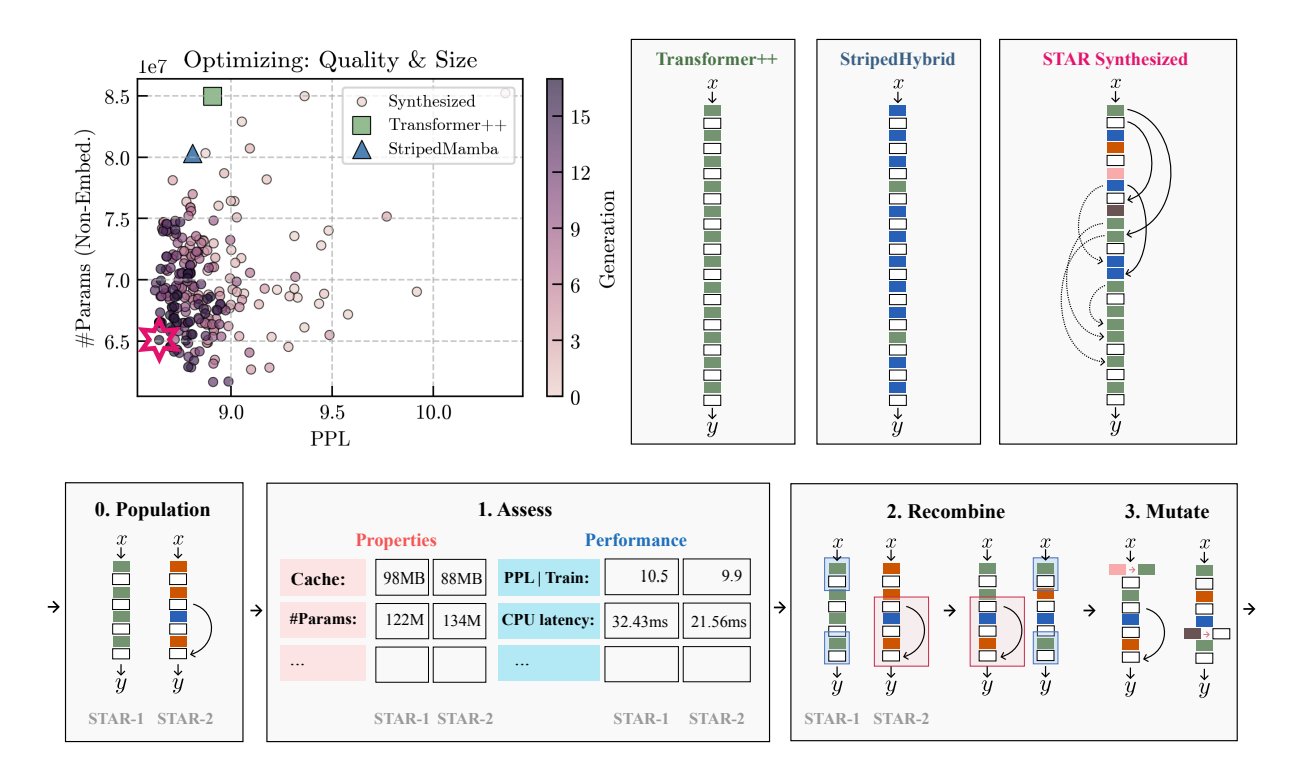
STAR Framework Evolves AI Model Architectures
By
–
STAR: Synthesis of Tailored Architectures Really cool work from my colleagues @liquidai on model architecture. This framework creates populations of architectures and uses evolutionary algorithms to iteratively create better solutions.
-

Peer Review Delays: Nature Article on OpenAI Model Openness
By
–
peer review is *so slow*…what's the point tbh imagine this – a perspective in nature about how open ai models aren't that open submitted in DECEMBER 2023 published a few days ago meanwhile, everyone and their dog knows this
-
AI agents formulating biomedical hypotheses with scientific trustworthiness
By
–
"An AI agent should be able to formulate biomedical hypotheses, critically evaluate them, characterize their uncertainty, and use that as a driver to acquire and refine its scientific knowledge bases in a way that human scientists can trust. AI agents should be designed to adapt
-
LLMs Generating Hypotheses: Creativity vs Next-Token Prediction
By
–
interesting: "Using LLMs as a comparison, generating novel hypotheses requires creativity and grounding in scientific knowledge, whereas generating novel text requires adherence to semantic and syntactic rules,16 so the latter approach aligns well with techniques for next-token
