When capability of a class of Turing complete systems is denied ("a computer/perceptron/transformer can never do X") it poses interesting epistemological and metaphysical challenges, which are unfortunately rarely discussed ("how can anything do X without breaking physics?").
RESEARCH
-
Capability Denialism in AI: Key Thinkers and Skepticism
By
–
Some call capability denialism 'garymarcusing', but Gary Marcus is by no means the inventor of the genre. Prominent denialists include Hubert Dreyfus, James Lighthill, John Searle, Stevan Harnad, Ned Block, Colin McGinn, Rolf Pfeiffer, Noam Chomsky, Roger Penrose, Emily Bender.
-
Capability Denialism: Dismissing AI Performance Potential
By
–
Capability denialism describes the claim that a given approach in Artificial Intelligence can never achieve human performance, often despite some evidence to the contrary. Capability denialism can take many forms, but it usually does not attempt any formal proof.
-
Capability Denialists Reject AI Approach Fundamentally
By
–
Capability denialists generally don't claim that the limitations of the AI system they criticize are due to capacity constraints that could be overcome (eg. with more memory, more compute, more data, algorithmic improvements), but that the entire approach is doomed.
-
Smart Actors Adapt Strategy or Hide Knowledge
By
–
i believe you, but they are also very smart, and likely to change course in the face of evidence. so i'd guess either (a) they will start trying something new or (b) they know something that we don't
-
SAEs criticism fades as interpretability researchers pivot forward
By
–
i don't see value in repeatedly dunking on SAEs, esp after google stated this publicly. interpretability people are already looking for a new paradigm. "The pessimist complains about wind; the optimist expects it to change; the realist adjusts the sails." – William Arthur Ward
-
Negative Understanding of LLMs: A Gary Marcus Critique
By
–
to garymarcus harder than the man himself, you had to acquire not zero but negative understanding of LLMs; respect
-
Balancing Truth, Goodness, Beauty, and Utility in AI Development
By
–
The true, the good, the beautiful, and the useful are all checks on each other. They need to be in harmony for anything worthwhile.
-
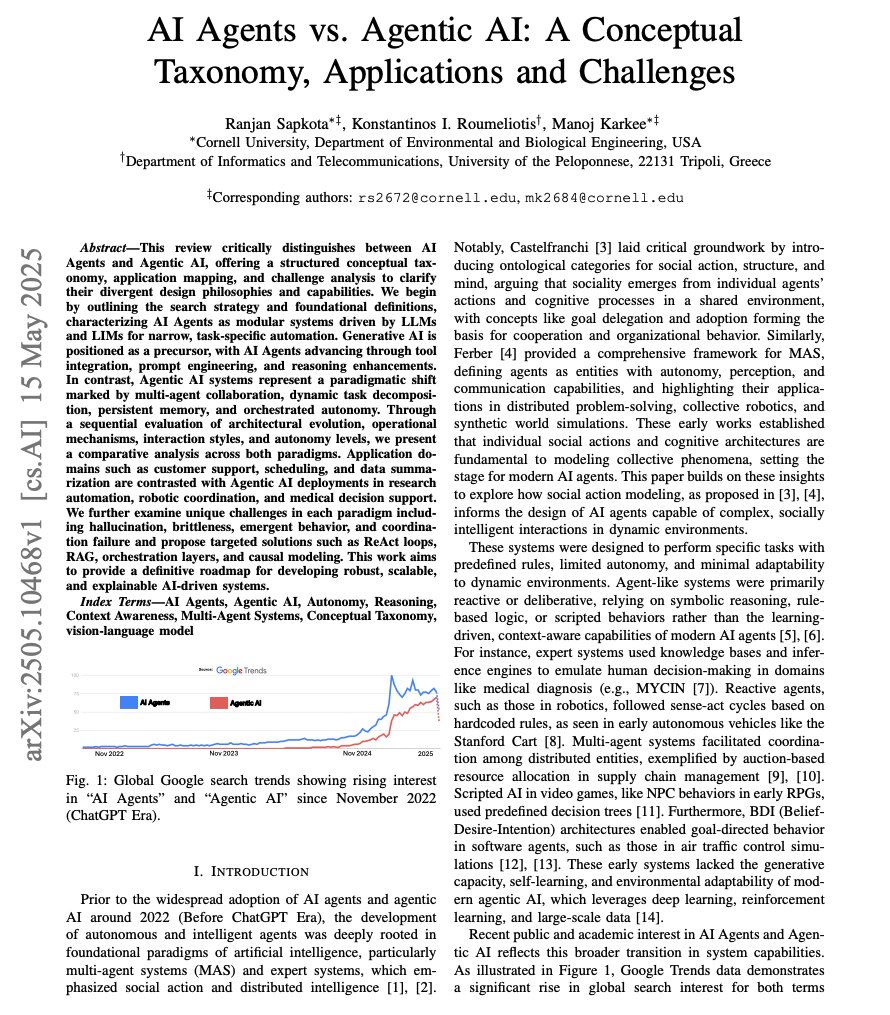
AI Agents vs Agentic AI: Architecture and Capabilities Review
By
–
9. AI Agents vs. Agentic AI This review paper distinguishes AI Agents from Agentic AI, presenting a structured taxonomy and comparing their architectures, capabilities, and challenges.
-

CellVerse: LLM Benchmark for Single-Cell Biology Tasks
By
–
10. CellVerse Introduces a benchmark to evaluate LLMs on single-cell biology tasks by converting multi-omics data into natural language.