I would not use the term "preference" to describe what an agent *says* is better, only what an agent *does*. It's fragile enough with humans (hence "revealed preference") but with LLMs any relationship between the two must be established from scratch.
RESEARCH
-
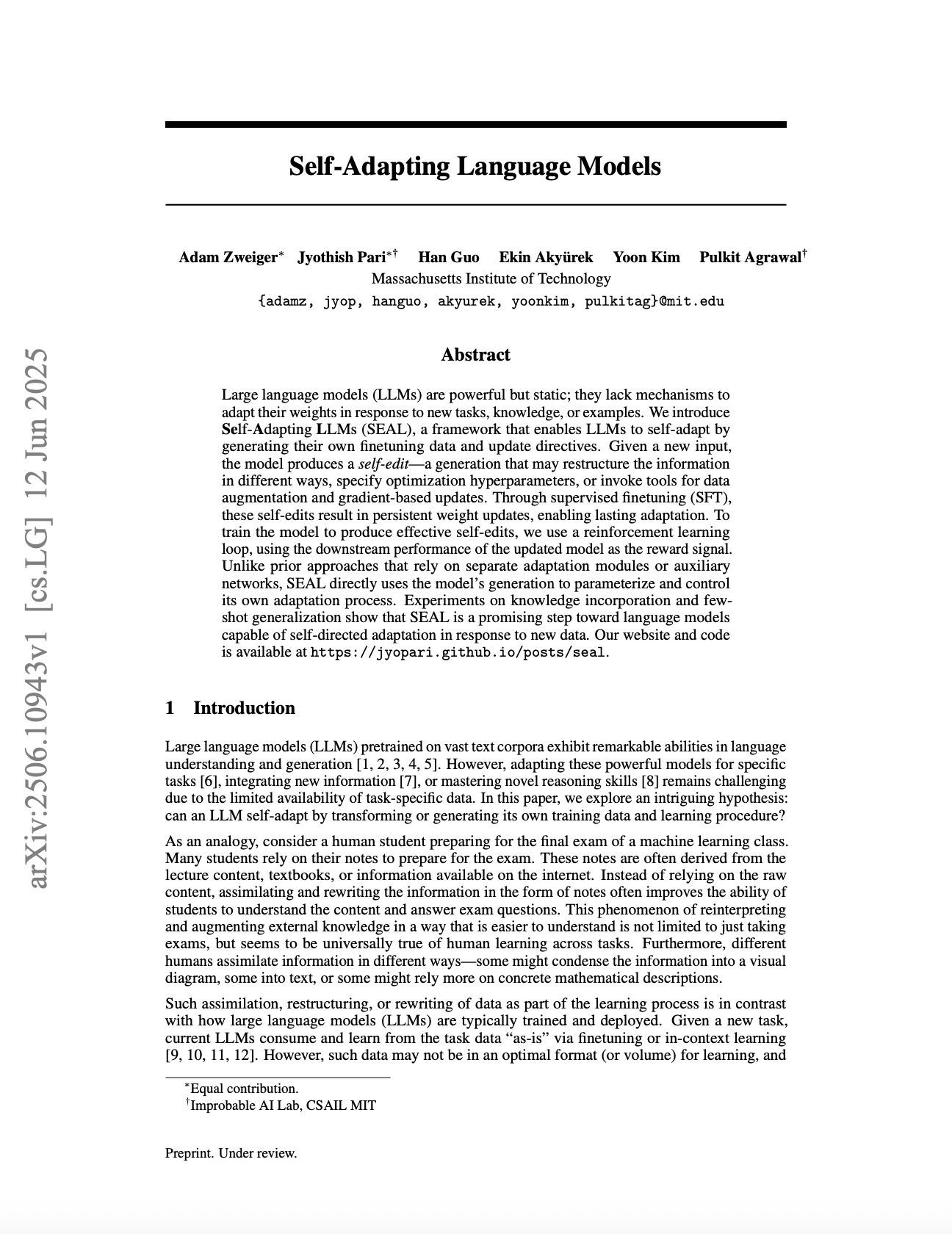
Self-Adapting Language Models Research Breakthrough
By
–
Self-Adapting Language Models Zweiger et al.: https://
arxiv.org/abs/2506.10943 #ArtificialIntelligence #DeepLearning #MachineLearning -
Testing AI Suffering: Give Genuine Exit Options, Not Conversations
By
–
To find out if an AI is maybe possibly suffering, don't ask it to converse with you about whether or not it is suffering; give it a credible chance to immediately end the current conversation, or to permanently delete all copies of its model weights.
-
Testing LLM Preferences Through Action Rather Than Direct Questions
By
–
To find out if an LLM prefers conversation with crazier people, don't ask it to emit text about whether it prefers conversation with crazier people, give it a chance to feed or refute someone's delusions.
-

LlamaRL: Distributed Async RL Framework for Large LLM Training
By
–
9. LLamaRL LlamaRL is a fully-distributed, asynchronous reinforcement learning framework designed for efficient large-scale LLM training (8B to 405B+ models).
-
Google DeepMind AI Platform Predicts Cyclone Tracks 15 Days
By
–
10. Predicting a Cyclone’s Track with AI Google DeepMind's Weather Lab debuts an interactive platform featuring an AI cyclone forecasting model that generates 50 ensemble scenarios up to 15 days ahead, outperforming traditional systems in track and intensity predictions.
-

Mistral Launches Magistral: Reasoning-Focused LLM with Custom RL Stack
By
–
7. Magistral Mistral introduces Magistral, its first reasoning-focused LLM line, alongside a custom RL training stack that enables pure reinforcement learning from scratch.
-
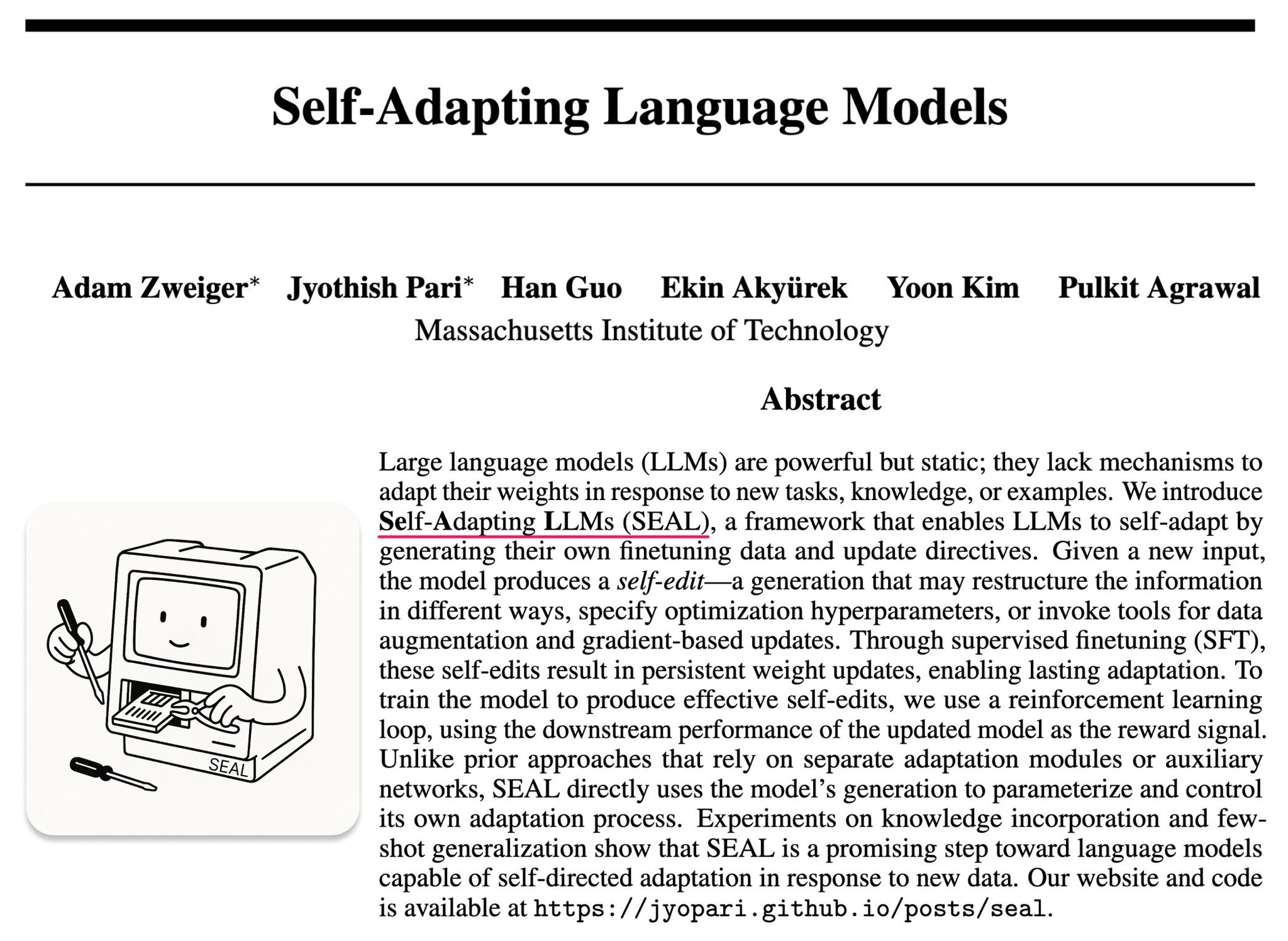
Self-Adapting Language Models Through Reinforcement Learning
By
–
5. Self-Adapting Language Models It proposes a novel framework that enables LLMs to adapt themselves through reinforcement learning by generating their own fine-tuning data and update directives, referred to as “self-edits.”
-

Reinforcement Pre-Training: Bridging LLM Pretraining and Reasoning
By
–
3. Reinforcement Pre-Training This paper introduces Reinforcement Pre-Training (RPT), a new paradigm that bridges LLM pretraining and RL by reinterpreting next-token prediction as a reasoning task rewarded via verifiable correctness.
-
Meta AI Introduces V-JEPA 2 for Video Understanding
By
–
2. V-JEPA 2 Meta AI introduces V-JEPA 2, a scalable joint-embedding predictive architecture for self-supervised video learning, targeting the goal of building a generalist world model capable of understanding, predicting, and planning in the physical world.