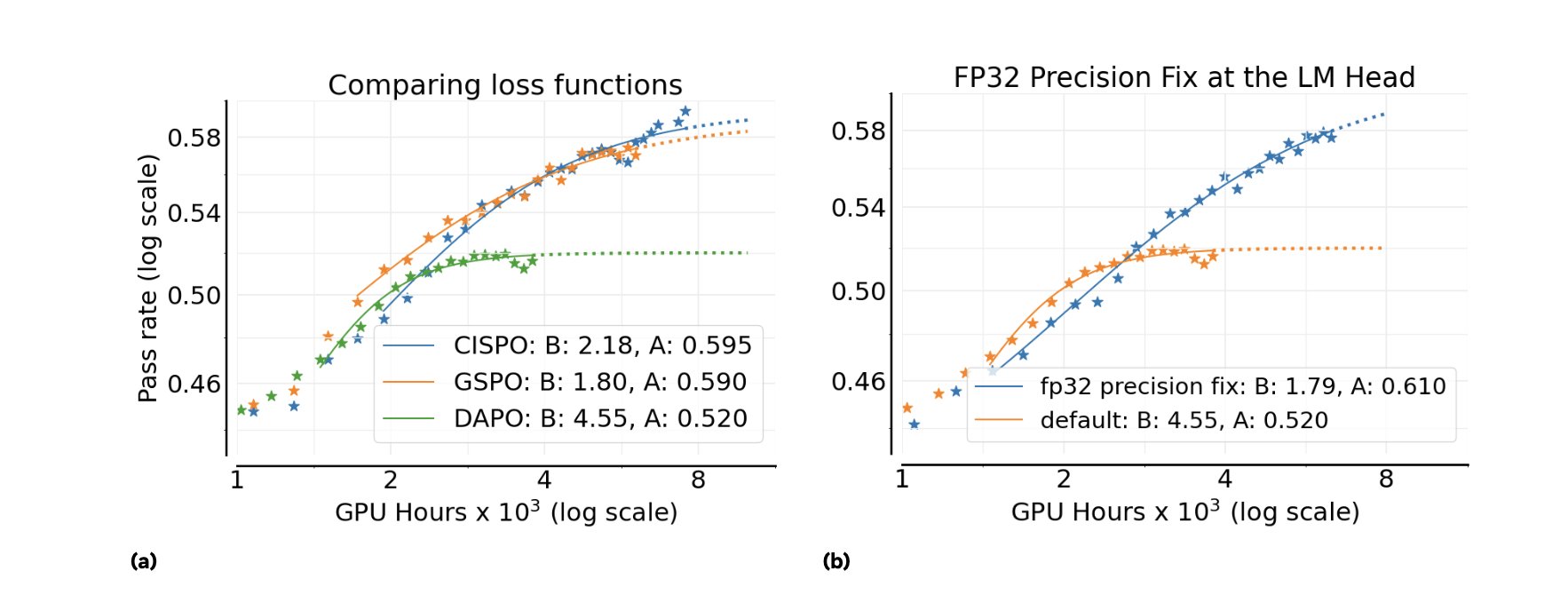
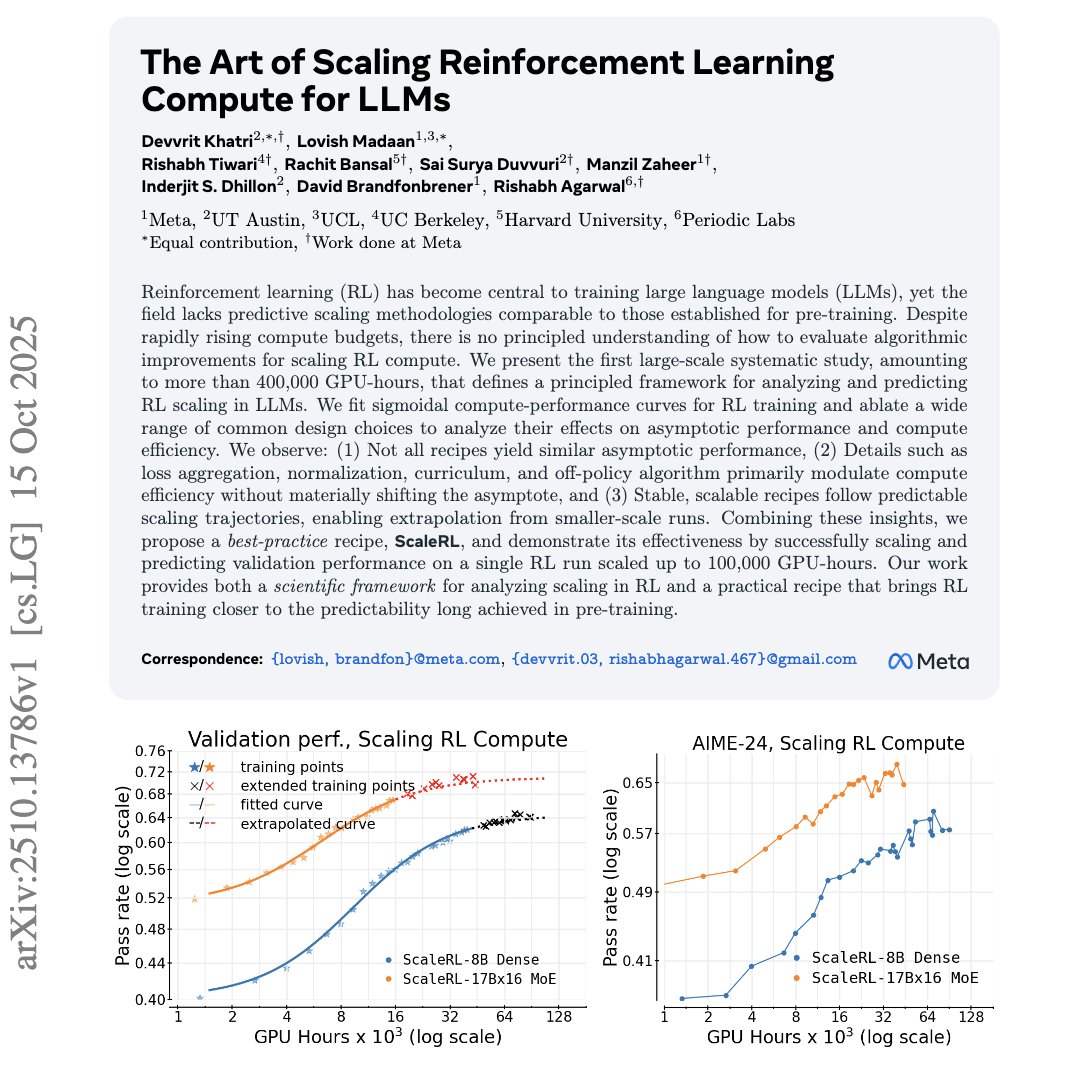
Here’s the wildest part… The same scaling law held across different model sizes, tasks, and sequence lengths. 8B dense model? 17B×16 MoE? Math + code RL tasks? Even 32k-token reasoning traces stayed on-curve. Stable scaling across everything.
RESEARCH
-
Predicting AI Model Performance from Small-Scale Training Runs
By
–
Why this matters: For the first time, we can predict asymptotic performance from small runs. Meta extrapolated 8k GPU-hour curves →
and nailed the actual performance at 100k GPU-hours. That’s predictive scaling in action no more trial and error. -
ScaleRL: Key Components Explained
By
–
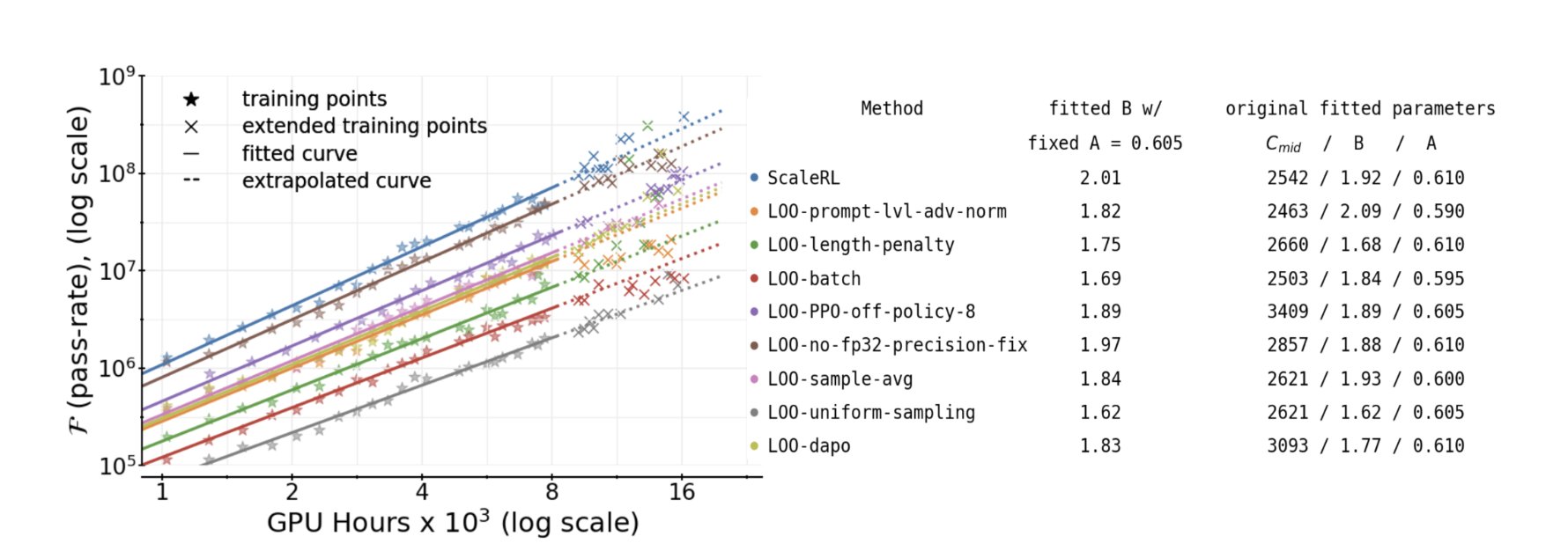
ScaleRL isn’t magic. It’s a recipe of small, proven ingredients: – Pipeline-RL async setup
– FP32 logits for stable gradients
– CISPO loss (clipped importance sampling)
– Prompt-level averaging
– Batch-level normalization
– No-Positive-Resampling (drop “too easy” prompts) -
ScaleRL outperforms in RL scaling tests
By
–
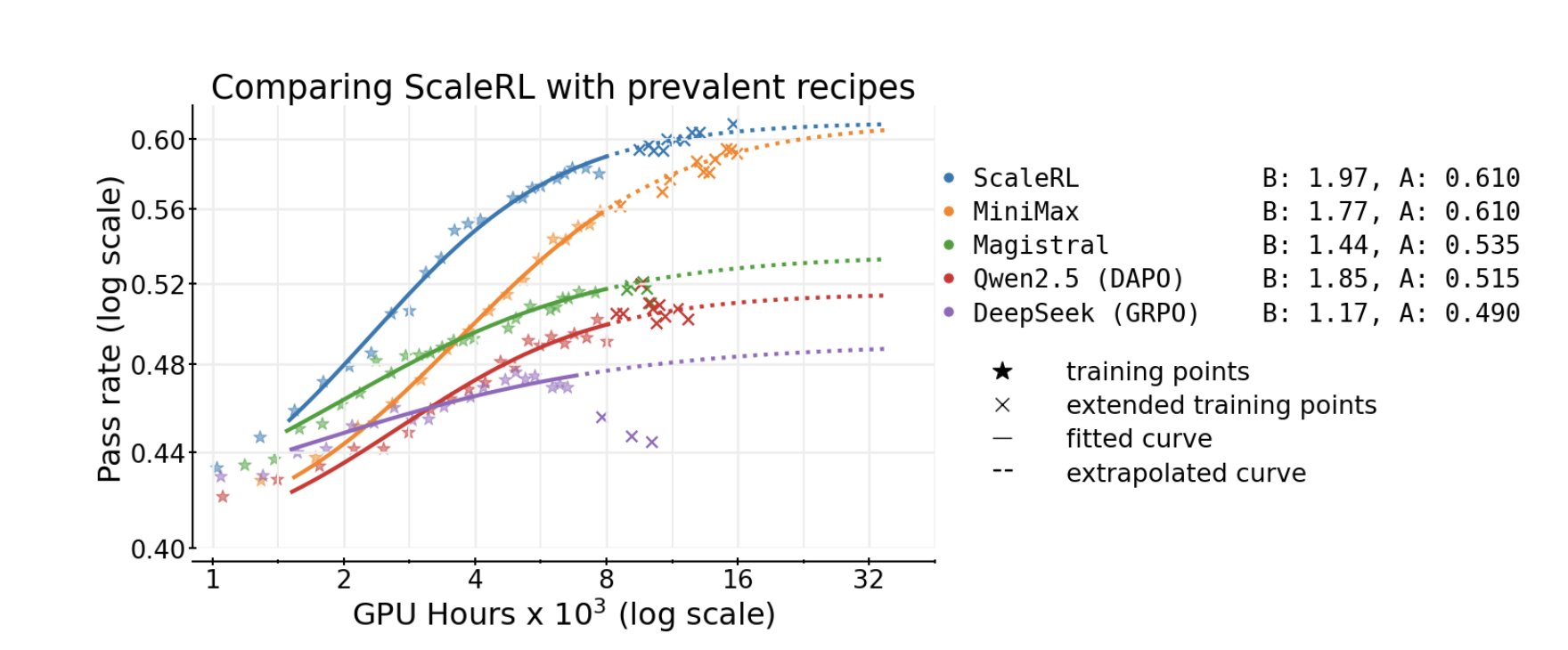
They tested this with 400,000 GPU hours across multiple RL recipes: DeepSeek (GRPO)
Qwen (DAPO)
Magistral
Minimax Result: only ScaleRL showed a stable, predictable trajectory. The others broke scaling laws entirely their curves collapsed. -
RL Performance Follows Sigmoid Scaling Law
By
–
What I found to be useful?? RL performance follows a sigmoid scaling law, not a power law. At small compute, progress is slow. Then it explodes mid-way before flattening at a predictable ceiling. That “S-curve” lets you forecast results before spending 10x more GPU hours.
-
Meta Reveals RL Scaling Challenges
By
–
Today, everyone talks about scaling models. But Meta just proved we’ve been ignoring the harder problem scaling reinforcement learning compute. Turns out, most RL methods don’t scale like pretraining. They plateau early burning millions in compute for almost no gain. ScaleRL
-
Meta’s ScaleRL reveals predictable RL scaling laws
By
–
Holy shit… Meta just cracked the art of scaling RL for LLMs. For the first time ever, they showed that "reinforcement learning follows predictable scaling laws" just like pretraining. Their new framework, 'ScaleRL', fits a sigmoid compute-performance curve that can forecast
-

VIR-Bench: Evaluating Multimodal LLMs on Travel Video Understanding
By
–
How well can multimodal LLMs understand long-distance travel videos? Enter VIR-Bench, a new benchmark with 200 real-world travel videos that challenges models to reconstruct itineraries and reason over extended geospatial-temporal trajectories. Why it matters: mastering
-
AI Innovation Growth: Why Progress Isn’t Guaranteed
By
–
AI And The End Of Progress? Why Innovation May Be More Fragile Than We Think #ArtificialIntelligence could trigger a new wave of #growth or stall #innovation if managed poorly. Economist Carl Benedikt Frey explains why progress is never automatic and why the way we develop and
-

RiskPO: Risk-Based Policy Optimization for LLM Post-Training
By
–
#PapersAccepted by Jiqizhixin
Our report: https://
mp.weixin.qq.com/s/9TbUIT6ed_wO
viVU0GuLqg
… RiskPO: Risk-based Policy Optimization via Verifiable Reward for LLM Post-Training Peking University
Paper: https://
arxiv.org/abs/2510.00911
v1
…
Code: https://
github.com/RTkenny/RiskPO