Rough thinking: neural nets are very tolerant of noise, so chopping off mantissa bits is akin to small amounts of noise. So I'd rather lose nearly all mantissa bits before losing exponent bits. So tried dropping 16 mantissa bits & model trained just fine w/ half the bandwidth.
RESEARCH
-
Mathematics and Science Enter an Exciting New Era
By
–
it’s an exciting time for mathematics (and science broadly)!
-
Human-Centric Metrics for AI Evaluation
By
–
Human-Centric Metrics for AI Evaluation
I use them to ensure trustworthy AI outcomes by:
• Focusing on user needs
• Ensuring fairness
• Enhancing explainability Click below to read more: https://
godofprompt.ai/blog/human-cen
tric-metrics-for-ai-evaluation
… -
The Dependence of LLMs on Wikipedia Data
By
–
LLMs would be really dumb without the existence of Wikipedia.
-

Cognition SWE-1.5 Speed Optimizations Reach 1881 Tokens
By
–
Just deployed additional speed optimizations for @cognition SWE-1.5. The fastest measured request was an eye watering 1,881 token/s per Grafana dashboard.
-
Terminology for AI Risk Advocates: Doomer, Pessimist, Anti-Extinction
By
–
"AI pessimist" or "anti-extinction" could both be quibbled with, but anyone who recognizes the word "doomer" could parse either of these ordinary terms given slight context.
-
FDA-Approved AI Platform Predicts Breast Cancer Risk
By
–
To close out Breast Cancer Awareness month, check out the latest episode of The Health Pulse podcast featuring Dr. Connie Lehman, Co-Founder of Clairity. Her team recently received FDA authorization as the first AI platform that predicts a woman’s five-year risk of developing
-
Frontier Models vs GPT Codex: Speed to Success Comparison
By
–
Even frontier models fail all the time. The difference is we fail in 15 sec and with one more prompt you get the right answer. Time to success = 30 sec. On GPT Codex it takes 22min just to find out it failed.
-
AI Researchers Need Peer-Reviewed Publications for Credibility
By
–
my most controversial opinion is that you shouldn’t trust anyone that calls themself an “AI researcher” but has never gotten a first author paper through peer review
-
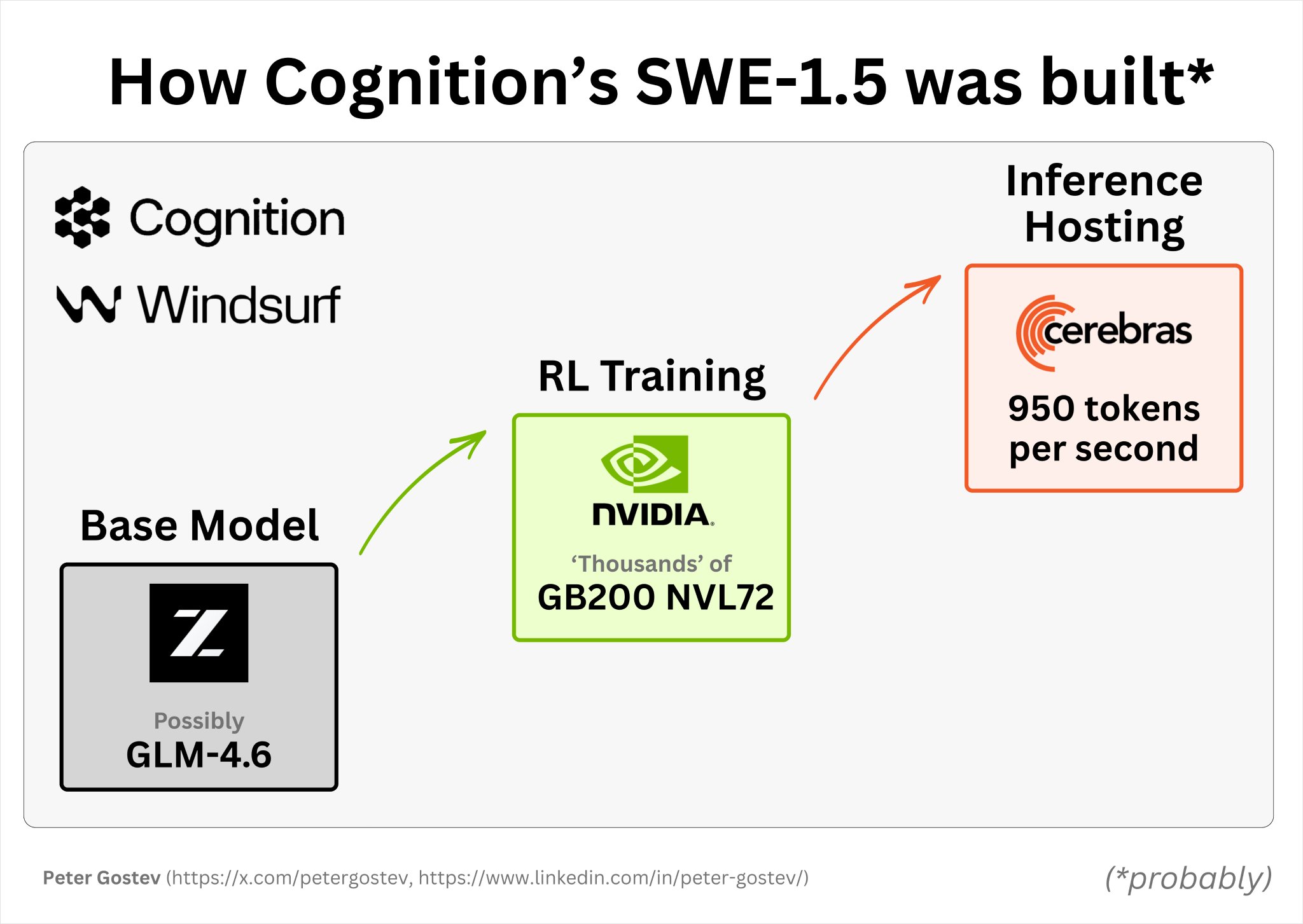
SWE-1.5 Model Architecture: Base Model, RL Training, Inference
By
–
How @cognition /
@windsurf new SWE-1.5 model was built (probably), based on piecing together bits of information that was shared. Base model by: @Zai_org possibly GLM-4.6
RL Training: @nvidia on 'thousands' GB200 NVL72
Inference: @cerebras at 950 tks/sec