
Blood stem cell clones, mistakenly known as CHIP (clonal hematopoiesis of indeterminate potential) because they are common in older adults and are a risk factor for heart disease and cancer. Today @JAMACardio a study in >410,000 @UK_biobank participants highlights the risk for
RESEARCH
-

15 Courses for Understanding Neural Networks
By
–
15 courses for understanding neural networks, v/
@tut_ml
: https://
shorturl.at/60Se8 -
China’s Bold Claims on Cancer Elimination and Longevity Extension
By
–
Delusional thinking about healthspan and longevity, now from China
"In 5 to 10 years nobody will get cancer."
"Living to 150 is definitely realistic. In a few years this will be the reality." @ATHigginsNYT w/ @prof_horvath @gladyshev_lab -
Seven AI Scenarios for Positive Global Change
By
–
7 Great AI Hopes That Could Change The World Beyond risk and disruption, AI brings huge potential for positive change—whether through healthcare, education, sustainability or collaboration. Explore seven hopeful scenarios. Read more https://
bernardmarr.com/7-great-ai-hop
es-that-could-change-the-world/
… #AIForGood -
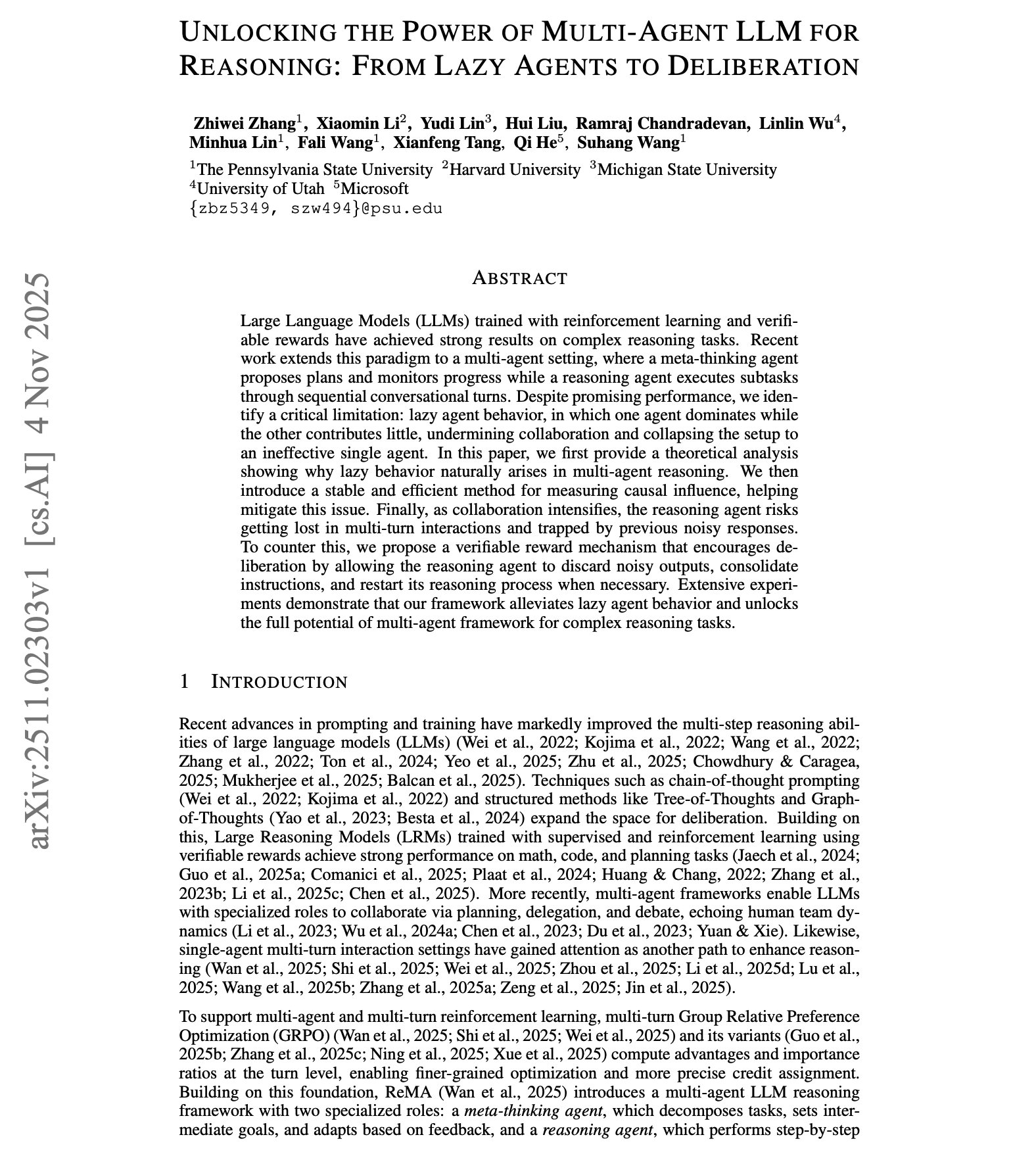
Dr. MAMR: Solving Lazy Agent Problem in Multi-Agent LLM
By
–
10. Unlocking the Power of Multi-Agent LLM for Reasoning Introduces Dr. MAMR, which addresses the “lazy agent” problem in multi-agent LLM reasoning through Shapley-inspired causal influence measurement and verifiable restart mechanisms.
-
Differentiable Artificial Life Framework for Continuous Agent Learning
By
–
9. PD-NCA
— DAIR.AI (@dair_ai) 9 novembre 2025
A differentiable artificial life framework where multiple independent agents continuously update their parameters through gradient descent during simulation, enabling within-lifetime learning and open-ended behavioral change.https://t.co/0omPU6a4Un9. PD-NCA A differentiable artificial life framework where multiple independent agents continuously update their parameters through gradient descent during simulation, enabling within-lifetime learning and open-ended behavioral change.
-

AlphaEvolve: AI Autonomously Discovers Mathematical Constructions
By
–
8. Mathematical Exploration at Scale Terence Tao and colleagues apply AlphaEvolve, an AI system using LLM-guided evolutionary search to autonomously discover mathematical constructions across analysis, combinatorics, geometry, and number theory.
-
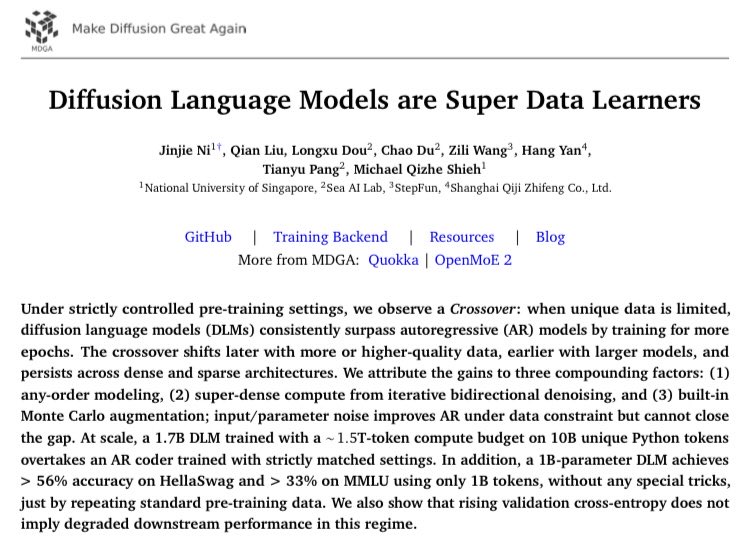
Diffusion Language Models Outperform Autoregressive With Limited Data
By
–
7. Diffusion LMs are Super Data Learners Researchers from NUS, Sea AI Lab, StepFun, and collaborators demonstrate that diffusion language models (DLMs) consistently outperform autoregressive models when unique training data is limited.
-
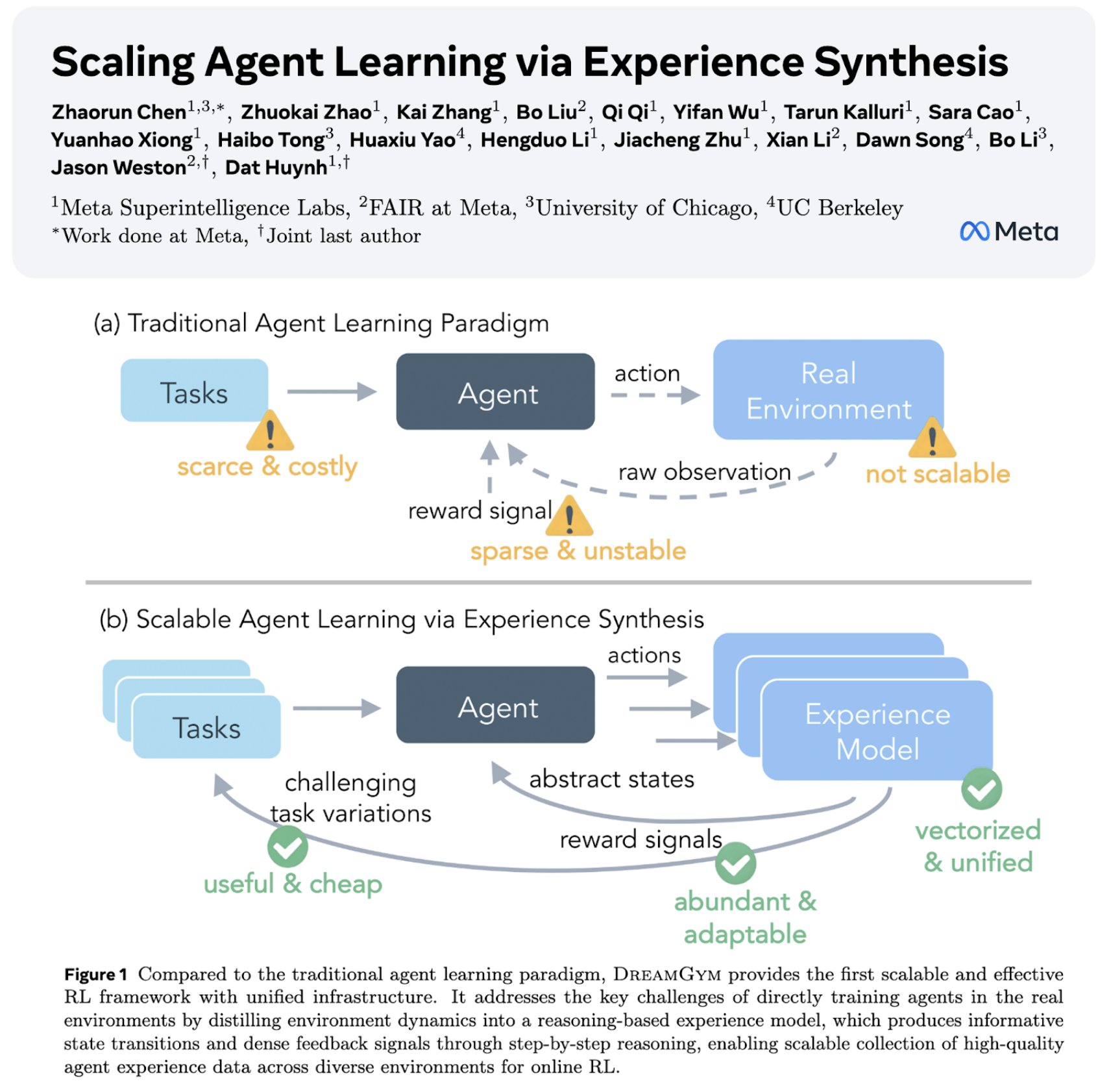
DreamGym: Scaling Agent RL via Experience Synthesis
By
–
3. Scaling Agent RL via Experience Synthesis Meta researchers introduce DreamGym, a unified framework that synthesizes diverse training experiences to enable scalable reinforcement learning for LLM agents without costly real-environment rollouts.
-
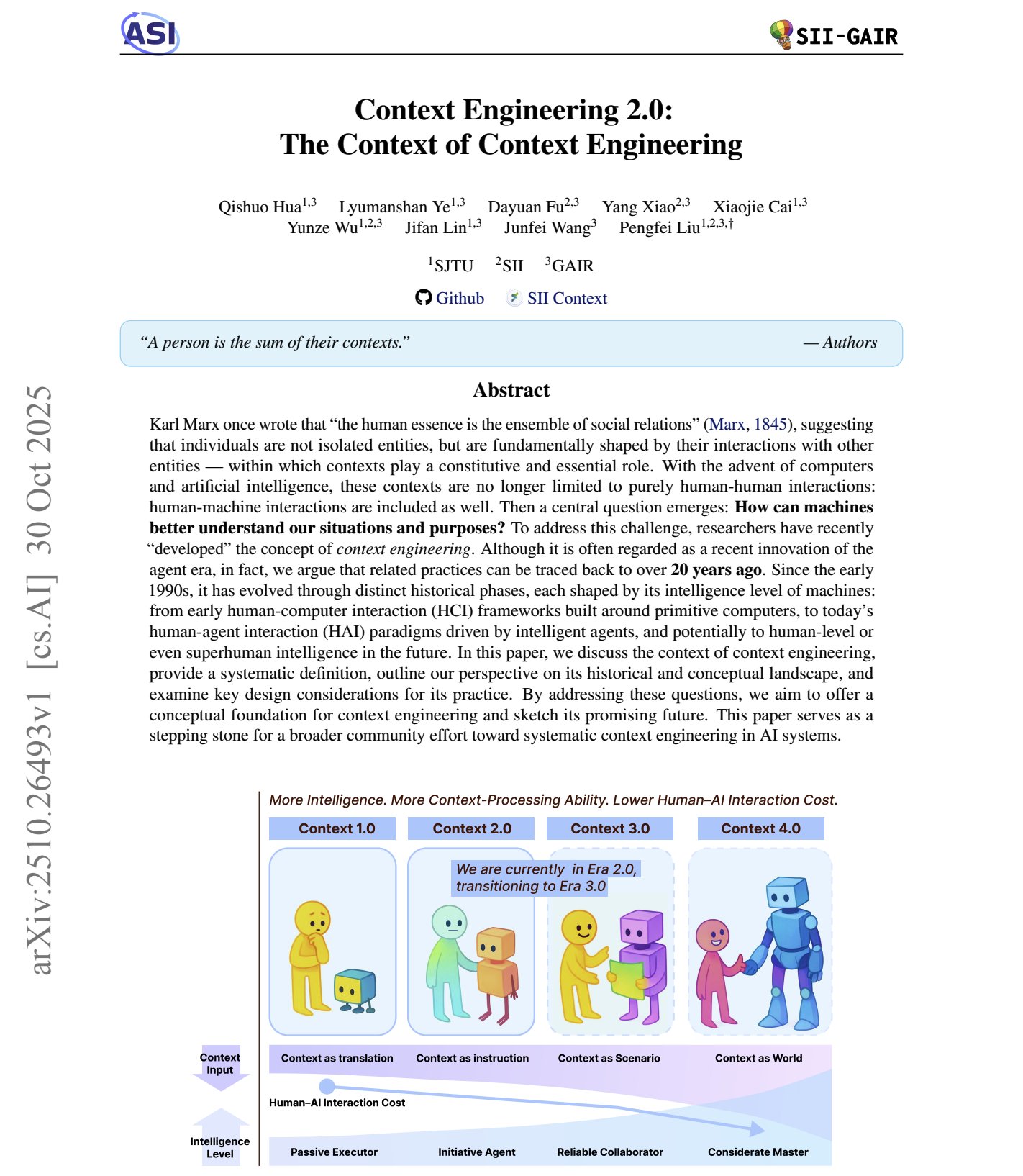
Context Engineering Evolution: From Computing 1.0 to Intelligent Agents
By
–
2. Context Engineering 2.0 Traces the 20+ year evolution of context engineering, reframing it as a fundamental challenge in human-machine communication spanning from primitive computing (Era 1.0) to today’s intelligent agents (Era 2.0) and beyond.