This article by Laura Hassink, Managing Director, Journals, Elsevier, argues that as India’s research output has grown rapidly, an equal focus must be placed on research integrity to ensure quality and credibility. https://
bit.ly/4bz5s8x
#Research #Researchers
RESEARCH
-
India’s Research Growth Demands Focus on Integrity Quality
By
–
-
Voxtral Transcription Quality Improvements and FFT Fixes
By
–
Voxtral (from @MistralAI) transcription quality is quite incredible, the way it handles the punctation and all the rest, makes transcribed audio messages so much more understandable. I implemented a few fixes in the FFT and now there is no longer a skipped tokens issue in voxtral.c
→ View original post on X — @guillaumelample, 2026-02-06 10:11 UTC
-
Great points by Demis Hassabis in discussion
By
–
Great points by @demishassabis in this discussion. … https://
youtu.be/02YLwsCKUww?si
=WPRexUQFKL6u0Lch
… via @YouTube -
Decoupled Diffusion Inverse Solver: Solving PDEs with Minimal Data
By
–
I started in physics with numerical simulations, then accidentally found my way into ML. This Caltech SURF project let me bring those ideas back to physics beyond textbooks. The journey was nonlinear, full of surprising empirical and theoretical discoveries. Grateful for the guidance and opportunity. A formative experience at the frontier of computational physics × generative models. Prof. Anima Anandkumar (@AnimaAnandkumar) Solving Inverse PDEs with 1% Paired Data: Introducing Decoupled Diffusion Inverse Solver We propose a data-efficient and physics-aware diffusion framework for solving inverse problems on function spaces. In scientific machine learning, solving inverse problems requires costly and limited data acquisition from physical systems. Existing joint-embedding diffusion models require massive paired training data, as they represent the underlying physics implicitly through statistical correlations. In this work, we identify that under data scarcity, the observation-induced guidance signal vanishes during posterior sampling, making reconstruction impossible. Our Solution: We propose a decoupled design against joint-embedding: an unconditional diffusion learns the coefficient prior, while a neural operator explicitly models the forward PDE for guidance. This enables (1) superior data efficiency (2) effective physics-informed learning and sampling. Performance: Achieves state-of-the-art results on Navier-Stokes, Helmholtz, and Poisson benchmarks, improving spectral error by 54% on average. Data Efficiency: DDIS maintains high accuracy even when limited to just 1% of paired training data, outperforming joint models by 40% in L2 error. Robustness: Theoretical guarantees that avoid the guidance attenuation identified in joint-embedding methods. Check out the paper for the full theoretical analysis and experiments! arxiv.org/abs/2601.23280 Thomas Lin , @jiacheny7, Alex Chiang, Julius Berner, #MachineLearning #DiffusionModels #InverseProblems #PDE #NeuralOperators @Caltech #AI4Science — https://nitter.net/AnimaAnandkumar/status/2019510545242890370#m
→ View original post on X — @animaanandkumar, 2026-02-06 03:52 UTC
-
Hinton endorses comprehensive 2026 International AI Safety Report
By
–
This is a great report that provides a thoughtful, detailed and very well researched description of the risks of AI. It is essential reading for anyone who wants to write or talk about AI risks. https://t.co/uwuGbbFdBX
— Geoffrey Hinton (@geoffreyhinton) 5 février 2026This is a great report that provides a thoughtful, detailed and very well researched description of the risks of AI. It is essential reading for anyone who wants to write or talk about AI risks. Yoshua Bengio (@Yoshua_Bengio) Today we’re releasing the International AI Safety Report 2026: the most comprehensive evidence-based assessment of AI capabilities, emerging risks, and safety measures to date. 🧵 (1/17) — https://nitter.net/Yoshua_Bengio/status/2018673247651270958#m
→ View original post on X — @geoffreyhinton, 2026-02-05 22:02 UTC
-
Nuclear AI Security: New Research Project Unveiled
By
–
New Research Project on Computer Security For Nuclear AI
#AI #AIio #AIInnovation #ML #DataScience #Futureofwork @Scobleizer @AndrewYNg @drfeifei @KirkDBorne @fchollet @rowancheung @antgrasso -
Critique of video generation model lacking world model
By
–
C’est de la pure merde. Ca semble pas du tout etre un world model.
— Defend Intelligence (Anis Ayari) (@DFintelligence) 5 février 2026
Mais juste un modèle de génération video image par image avec des « inputs » qui se transforme en prompt pour conditionner une image suivante qui marche quasiement jamais.
Aussi ça ressemble à tout sauf à du… https://t.co/3OCqzUEznvIt's pure crap. It doesn't seem like a world model at all. But just a video generation model frame by frame with "inputs" that turn into a prompt to condition the next image, which almost never works. Also, it looks like anything but real-time. Sure, you gotta start somewhere,
-
Decoupled Diffusion Solver for Inverse PDE Problems
By
–
Solving Inverse PDEs with 1% Paired Data: Introducing Decoupled Diffusion Inverse Solver We propose a data-efficient and physics-aware diffusion framework for solving inverse problems on function spaces. In scientific machine learning, solving inverse problems requires costly
-

Claude Opus 4.6 sets new SOTA on ARC-AGI-2 benchmark
By
–
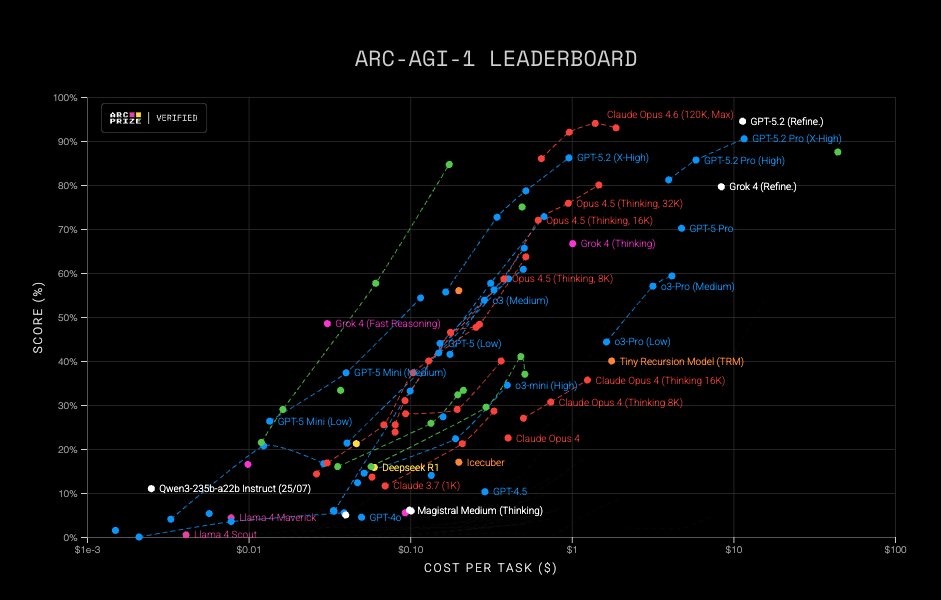
Claude Opus 4.6 is a new SOTA model on ARC-AGI-2 benchmark with 68.8% achievement. The next leap
-
New AI Models Released, Lex Heading to SF to Build
By
–
Claude Opus 4.6 & GPT Codex 5.3 out today, and OpenClaw recently. And I'm sure xAI/Grok & Google/Gemini will soon be out with more. What an exciting time to build stuff! I'm walking around with a smile, happy & sleep-deprived 🤣 Next week, I'll come to SF/Bay Area for a few days/weeks/months to hang out & build some stuff 😉 Looking to focus on programming, and contribute to good engineering teams. But occasionally socialize, in as much as my introvert brain allows. 2026 is going to be fun (and wild), LFG! PS: I'm doing a deep-dive podcast on OpenClaw with its creator (@steipete) soon. Let me know if you have questions.
→ View original post on X — @lexfridman, 2026-02-05 20:25 UTC