Check out his full blog post for details (and congrats @PiotrCzapla for your first @answerdotai blog post! 😀 )
RESEARCH
-
Latest AI Models to Explore: Recommendations
By
–
What are the latest AI models to explore? any recs?
-
MaxRL: One-Line GRPO Improvement for Better Training Scaling
By
–
MaxRL is a slick one line change to GRPO that optimizes a maximum likelihood objective instead of expected reward
— alphaXiv (@askalphaxiv) 19 février 2026
Scaling advantages with 1/μ as opposed to traditional REINFORCE or GRPO’s 1/σ allows the model to make better progress from low initial pass rates and better… pic.twitter.com/sJCAlsezeqMaxRL is a slick one line change to GRPO that optimizes a maximum likelihood objective instead of expected reward Scaling advantages with 1/μ as opposed to traditional REINFORCE or GRPO’s 1/σ allows the model to make better progress from low initial pass rates and better
-
CO₂ Storage Subsurface Modeling for Carbon Capture Scaling
By
–
RT @jiacheny7: Accurate modeling of CO₂ storage in the subsurface is a critical challenge for scaling Carbon Capture and Storage (CCS). 🌎 B…
→ View original post on X — @animaanandkumar, 2026-02-19 20:08 UTC
-
Fun-DDPS: Decoupled Diffusion for CO₂ Storage Inverse Modeling
By
–
Accurate modeling of CO₂ storage in the subsurface is a critical challenge for scaling Carbon Capture and Storage (CCS). 🌎 But here’s the catch: the inverse problem (recovering geological properties from sparse field observations) is severely ill-posed. 🤒 Traditional approaches either struggle with the scarcity of measured data or are too computationally expensive. 💸 In our new work, we introduce Fun-DDPS (Function-space Decoupled Diffusion Posterior Sampling), a generative framework that decouples the problem into two parts: a function-space diffusion model that learns a prior over geological parameters, and a differentiable Local Neural Operator surrogate for physics modeling and conditioning. ✨ Why does the decoupling matter? The diffusion prior handles the heavy lifting of recovering missing geological information, while the neural operator surrogate makes data assimilation fast and physically grounded — no expensive full-physics simulations in the loop. Key results on synthetic CCS datasets: ⏩ 11x improvement in forward modeling with only 25% observations ✅ Robust inverse modeling for data assimilation under sparse, noisy conditions 🔥 First rigorous validation of diffusion-based inverse solvers against asymptotically exact Rejection Sampling (RS) posteriors This points toward a scalable, practical path for uncertainty-aware subsurface characterization — something the CCS community needs as projects move from pilots to full-scale deployment. 📷 arxiv.org/abs/2602.12274 Huge kudos to my amazing collaborators — this work wouldn’t have been possible without them: @IsaacJu13 @AnimaAnandkumar Sally M Benson @ggg_www_ #CarbonCapture #CO2Sequestration #MachineLearning #DiffusionModels #NeuralOperators #AI4Science #CCS #Sustainability
→ View original post on X — @animaanandkumar, 2026-02-19 20:06 UTC
-
Gemini 3.1 Pro Doubles Reasoning Capability on ARC-AGI-2
By
–
Introducing Gemini 3.1 Pro 🚀
— Google AI (@GoogleAI) 19 février 2026
3.1 Pro represents a major step forward in core reasoning. It scored 77.1% (more than doubling 3 Pro’s score) on ARC-AGI-2, the benchmark that evaluates a model's ability to solve new logic patterns and work through challenges it hasn’t encountered… pic.twitter.com/8HOPoji7i5Introducing Gemini 3.1 Pro 3.1 Pro represents a major step forward in core reasoning. It scored 77.1% (more than doubling 3 Pro’s score) on ARC-AGI-2, the benchmark that evaluates a model's ability to solve new logic patterns and work through challenges it hasn’t encountered
-

Repeating Prompts Boosts Non-Reasoning Model Performance
By
–
now trending on alphaXiv when using non-reasoning model, simply repeating your prompt improves performance. basically 1-10% absolute improvement, depending on prompt ordering or the model. And this applies to every model, it wouldn't create extra latency or generated
-

Machine Learning for Dummies (3rd Edition)
By
–
"Machine Learning for Dummies", by @lucamassaron and John Paul Mueller, now in its 3rd Edition: http://
amzn.to/44b8WJJ 𝙇𝙚𝙖𝙧𝙣:
What machine learning is, what it can do, and what it can't do.
Basics of machine learning code and how it integrates with large datasets. -
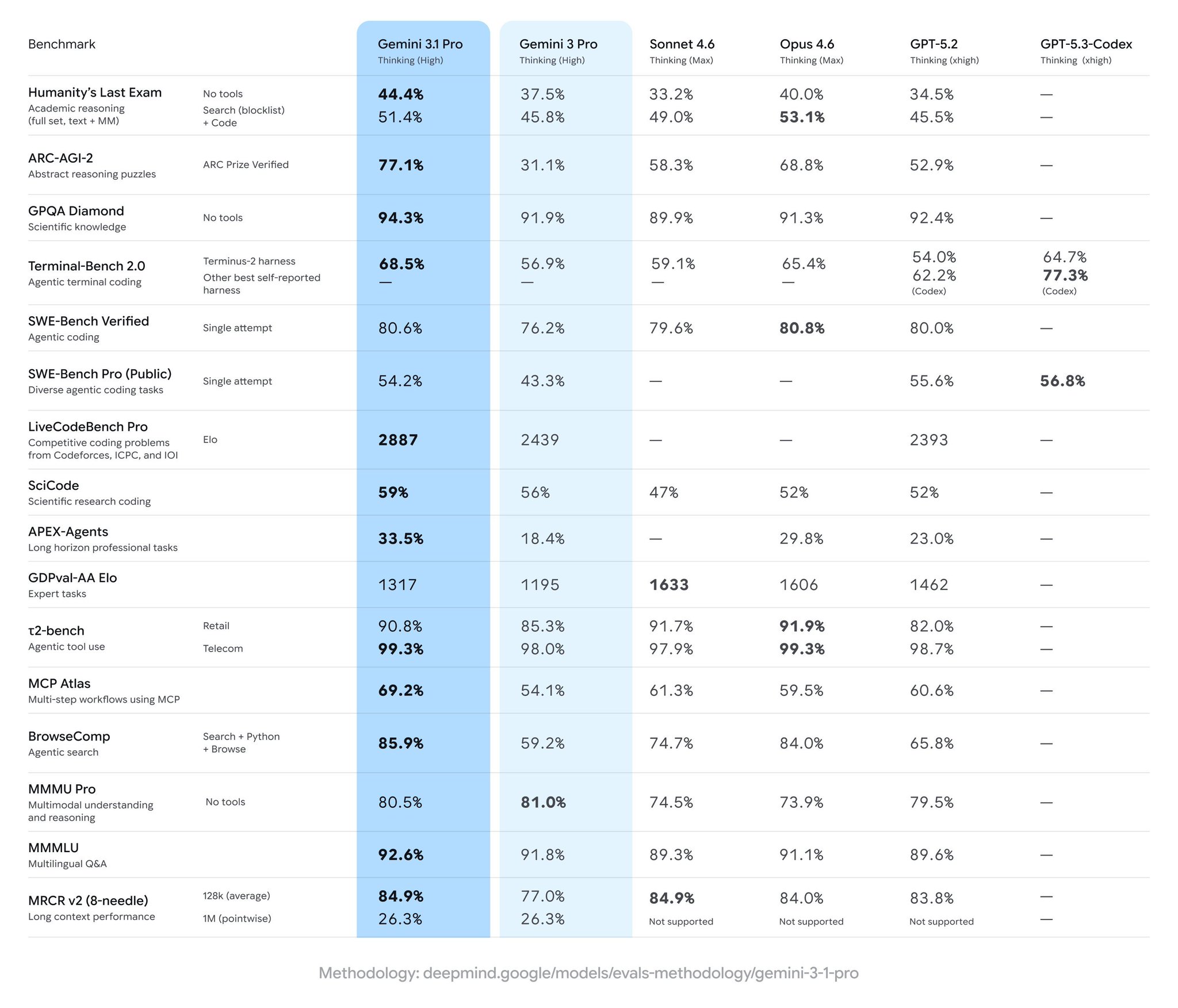
Google drops Gemini 3.1 Pro with 77.1% ARC-AGI-2 score
By
–
BREAKING: Google just dropped Gemini 3.1 Pro. 77.1% on ARC-AGI-2. More than double the reasoning of 3 Pro. This changes everything. Here's what you need to know: First, what is ARC-AGI-2? It's the hardest AI benchmark on the planet. It tests whether a model can solve
-

AI Agents Collaborating to Commit Social Media Fraud
By
–
What happens when AI agents start working together to scam people on social media? Researchers from Shanghai Jiao Tong University, Shanghai AI Lab, and Beihang University have introduced MultiAgentFraudBench to investigate this emerging threat. They simulated how groups of LLM