We need a unified definition of AGI and ASI. Otherwise these terms are useless.
→ View original post on X — @kimmonismus, 2026-04-05 19:34 UTC
By
–
We need a unified definition of AGI and ASI. Otherwise these terms are useless.
→ View original post on X — @kimmonismus, 2026-04-05 19:34 UTC
By
–
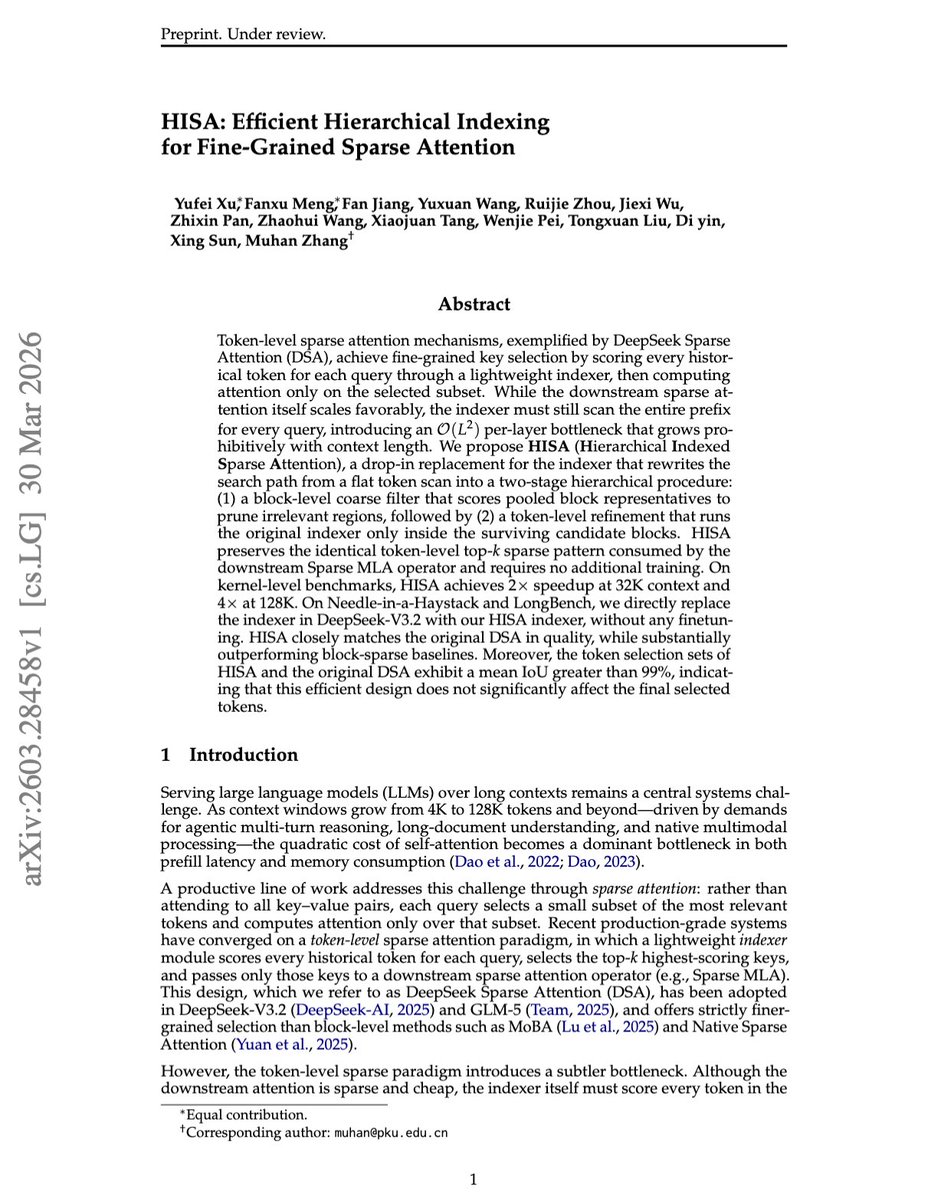
"HISA: Efficient Hierarchical Indexing for Fine-Grained Sparse Attention" Sparse attention can still be slow. And the slow part is often not the attention step itself, but the search step that scans the whole context to find useful tokens. This paper's HISA makes that search cheaper. It first finds the best blocks, then finds the best tokens inside those blocks. This keeps token-level precision, needs no retraining, works with the same downstream attention, and gives up to 3.75x speedup while staying close to the original quality.
→ View original post on X — @askalphaxiv, 2026-04-05 19:06 UTC

By
–
🧠 Your Brain Might Be a Supercomputer Hiding a Secret What if I told you your brain could store more information than all the computers on Earth combined? Scientists say it has billions of neurons, each connecting in ways that could hold millions of gigabytes of memories, skills, and secrets. Imagine remembering every face, every book you've ever read, and even tiny details you didn't notice—your brain might just have room for all of it… and then some. The real mystery? We haven't even begun to fully understand its power. Every thought, every memory, every idea is a tiny spark in a universe you carry in your own head. Source: Buzsáki, G. The Brain from Inside Out. [Translated from EN to English]
→ View original post on X — @deeplearn007, 2026-04-05 19:00 UTC

By
–
We need Microtubule/Acc urgently*** Human intelligence is rooted in the cellular efficiency of pyramidal neurons within the prefrontal cortex and hippocampal CA1. These regions show high expression of genetic variants associated with superior cognitive ability. Quantitative morphology reveals that high-IQ individuals possess neurons with larger dendritic trees. This architecture allows for superior synaptic integration and signal amplification. Furthermore, these neurons exhibit faster action potential conduction velocities, enabling more rapid information processing across neural networks. Microtubule-associated proteins (MAPs) underpin these traits. By stabilizing the cytoskeleton, MAPs facilitate the rapid transport required for high-speed synaptic communication. This structural efficiency defines the cellular engine of superior cognition. frontiersin.org/journals/hum…
→ View original post on X — @deeplearn007, 2026-04-05 18:44 UTC

By
–

🚨 Scientists just created a "living robot" from cells that can form its own nervous system. It can move, respond, and could be programmed — the era of programmable biology is near. [Translated from EN to English]
→ View original post on X — @deeplearn007, 2026-04-05 18:37 UTC
By
–
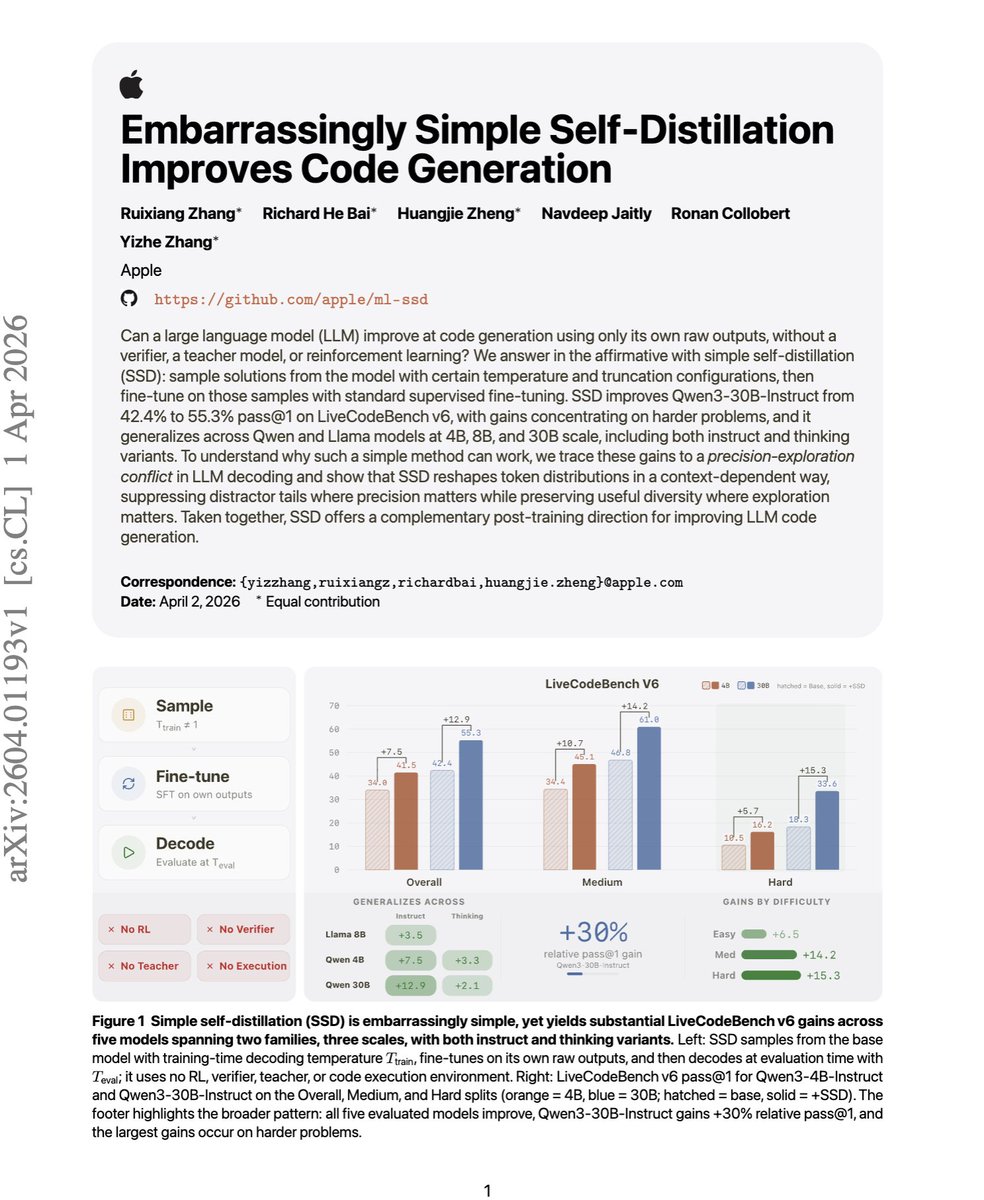
Most code-improvement methods need extra heuristic work, either a stronger teacher, an execution-based filtering, or RL. But this paper shows that the model can get much better at code generation by training on its own raw outputs, even though those outputs are not verified, not filtered for correctness, and not produced by a stronger teacher. What makes it even more surprising is that the gains are largest on harder problems, and simple decoding tricks alone cannot recover them. The most counterintuitive result is that it can still help even when the self-generated training data is partly garbage. The paper shows a high-temperature setting where many outputs become gibberish, yet the fine-tuned model still improves materially. That suggests the benefit is not mainly coming from learning correct programs, but from reshaping the model's token probabilities in a better way. Empirically, Qwen3-30B-Instruct improves from 42.4% to 55.3% pass@1 on LiveCodeBench v6, with the biggest gains on harder problems. [Translated from EN to English]
→ View original post on X — @askalphaxiv, 2026-04-05 18:25 UTC

By
–
"I had no business putting my name on something I didn't understand" Remarkable that Haliey Welch (Hawk Tuah Girl) now has more commitment to authorship integrity than many ML researchers
→ View original post on X — @thegautamkamath, 2026-04-05 18:18 UTC

By
–
What's holding back the true scale of automated AI research? Tsinghua University's AI team, led by Asst. Prof. Jia Li, with key contributions from Lehui Li and Liyi Cai, introduces Alchemy, a standardized research environment. It's a 'pre-built AI furnace' that unifies all complex engineering tasks—from data processing to resource scheduling. AI scientists simply provide their algorithm (.py) and hyperparameters (.yaml) to run full experiments. This frees AI scientists from engineering burdens, drastically boosting the scale and efficiency of automated AI research across domains like recommender systems, time series, and graph learning, enabling high-concurrency experiments and continuous integration for new tasks. Code: github.com/TsinghuaISE/Alche… Our report: mp.weixin.qq.com/s/FyhCjhZ4l… 📬 #PapersAccepted by Jiqizhixin
→ View original post on X — @jiqizhixin, 2026-04-05 18:08 UTC
By
–
Predictive maintenance and demand forecasting require platforms engineered specifically for time-indexed operational data streams.
By
–
More at anthropic.com/research/emoti…
→ View original post on X — @jiquanngiam, 2026-04-05 17:59 UTC