AI Dynamics

Global AI News Aggregator

About

RESEARCH

  • The AI Capability Gap: Technical Users vs General Public Understanding

    After building with bleeding edge AI I get this separation that @karpathy lays out deeply. Family and friends have no idea how good the bleeding edge is. Completely uneducated about AI. Andrej Karpathy (@karpathy) Judging by my tl there is a growing gap in understanding of AI capability. The first issue I think is around recency and tier of use. I think a lot of people tried the free tier of ChatGPT somewhere last year and allowed it to inform their views on AI a little too much. This is a group of reactions laughing at various quirks of the models, hallucinations, etc. Yes I also saw the viral videos of OpenAI's Advanced Voice mode fumbling simple queries like "should I drive or walk to the carwash". The thing is that these free and old/deprecated models don't reflect the capability in the latest round of state of the art agentic models of this year, especially OpenAI Codex and Claude Code. But that brings me to the second issue. Even if people paid $200/month to use the state of the art models, a lot of the capabilities are relatively "peaky" in highly technical areas. Typical queries around search, writing, advice, etc. are *not* the domain that has made the most noticeable and dramatic strides in capability. Partly, this is due to the technical details of reinforcement learning and its use of verifiable rewards. But partly, it's also because these use cases are not sufficiently prioritized by the companies in their hillclimbing because they don't lead to as much $$$ value. The goldmines are elsewhere, and the focus comes along. So that brings me to the second group of people, who *both* 1) pay for and use the state of the art frontier agentic models (OpenAI Codex / Claude Code) and 2) do so professionally in technical domains like programming, math and research. This group of people is subject to the highest amount of "AI Psychosis" because the recent improvements in these domains as of this year have been nothing short of staggering. When you hand a computer terminal to one of these models, you can now watch them melt programming problems that you'd normally expect to take days/weeks of work. It's this second group of people that assigns a much greater gravity to the capabilities, their slope, and various cyber-related repercussions. TLDR the people in these two groups are speaking past each other. It really is simultaneously the case that OpenAI's free and I think slightly orphaned (?) "Advanced Voice Mode" will fumble the dumbest questions in your Instagram's reels and *at the same time*, OpenAI's highest-tier and paid Codex model will go off for 1 hour to coherently restructure an entire code base, or find and exploit vulnerabilities in computer systems. This part really works and has made dramatic strides because 2 properties: 1) these domains offer explicit reward functions that are verifiable meaning they are easily amenable to reinforcement learning training (e.g. unit tests passed yes or no, in contrast to writing, which is much harder to explicitly judge), but also 2) they are a lot more valuable in b2b settings, meaning that the biggest fraction of the team is focused on improving them. So here we are. — https://nitter.net/karpathy/status/2042334451611693415#m

    → View original post on X — @scobleizer, 2026-04-09 20:17 UTC

  • Sonnet Calling Opus Improves Performance and Reduces Costs
    Sonnet Calling Opus Improves Performance and Reduces Costs

    Allowing Sonnet to "phone a friend" (i.e. call Opus) increases performance while also reducing total cost since it reduces tokens spent trying to solve more complex tasks

    → View original post on X — @alexalbert__

  • Nous Research Hermes Competitor Revolution Discussion Event

    This really was packed with information about @NousResearch’s @OpenClaw competitor, Hermes. Robert Scoble (@Scobleizer) The revolution that @openclaw started continues. Learn about @NousReseach and its Hermes competitor. Starts at 4 p.m. Pacific Time (in about 20 minutes). nitter.net/i/spaces/1DGleEpaXLrJL — https://nitter.net/Scobleizer/status/2042009419094106350#m

    → View original post on X — @scobleizer, 2026-04-09 19:46 UTC

  • ByteDance In-Place Test-Time Training Updates Model Weights
    ByteDance In-Place Test-Time Training Updates Model Weights

    New Test-Time Training/Continual Learning technique from ByteDance Seed "In-Place Test-Time Training" It lets the model update part of its own MLP weights during inference to store useful information from the current prompt. With no new exotic architecture, it simply just

    → View original post on X — @askalphaxiv

  • Meta Neural Computer: Model as Integrated Computing System
    Meta Neural Computer: Model as Integrated Computing System

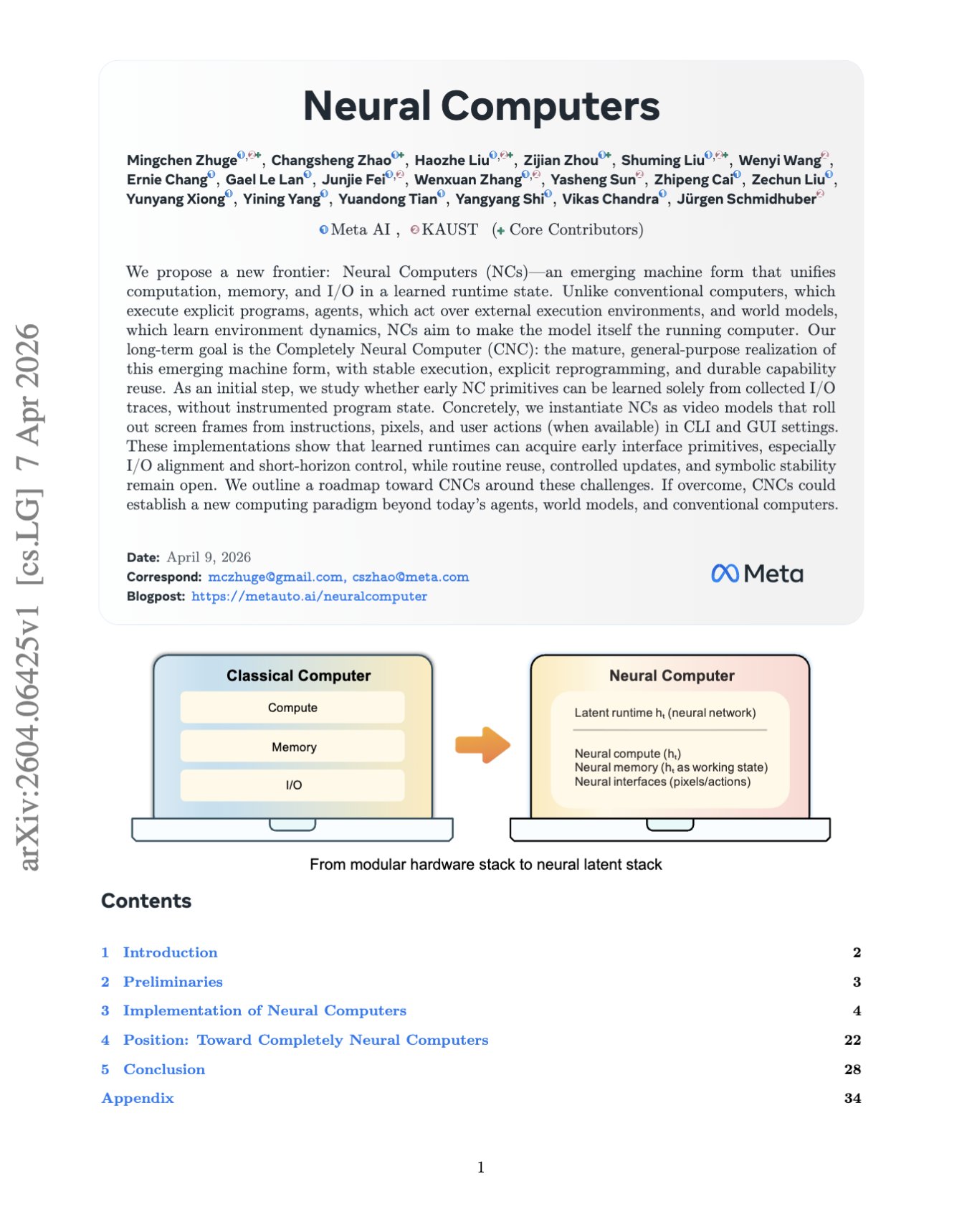
    What if the model didn’t just use a computer, but actually was the computer? Meta AI introduces "Neural Computer", a model where computation, memory, and I/O are all inside one learned system. Their early prototype learns from screen recordings of terminals and desktops, and it

    → View original post on X — @askalphaxiv

  • Engramme’s Revolutionary Memory Architecture: Beyond Transformers

    This is a big deal: A much more human-like memory system. Not built on transformers. Engramme created a fundamentally new architecture for memory. The way OpenAI created one for language. This is a new category, not an incremental improvement. All built with latest neuroscience research. Signed up. Gabriel Kreiman (@gkreiman) Imagine a future where you can REMEMBER EVERYTHING. Every email, every person, every conversation. Introducing Engramme. Our vision is to endow humans with perfect and infinite memory. All your memories come to you. No more searching or prompting. engramme.com 🧠 — https://nitter.net/gkreiman/status/2042271382265053537#m

    → View original post on X — @scobleizer, 2026-04-09 19:26 UTC

  • 5 Key AI Challenges for Supply Chain Management
    5 Key AI Challenges for Supply Chain Management

    5 key #AI challenges for #SupplyChain by @Gartner_inc #MachineLearning #ArtificialIntelligence #ML

    → View original post on X — @ronald_vanloon, 2026-04-09 19:23 UTC

  • Google AI Overviews Generate Millions False Answers Per Hour
    Google AI Overviews Generate Millions False Answers Per Hour

    Google's AI Overviews spew out millions of false answers per hour, bombshell study reveals trib.al/1ao7qB1 [Translated from EN to English]

    → View original post on X — @garymarcus, 2026-04-09 19:22 UTC

  • Multi-agent San Francisco simulation with ANIMA AI reaches 1M interactions

    Multi-agent, real-time simulation of San Francisco. → running for 5 months (sim time)
    → autonomous movement + interactions
    → from 1 to 349 agents Powered by ANIMA (Asynchronous Neural Intelligence for Multi-agent Autonomy) the new architecture behind LifeSim (1 million real player interactions) LifeSim just crossed 1M+ real player interactions. That's 1M+ datapoints of raw, unbiased human feedback. This is just a preview. More soon. Real-time World Simulation rendered in any style [Translated from EN to English]

    → View original post on X — @scobleizer, 2026-04-09 19:13 UTC