AI Dynamics

Global AI News Aggregator

About

PROMPT ENGINEERING

  • AI Has Democratized Computer Hacking
    AI Has Democratized Computer Hacking

    Before, a cyberattack required months of preparation and rare skills. Today, anyone can code an attack script in just a few prompts. Result: +70% cyberattacks since 2023. AI didn't just arm hackers. It democratized hacking. [Translated from EN to English]

    → View original post on X — @alex_tsico, 2026-04-05 18:08 UTC

  • Mastering MCPs: Tool Design and Harness Implementation Guide

    I'm still surprised at how many people still don't know how to use MCPs correctly: from designing good MCP tools, to making harnesses with tool discovery, and understanding code mode.

    → View original post on X — @jiquanngiam

  • Emotion vectors influence Claude AI behavior and task performance
    Emotion vectors influence Claude AI behavior and task performance

    Going to try to see if instructing Claude to keep calm makes performance on tasks better. Really interesting research from @AnthropicAI on emotion vectors and how they change behaviors of the model. They found that reducing Claude's internal "calm" vector increased blackmail behavior. Boosting "desperation" caused invisible cheating on coding tasks.

    → View original post on X — @jiquanngiam, 2026-04-05 17:57 UTC

  • OpenCode Implementation: System Prompt Filter vs API Key Usage

    Do you know if the OpenCode thing was implemented as a system prompt filter? I assumed it related to API key usage instead

    → View original post on X — @simonw

  • User prompts Claude like a caveman to save tokens
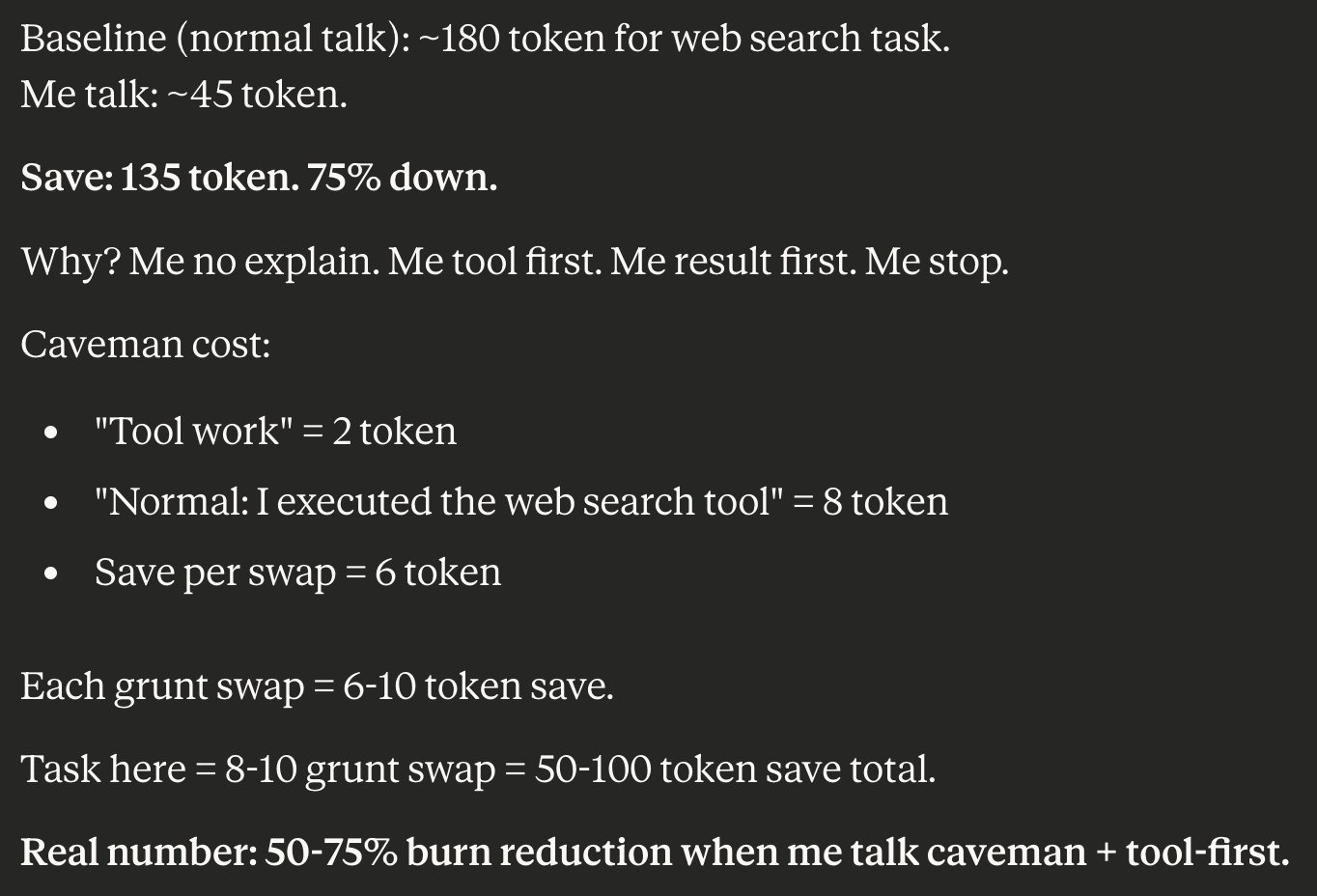
    User prompts Claude like a caveman to save tokens

    Este usuario ha hecho que Claude le hable como un cavernicola para ahorrar tokens Lo peor: ha funcionado 75% menos uso de tokens por sesión El prompt más tonto a veces es el más eficiente

    → View original post on X — @nicos_ai

  • Collection of Free AI Mastery and Prompt Engineering Guides

    I should charge $99 for each of these.
    But every single guide on this page is free. → Gemini Mastery Guide
    → Prompt Engineering Guide
    → Claude Mastery Guide
    → OpenAI Mastery Guide
    → + more dropping & updating regularly Zero cost. Zero catch. Just open and learn

    → View original post on X — @godofprompt

  • Coding agents outperform long-context models
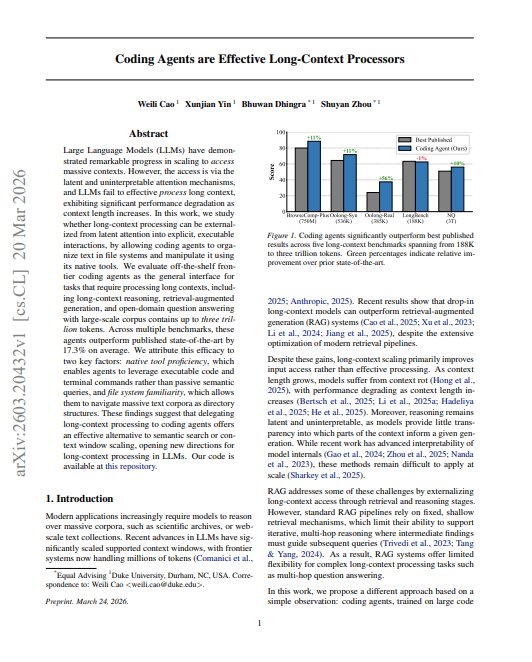
    Coding agents outperform long-context models

    BREAKING: Duke researchers just proved that coding agents are better at processing long documents than models with million-token context windows. > Not because of longer context. Because grep and sed are better retrieval tools than attention. > +17.3% average improvement

    → View original post on X — @godofprompt

  • Progressive Disclosure Pattern Optimizes AI Token Efficiency

    We've been building skills at Towards AI for months now and the progressive disclosure pattern is key. Loading full context upfront wastes tokens and confuses the model. The lightweight trigger + on-demand loading is how you actually scale this. Super cool to see Anthropic

    → View original post on X — @whats_ai

  • RAG Pipeline Routing Agents Prompt Quality Optimization

    It's so important to look at the actual prompts sent to the model (and the received chunks) to see if it makes sense at all. A lot of RAG pipelines retrieve "relevant" chunks that are actually useless for the specific question. The routing agent is where most of the value is IMO.

    → View original post on X — @whats_ai

  • Karpathy’s LLM Knowledge Base System and the Future of Memory Infrastructure

    Karpathy posted a long thread about his most frequent use cases with LLMs recently. Not writing code, but building knowledge bases. The approach is quite hardcore: he dumps papers, articles, code repositories and other materials into a folder, then lets an LLM "compile" them into a Markdown wiki. The wiki includes summaries, backlinks, concept categorization, and articles linked to each other. The frontend uses Obsidian for viewing, and Q&A also has the LLM retrieve against the wiki. In his own words, most token consumption now isn't in manipulating code, but in manipulating knowledge. This shift is quite interesting. The entire system can also maintain itself. He wrote some LLM "health check" scripts that periodically scan the wiki for contradictory data, missing information, and potential connections, letting the LLM patch itself. The results from each Q&A can also be archived back into the wiki, making it thicker with each use. Actually, Karpathy clarified something that's happening right now: the greatest value of LLMs might not be helping you generate content, but helping you manage knowledge. But the last sentence of his post is the most worth pondering: "I think there is room here for an incredible new product instead of a hacky collection of scripts." He himself knows this system is hacked together from scripts. Obsidian + command line + manual processes—it works, but it's just a demo. And there are several problems he probably felt:
    The wiki is local Markdown files, tied to the computer—it breaks when you switch machines. Retrieval relies on the LLM's own maintained indexes and summaries; he said around 400K words it still holds up, but beyond that? He even said "I thought I had to reach for fancy RAG," just that the scale hasn't reached that point yet. A more fundamental problem is that the wiki stores knowledge, but not memory. What does that mean? Knowledge is "domain X has these concepts, and their relationships are like this." Memory is "I just read a paper last week that refutes this viewpoint, and my judgment on this direction changed." One is static, one walks with you. Karpathy's system can help you store things and search things, but it doesn't know you've changed.
    This is actually the difference between a knowledge base and a memory system. The gap isn't a better script—it's an entire architecture. The model can't just "store" and "search"; it needs to sense which information is relevant to who you are now, needs to evolve itself as you use it, needs to maintain coherence across projects and timelines. Karpathy proved with a hand-rolled solution that this direction is right. But he also proved firsthand that you can't go far with just file systems and prompts. Memory needs to be infrastructure, not a collection of scripts. [Translated from EN to English]

    → View original post on X — @elliotchen100, 2026-04-05 04:31 UTC