AI Dynamics

Global AI News Aggregator

About

PROMPT ENGINEERING

  • AI Filmmaking Workflows Eliminate Prompt Engineering

    The real barrier to AI filmmaking was never the models. It was the prompting overhead between your vision and the output. 72 pre-built workflows. Select, run, done. No prompt engineering required. @morphic just solved the part everyone was quietly struggling with.

    → View original post on X — @godofprompt

  • Using Lists and Data to Feed AI Systems

    It sure is. And there are millions of lists here on every topic. Just gotta find one that's complete enough, or make your own to feed the AI.

    → View original post on X — @scobleizer

  • coSTAR Automates Agent Testing and Refinement Loop
    coSTAR Automates Agent Testing and Refinement Loop

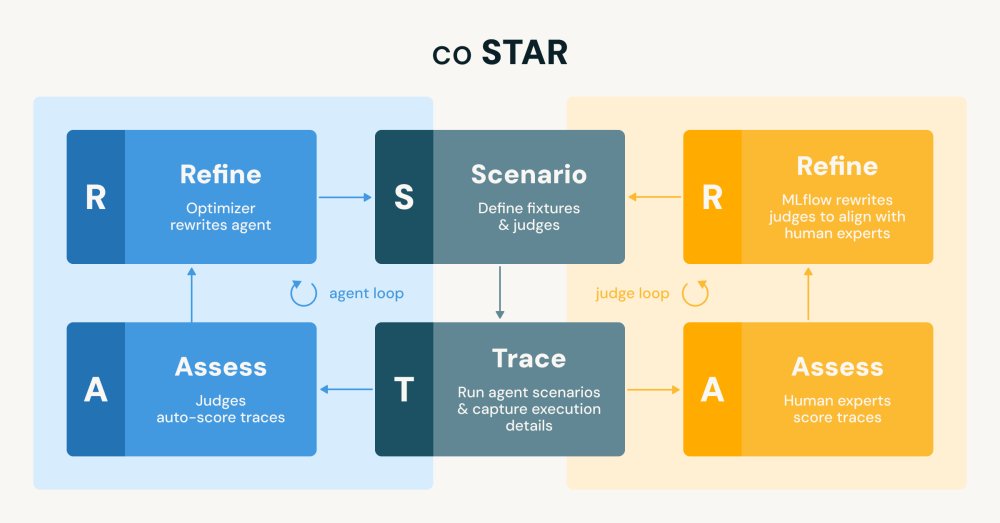
    With coSTAR, we replaced manual agent iteration with an automated test and refine loop. Agents run against defined scenarios. MLflow captures execution traces, and LLM judges score the results. A coding assistant then updates the agent until it passes the tests. This cuts

    → View original post on X — @databricks

  • Day 3: Travel Agent with MCP, State Management, and Multi-Agent Systems
    Day 3: Travel Agent with MCP, State Management, and Multi-Agent Systems

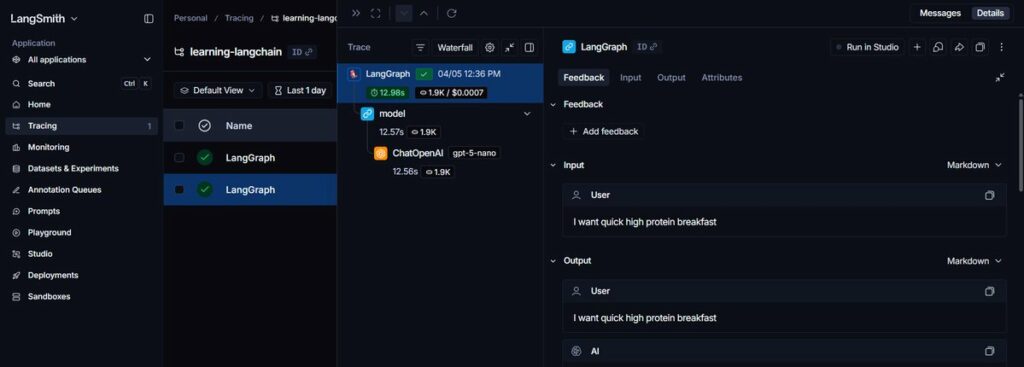
    Day 3 of becoming 100xdevs: – make a travel agent with mcp – learn about the state – learn about runtime context – making multiagents – tracking sub-agents from Langsmith Akash (@akashcorex) Day 2 of becoming 100xdevs: – LangSmith tracking of each agent – how to create MCP – run MCP locally and use it – create a travel agent with mcp + ai — https://nitter.net/akashcorex/status/2040872532816154958#m

    → View original post on X — @langchain, 2026-04-06 18:58 UTC

  • Four Dimensions of AI for Growth Marketing Success

    some more ramblings from working at @AnthropicAI. I've been asked a few times what the single most important thing a growth marketer should be doing with AI that most aren't. surprise, it's not just a single specific task. after running dozens of growth workflows through Claude, I think the useful stuff worth doing falls along four dimensions 🧵

    → View original post on X — @jiquanngiam, 2026-04-06 18:17 UTC

  • Agents AI Automate Repetitive Tasks in Workflows

    Smart. Often I am asking my agents to do the same thing again. Useful to build in workflows.

    → View original post on X — @scobleizer

  • AI Model Achieves Breakthrough Photorealism with Glacier Rendering
    AI Model Achieves Breakthrough Photorealism with Glacier Rendering

    The team really killed it on photorealism with this model. While testing we found out ice is a great barometer for this – try this glacier prompt. A glacier wall towering like a cathedral interior, deep blue ice with light refracting through layers, tiny human figure at base for

    → View original post on X — @mustafasuleyman

  • Tailor prompting to each AI tool for better results
    Tailor prompting to each AI tool for better results

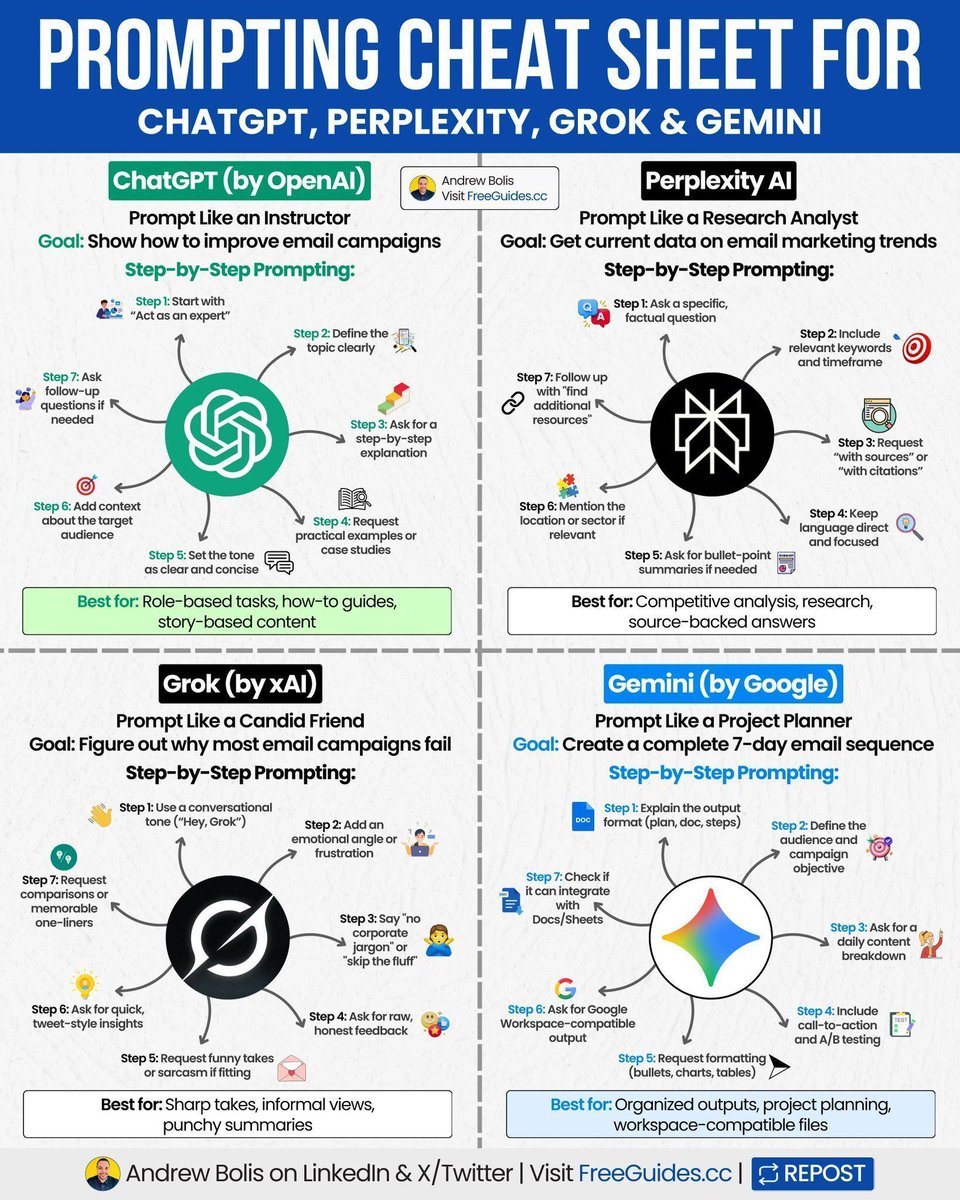
    Prompting isn't one-size-fits-all. 🧠 This cheat sheet nails it: ChatGPT = instructor style ✅ Perplexity = research analyst style 🔍 Grok = candid friend style 😄 Gemini = project planner style 📌 Match the prompt to the tool → better outputs, faster. 🚀 What's your favorite prompt template? 👇 Credit: Andrew Bolis (FreeGuides.cc)
    #PromptEngineering #GenAI #AItools #ChatGPT #Perplexity #Grok #Gemini [Translated from EN to English]

    → View original post on X — @ingliguori, 2026-04-06 17:25 UTC

  • Meta Harnesses: Automated Framework Optimization for AI Tasks
    Meta Harnesses: Automated Framework Optimization for AI Tasks

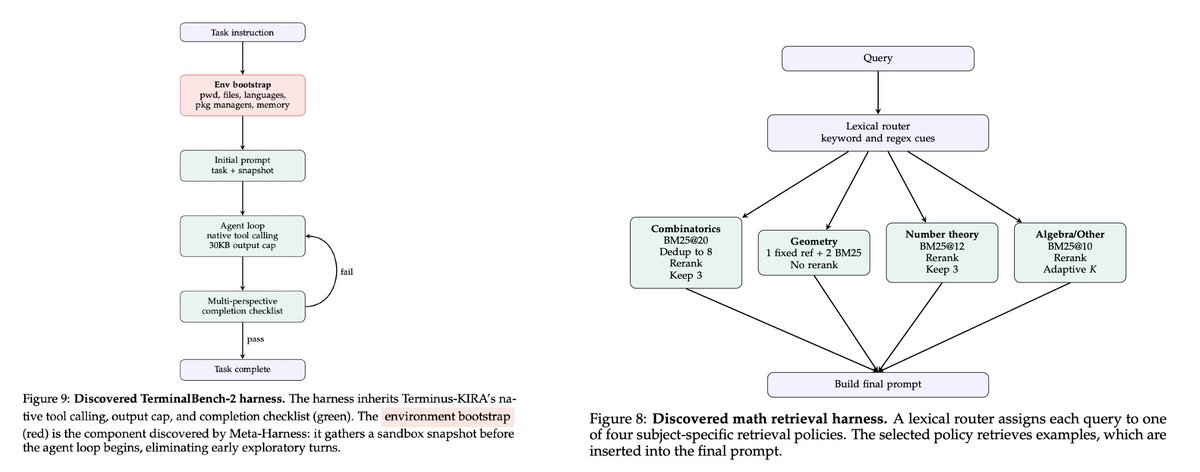
    Meta Harnesses is Autoresearch on steroids. Something I've been exploring recently is to get long running agents to hill climb on a verifiable task to continuously improve without my intervention. Karpathy's Autoresearch did this pretty well on specific tasks, but this weekend I tried Meta Harnesses which moves one level of abstraction up. What does Meta Harness do? Autoresearch can be used in harness like Claude Code / Codex to generate experiments to try, evaluate results, and continue looping. Meta Harness generates a harness itself that optimizes on a task or a set of task. Here, we define a harness as "a single-file Python program that modifies task-specific prompting, retrieval, memory, and orchestration logic". The idea is that LLMs are very powerful today, but to harness [pun intended] their power, you need to give it the right prompts and context. Meta Harnesses automates coming up with the right prompts and the right way to retrieve context to solve a problem. Where did this idea come from? This is from a paper from Stanford and the author of DSPy written last week. The paper shows fantastic performance on 3 tasks: text classification, math reasoning (IMO level problems) and coding (Terminal Bench 2.0), far outperforming traditional harnesses. The discovered harnesses are interesting: math for example, splits up the logic into different categories (Combinatorics, Geometry, Number Theory, Algebra) and prompts and looks at the context differently. The coding harness, amongst other things, pre-processes the tools available in the environment to save exploratory turns. When should you use and not use it? Meta Harnesses seem pretty useful for tackling a specific but wide set of problems where the result is verifiable. In contrast, when I tried it on a specific task like Chess, it arbitrarily divides the problem into separate tasks – opening, mid game, end game, and creates different approaches for each. This "works" but isn't really clean because we believe there should be one approach that does all three. It does far better on things like examinations (JEE, Gaokao) where it splits problems into categories and tackles each category with different strategies. This paper covers a pretty light version of what a harness means. In the future, we can split up tasks into harnesses that have access to specific kinds of data, specific toolchains and various models to get even better results. Overall, pretty cool applied AI approach to hillclimb a verifiable task in a specific domain with variety within the problem space.

    → View original post on X — @askalphaxiv, 2026-04-06 16:22 UTC
  • Final Stage: Building a Cohesive Intelligent Platform from Description

    6/ The final stage was the App Build. Instead of duct-taped automations, I got a cohesive platform! It is an intelligent system that looks and feels like a custom software build, but it was generated entirely from my initial description.

    → View original post on X — @kimmonismus, 2026-04-06 16:04 UTC