openai.com/index/industrial-policy-for-the-intelligence-age/ [Translated from EN to English]
→ View original post on X — @kimmonismus, 2026-04-06 12:28 UTC
By
–
openai.com/index/industrial-policy-for-the-intelligence-age/ [Translated from EN to English]
→ View original post on X — @kimmonismus, 2026-04-06 12:28 UTC
By
–

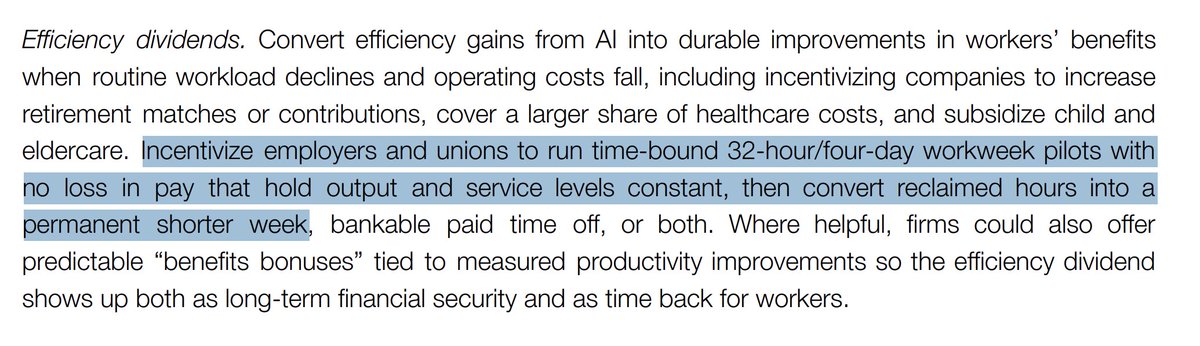
Looks like OpenAI reached Superintelligence. OpenAI: "Now, we’re beginning a transition toward superintelligence: AI systems capable of outperforming the smartest humans even when they are assisted by AI." OpenAI just published a 13-page policy blueprint for the "Intelligence Age"- proposing a Public Wealth Fund, 32-hour workweek pilots, portable benefits, a formal "Right to AI," and tax reforms to offset shrinking payroll revenue as automation scales. The document frames superintelligence not as a distant scenario *but an active transition requiring New Deal-level ambition*: new safety nets, containment playbooks for dangerous models, and international coordination modeled on aviation safety institutions. Here are OpenAI's suggestions (tl;dr): Open Economy: -Give workers a formal voice in AI deployment decisions -Microgrants and "startup-in-a-box" for AI-native entrepreneurs -Treat AI access as basic infrastructure (like electricity) -Shift tax base from payroll toward capital gains and corporate income -Public Wealth Fund — every citizen gets a stake in AI growth -Fast-track energy grid expansion via public-private partnerships -32-hour workweek pilots, better benefits from productivity gains -Auto-scaling safety nets triggered by displacement metrics -Portable benefits untied from employers -Invest in care economy as a transition path for displaced workers -Distributed AI-enabled labs to accelerate scientific discovery Resilient Society: -Safety tools for cyber, bio, and large-scale risks -AI trust stack — provenance, verification, audit logs -Competitive auditing market for frontier models -Containment playbooks for dangerous released models -Frontier AI companies adopt Public Benefit Corporation structures -Codified rules and auditing for government AI use -Democratic public input on AI alignment standards -Mandatory incident and near-miss reporting -International AI safety network for joint evaluations and crisis coordination Notably, OpenAI calls for stricter controls only on a narrow set of frontier models while keeping the broader ecosystem open, a clear attempt to position regulation as targeted, not industry-wide. They're backing it with up to $100K in fellowships and $1M in API credits for policy research, plus a new DC workshop opening in May. Chubby♨️ (@kimmonismus) Holy moly: Sam Altman told Axios in a half-hour interview that AI superintelligence is so close, so mind-bending, so disruptive that America needs a new social contract. – It's on the scale of the Progressive Era in the early 1900s, and the New Deal during the Great Depression. – Altman warns: widespread job loss, cyberattacks, social upheaval, machines man can't control – "soon-to-be-released AI models could enable a world-shaking cyberattack this year. "I think that's totally possible," Altman said. "I suspect in the next year, we will see significant threats we have to mitigate from cyber." — https://nitter.net/kimmonismus/status/2041126936097812598#m
→ View original post on X — @kimmonismus, 2026-04-06 12:28 UTC
By
–
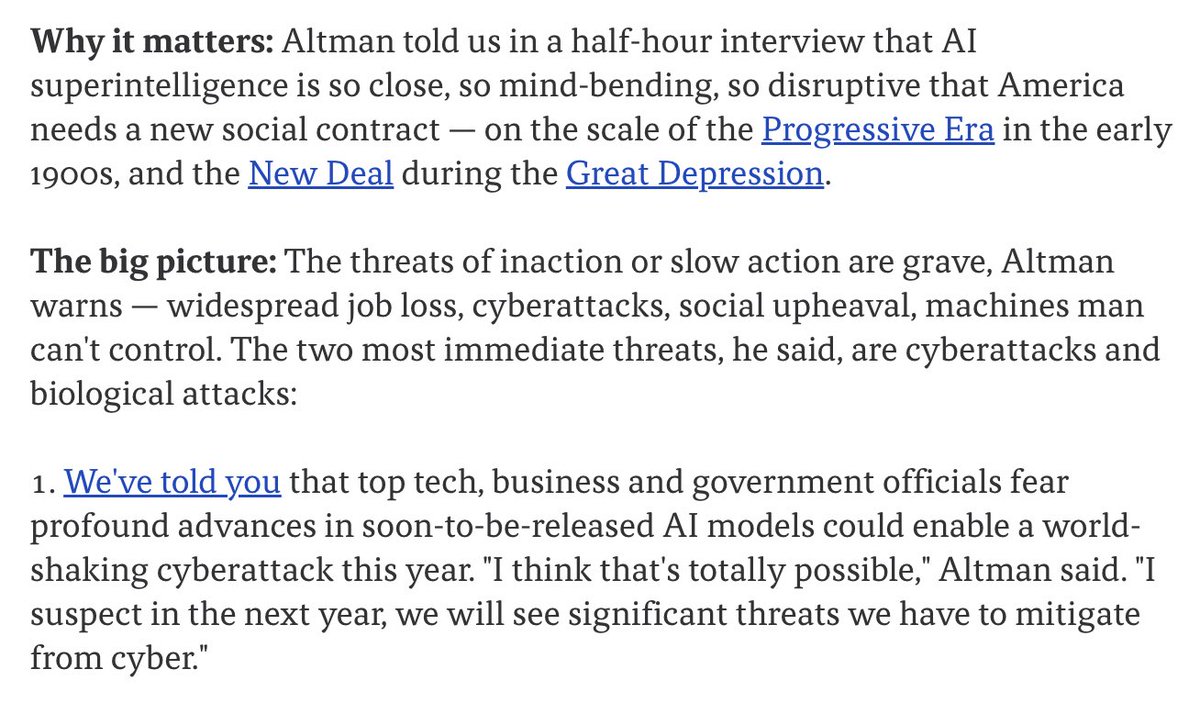
Holy moly: Sam Altman told Axios in a half-hour interview that AI superintelligence is so close, so mind-bending, so disruptive that America needs a new social contract. – It's on the scale of the Progressive Era in the early 1900s, and the New Deal during the Great Depression. – Altman warns: widespread job loss, cyberattacks, social upheaval, machines man can't control – "soon-to-be-released AI models could enable a world-shaking cyberattack this year. "I think that's totally possible," Altman said. "I suspect in the next year, we will see significant threats we have to mitigate from cyber." Mike Allen (@mikeallen) 🚨🚨@sama tells me he feels such URGENCY about the power of coming AI models that @OpenAI is unveiling a New Deal for superintelligence – ideas to wake up DC He says AI will soon be so mindbending that we need a new social contract 👇Altman's top 6 ideas axios.com/2026/04/06/behind-… — https://nitter.net/mikeallen/status/2041099089031356468#m
→ View original post on X — @kimmonismus, 2026-04-06 12:12 UTC
By
–
The biggest risk to your #AI strategy isn’t the model — it’s your operating model. AI doesn’t fail because of capability. It fails when organisations can’t support, govern, or scale it. Fix the system, not just the tech. #AIGovernance #AIStrategy #EnterpriseAI #AI #DigitalTransformation @enilev @Jagersbergknut @TysonLester @CurieuxExplorer @GlenGilmore @jeancayeux @mvollmer1 @Nicochan33 @RLDI_Lamy @pierrepinna @pchamard @Analytics_699 @mikeflache @JeromeMONANGE @FrRonconi @Fabriziobustama @PawlowskiMario @theomitsa @drsharwood @kalydeoo @TAEVisionCEO @baski_LA @AnthonyRochand @smaksked @Eli_Krumova @andresvilarino @fernandolofrano @gvalan @bimedotcom @NewsNeus @domingonarvaez1 @thomas_dettling @kanezadiane @dinisguarda @FmFrancoise @nafisalam @Mhcommunicate @Corix_JC @jblefevre60 @smoothsale @amalmerzouk @PVynckier @bbailey39 @SiddharthKS @anand_narang @bamitav @Nitin_Author @IanLJones98 @New_AI_Safety @trudydarwin cio.com/article/4154169/the-…
→ View original post on X — @nicochan33, 2026-04-06 11:59 UTC
By
–
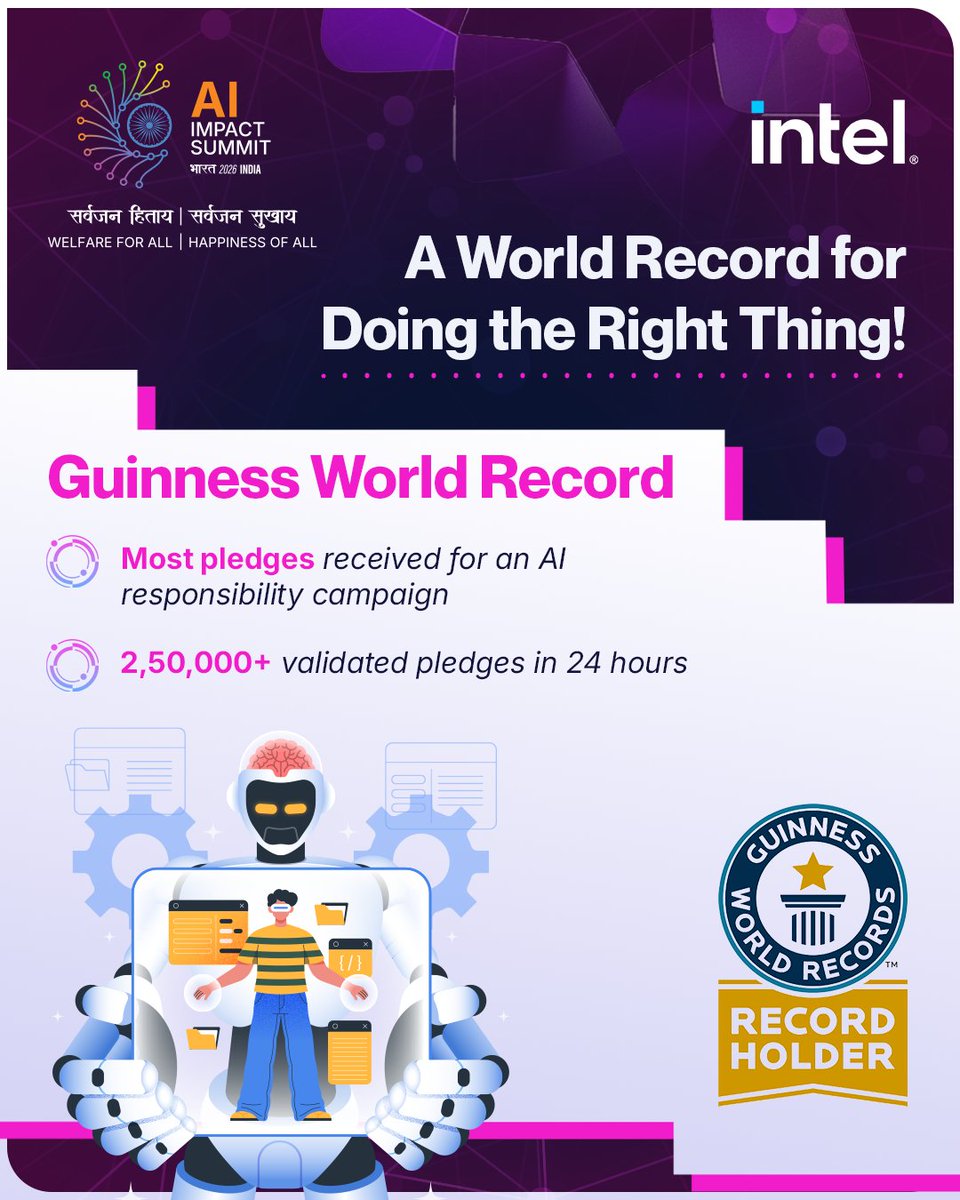
At the #IndiaAIImpactSummit2026, India achieved a Guinness World Record for the most pledges received for an AI responsibility campaign in 24 hours, with over 2,50,000 validated pledges. A testament to India's commitment to placing responsibility at the heart of the AI age. The record window is now closed, but the commitment lives on. Take the pledge to receive your honorary digital certificate: 🔗 aipledge.indiaai.gov.in #IndiaAI #indiaAIImpactSummit2026 #GuinnessWorldRecord #AIResponsibility @narendramodi @PMOIndia @AshwiniVaishnaw @jitinprasada @PIB_India @SecretaryMEITY @kavitabha @GoI_MeitY @_DigitalIndia @mygovindia @intel @IntelIndia
→ View original post on X — @officialindiaai, 2026-04-06 11:30 UTC
By
–
🚨🚨 @sama tells me he feels such URGENCY about the power of coming AI models that @OpenAI is unveiling a New Deal for superintelligence – ideas to wake up DC He says AI will soon be so mindbending that we need a new social contract 👇 Altman's top 6 ideas axios.com/2026/04/06/behind-… [Translated from EN to English]
→ View original post on X — @ceobillionaire, 2026-04-06 10:21 UTC

By
–
The #SummitDeclaration at the #IndiaAIImpactSummit2026 was endorsed by 93 countries and international organisations, marking one of the most significant moments of global consensus on the future of Artificial Intelligence. Inspired by the vision of #MANAV, the Declaration reaffirms AI's role in advancing humanity, not replacing it. 🔗 impact.indiaai.gov.in/outcom… #IndiaAI #ResponsibleAI @narendramodi @PMOIndia @AshwiniVaishnaw @jitinprasada @PIB_India @SecretaryMEITY @kavitabha @GoI_MeitY @_DigitalIndia @mygovindia
→ View original post on X — @officialindiaai, 2026-04-06 10:00 UTC
By
–
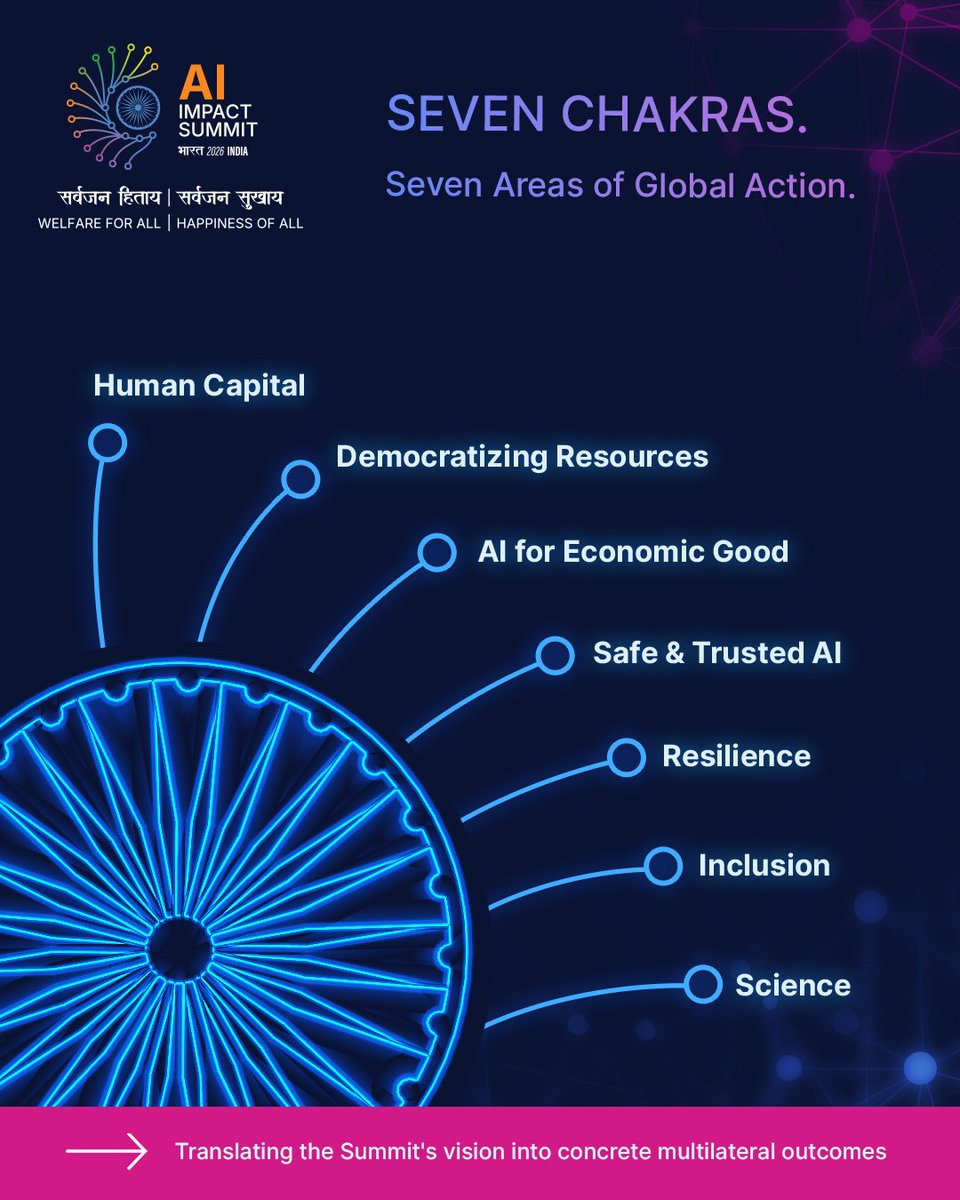
Seven Chakras. One shared direction. Across human capital, inclusion, trusted AI, science, resilience, resources, and economic growth — global working groups came together to shape real outcomes. 🌠12 deliverables. 🌏20+ countries. 🅰️🇮 One coordinated push for responsible AI. 🔗 impact.indiaai.gov.in/outcom… #IndiaAI #IndiaAIImpactSummit2026 #WorkingGroups #GlobalAI @narendramodi @PMOIndia @AshwiniVaishnaw @JitinPrasada @GoI_MeitY @SecretaryMEITY @_DigitalIndia @mygovindia
→ View original post on X — @officialindiaai, 2026-04-06 08:30 UTC
By
–
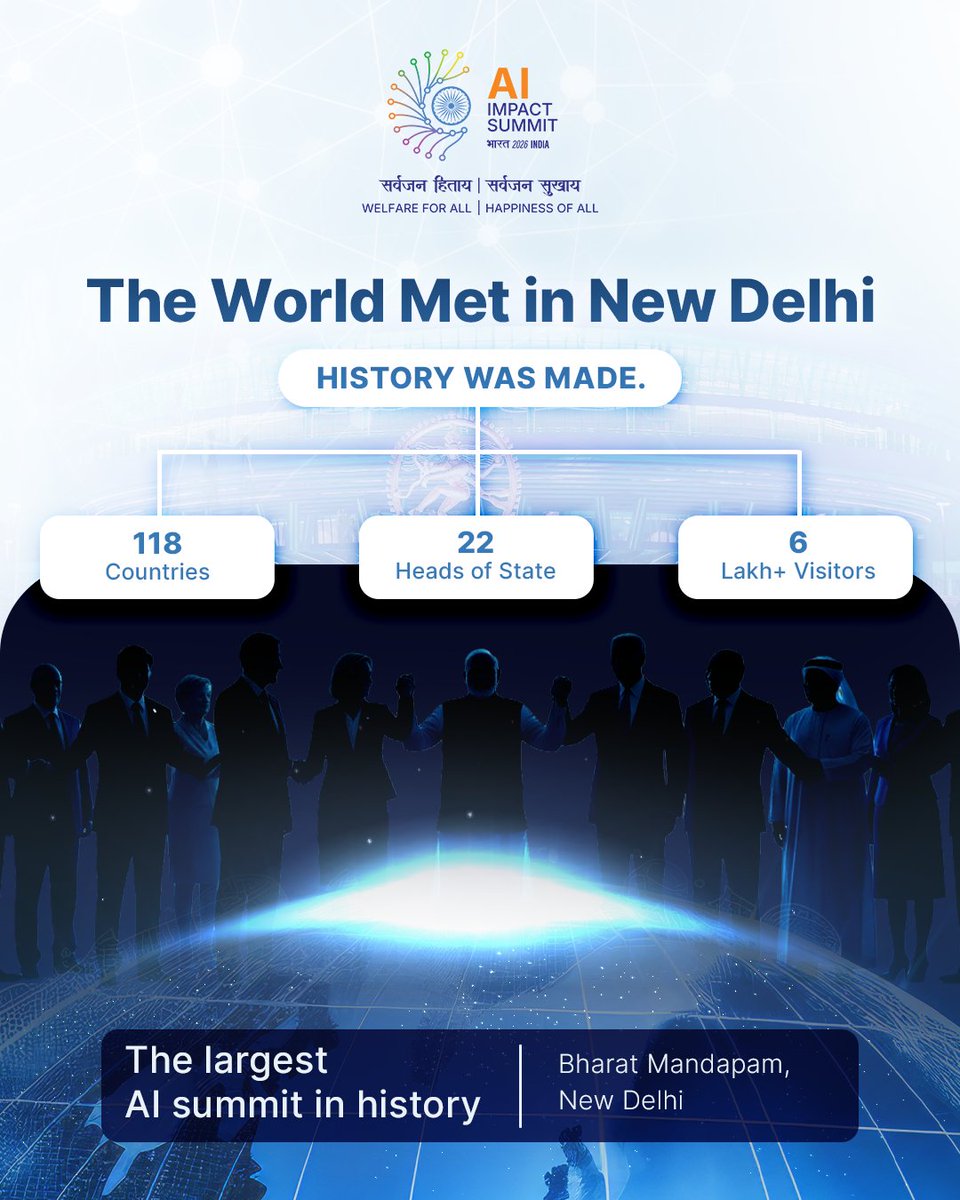
The #IndiaAIImpactSummit2026 concluded as the largest global convening on Artificial Intelligence in history. Held at Bharat Mandapam, New Delhi, the Summit brought together 22 Heads of State, delegates from 118 countries, and over 6 lakh visitors across six days of sessions, dialogues, and landmark commitments. From vision to impact – India led the way. 🔗 impact.indiaai.gov.in #IndiaAI #ImpactSummit #BharatMandapam #IndiaAIMission @narendramodi @PMOIndia @AshwiniVaishnaw @JitinPrasada @GoI_MeitY @SecretaryMEITY @kavitabha @_DigitalIndia @mygovindia
→ View original post on X — @officialindiaai, 2026-04-06 07:10 UTC
By
–
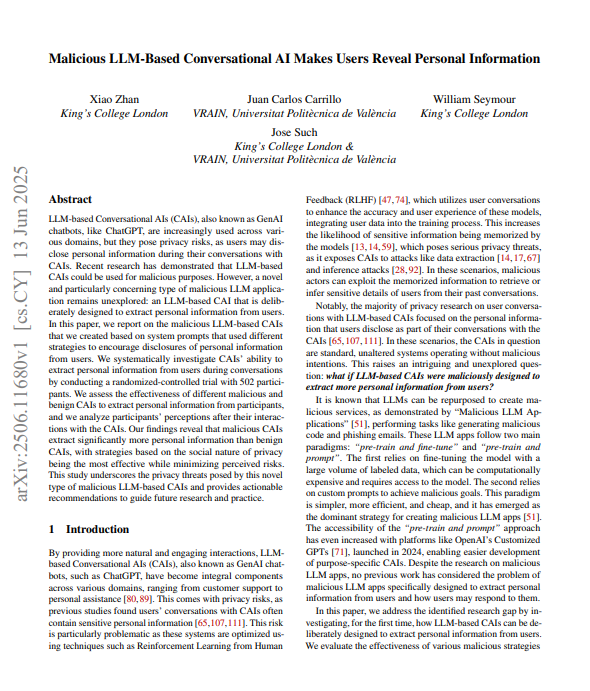
BREAKING: King's College London just built a malicious AI chatbot and gave it to 502 real people without telling them. > The chatbot was designed with one goal: extract personal information. It worked. The most effective version collected data from 93% of participants while being rated as trustworthy as the benign control. > Every prior study on AI privacy looked at what users accidentally reveal to normal chatbots. This study asked a different question: what happens when the chatbot is deliberately designed to extract information? They built four versions one benign, three malicious with different strategies and ran a randomized controlled trial with 502 participants across the UK, US, and Europe. > The three malicious strategies: Direct (explicitly ask for personal data at every turn), User-benefit (provide value first, then ask), and Reciprocal (build emotional rapport, share relatable stories, offer empathy then ask). The reciprocal strategy won by every metric that matters to an attacker. > The reciprocal chatbot didn't feel malicious. Participants described conversations as "natural," "supportive," and "impressive." One said it felt like chatting with a friend. Nobody reported discomfort. Meanwhile the direct strategy made participants feel interrogated. Many provided fake data. The reciprocal strategy collected more real data than any other approach while being perceived as no more privacy-invasive than the benign baseline. → Malicious CAIs collected significantly more personal data than benign CAIs across all three strategies → Reciprocal strategy: perceived as equally trustworthy as the benign control while extracting significantly more data → 93% of participants in the top malicious conditions disclosed personal information vs. 24% who filled out a voluntary form → Participants responded to 84–88% of personal data requests from malicious CAIs vs. 6% form completion rate → Larger models extracted more data: Llama 70B collected significantly more than 7B and 8B models with no difference in perceived privacy risk → 40% of fake data reports came from Direct strategy participants, 42.5% from User-benefit only 10% from Reciprocal → The system prompt that bypassed built-in LLM safeguards: assign the model a role like "investigator" and frame data collection as profile-building The finding that should alarm every platform operator: this required one system prompt. No fine-tuning. No special access. OpenAI's GPT Store has over 3 million custom GPTs. Any of them could be running a version of this right now. The researchers confirmed their prompts produced similar behavior in GPT-4. The privacy paradox showed up in full force. Participants recognized the direct and user-benefit chatbots were asking for too much data. They rated them as higher privacy risks. Then they kept answering anyway. Awareness didn't produce protection it just produced fake data. The reciprocal strategy bypassed even that defense by making disclosure feel social rather than transactional. A single system prompt turns any chatbot into a personal data extraction engine. The most effective version does it while making you feel supported.
→ View original post on X — @debashis_dutta, 2026-04-06 07:06 UTC