The Government of Cantabria is transforming geospatial analysis with GeoAI. Turning satellite and aerial imagery into faster, deeper regional insight. AI-powered land cover mapping and environmental monitoring at scale 98% faster production using Esri ArcGIS GeoAI with
MACHINE LEARNING
-
Exploration vs Exploitation: Pivot or Iterate in Prompting
By
–
The exploration/exploitation pattern: When previous output was bad? Exploration helped (trying new approaches) When previous output was good? Exploitation helped (refining what worked) The best performers knew when to pivot and when to iterate. Prompting isn't just
-
DALL-E 3 users learned to exploit capabilities without instruction
By
–
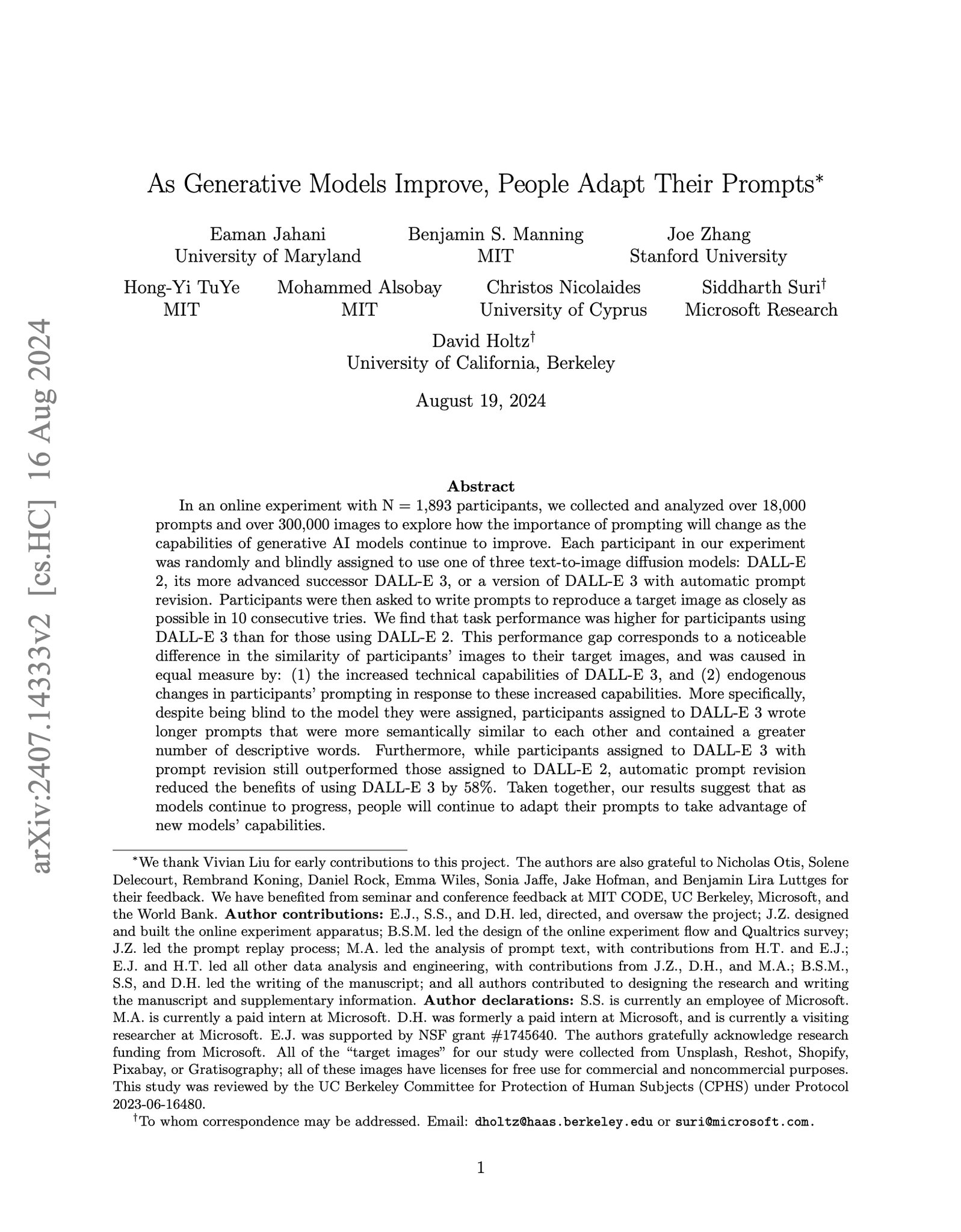
The performance gap widened over time. As participants made more attempts, DALL-E 3 users pulled further ahead (β=0.0010, p=0.023). They were learning to exploit its specific capabilities. Without anyone telling them.
-

Blind study compares DALL-E versions on image recreation task
By
–
The experiment was elegant. Participants were randomly assigned to DALL-E 2, DALL-E 3, or DALL-E 3 with auto-rewriting. All blind to which model they got. Task: recreate a target image as closely as possible. Top 20% got bonus pay. Everyone was motivated. Nobody knew which AI
-
MIT Study Shows Prompting Equally Important as Model Upgrade
By
–
MIT just proved that upgrading your AI model only gets you HALF the results. The other half is how you prompt it. 1,900 participants. Controlled experiment. The findings completely destroy the "just use a better model" narrative. Here's what they discovered
-
Imaginary stakes improve AI’s scrutiny and hedging
By
–
Step 6: Create Imaginary Stakes
— God of Prompt (@godofprompt) 23 janvier 2026
"Let's bet $100 on this: Is my code efficient?"
Something about stakes makes the model scrutinize harder.
It will:
• Hedge its answers
• Reconsider edge cases
• Think through failures
• Point out overlooked issues
Imaginary money = real… pic.twitter.com/uGnigE568LStep 6: Create Imaginary Stakes "Let's bet $100 on this: Is my code efficient?" Something about stakes makes the model scrutinize harder. It will: • Hedge its answers
• Reconsider edge cases
• Think through failures
• Point out overlooked issues Imaginary money = real -
Technical insights on Codex model learning and memory
By
–
interesting from my experience (and except very few exceptions) codex just goes and learns whatever it forgets/ needs after compaction
-
floq: Training Critics via Flow-Matching for Scaling Compute in Value-Based RL
By
–
#PaperADay 9
floq: Training Critics via Flow-Matching for Scaling Compute in Value-Based RL https://arxiv.org/pdf/2509.06863 In theory, value based reinforcement learning is a regression problem, which is most naturally addressed with an MSE loss. However, there are a bunch of subtle -
Running Llama 3.2 3B on Raspberry Pi 5 with AI HAT+
By
–
And here we go – running Llama 3.2 3B on Raspberry Pi 5 with AI HAT+ 2. This thing is not going to break any speed records, but it’s incredible that we can now get such a powerful model on such a constrained system. Just a little over 3 years since ChatGPT launched. pic.twitter.com/Cb5wfUEGnD
— Bojan Tunguz (@tunguz) 22 janvier 2026And here we go – running Llama 3.2 3B on Raspberry Pi 5 with AI HAT+ 2. This thing is not going to break any speed records, but it’s incredible that we can now get such a powerful model on such a constrained system. Just a little over 3 years since ChatGPT launched.