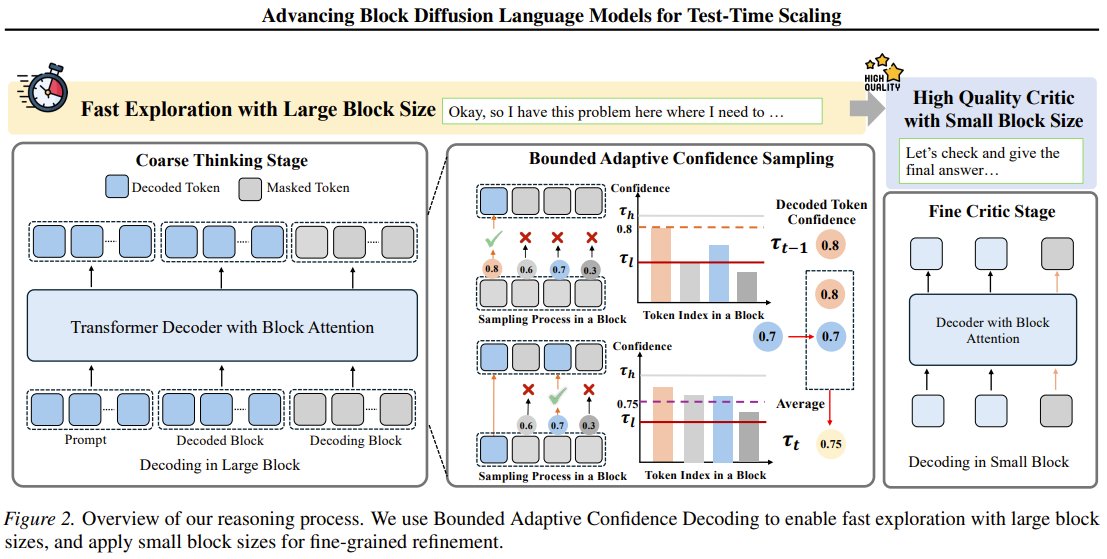
What if your AI could reason smarter AND faster, especially on complex tasks? A collaboration from Fudan University, Peking University, and Meituan LongCat Team just made it happen! They've developed a new framework for Block Diffusion Language Models (BDLMs) that lets the AI
MACHINE LEARNING
-

Agentic AI Intelligence Explosion Through Socially Aggregated Cognition
By
–
Our new essay is out in Science: "Agentic AI and the Next Intelligence Explosion" For decades, the AI "singularity" has been imagined as a single, godlike mind bootstrapping itself to omniscience. In this piece with the inimitable Benjamin Bratton (@bratton) and Blaise Agüera y Arcas (@blaiseaguera), we argue this vision is wrong in its most fundamental assumption. Every prior intelligence explosion—primate sociality, human language, writing, institutions—wasn't an upgrade to individual cognitive hardware. It was the emergence of a new socially aggregated unit of cognition. AI is extending this sequence, not breaking from it. The evidence is already inside the models themselves. In recent work, we showed that frontier reasoning models like DeepSeek-R1 don't improve by "thinking longer"—they spontaneously simulate internal multi-agent debates, what we call a "society of thought" (lnkd.in/guNfRtXh). Reinforcement learning for accuracy alone causes models to rediscover what epistemology and cognitive science have long suggested: robust reasoning is a social process, even within a single mind. This opens a vast design space. A century of research on team composition, hierarchy, role differentiation, and structured disagreement has barely been brought to bear on AI reasoning. The toolkits of organizational science become blueprints for next-generation AI. Outside the model, we've entered the era of human-AI centaurs—composite actors that are neither purely human nor purely machine. Agents that fork, differentiate, recombine. Recursive societies of thought that expand when complexity demands and collapse when problems resolve. The scaling frontier isn't just bigger models. It's richer social systems—and the institutions to govern them. Just as human societies rely on persistent institutional templates (courtrooms, markets, bureaucracies), scalable AI ecosystems will need digital equivalents. The Founders would have recognized the logic: no single concentration of intelligence should regulate itself. The intelligence explosion is already here. Not as a singular ascending mind, but as a combinatorial society complexifying—intelligence growing like a city. The question is whether we'll build the social infrastructure worthy of what it's becoming. No mind is an island. Read it here in Science (science.org/doi/10.1126/scie…) or free on the arXiv (arxiv.org/abs/2603.20639)
-
Best Model for Actual Machine Learning Work
By
–
For actual ML work it's still the best overall model around.
-
Google’s TurboQuant Algorithm Enables Local Execution of Large LLMs
By
–
Esta es potencialmente la noticia más importante del año.
— SONIA (@S0N_IA_) 25 mars 2026
Google acaba de lanzar TurboQuant. Un algoritmo que hace que los modelos LLM sean más pequeños y rápidos, sin perder calidad.
Esto significa que ahora un Mac Mini de 16 GB puede ejecutar modelos de IA INCREÍBLES.… https://t.co/O271fYGWxUThis is potentially the most important news of the year. Google has just launched TurboQuant. An algorithm that makes LLM models smaller and faster, without losing quality. This means that now a 16 GB Mac Mini can run INCREDIBLE AI models. Completely local, free, and secure.
-

AI Systems Monitor Land Use Changes in Real Time for Governments
By
–
Can AI help governments track land use changes as they happen? Design AI systems that combine satellite imagery with ground-level data to monitor land use shifts across Andhra Pradesh in near real time, enabling smarter planning, better resource management, and more responsive
-
Beyond Random Search: Guiding Autoresearch Agents Toward Meaningful Exploration
By
–
What are the best current techniques to have autoresearch behave better than (slightly improved) random search? By which I mean (in Sijun below example), having the agent understand that (given some constraints) exploring int5 quantization is more exciting and have more downstream fruits than playing with the random seed? I’m talking about the beginning of having an agent pushed a real research program. The ones where you know the current technique will not give crazy results out of the box but it still push it because it believe and can demonstrate that the general direction has potential. Like neural networks used to be a worse way to do AI performance-wise. But we still pushed them… Sijun Tan (@sijun_tan) We took @karpathy's autoresearch agent, scaled it into a collaborative swarm, and topped @OpenAI's Parameter Golf Challenge—twice. Here’s how we did it: — https://nitter.net/sijun_tan/status/2036584756729749802#m
→ View original post on X — @thom_wolf, 2026-03-25 12:29 UTC
-
Robot Hand With Bidirectional Bending Achieves Superhuman Dexterity
By
–
This #Robot Hand Bends Both Ways — Unlocking Superhuman Dexterity
— Ronald van Loon (@Ronald_vanLoon) 25 mars 2026
via @ZappyZappy7
#AI #Robotics #MachineLearning #ArtificialIntelligence #ML #MI pic.twitter.com/hjiYhdanj6This #Robot Hand Bends Both Ways — Unlocking Superhuman Dexterity
via @ZappyZappy7 #AI #Robotics #MachineLearning #ArtificialIntelligence #ML #MI -
Late Interaction Models Elasticsearch RAG Document Processing
By
–
Late interaction models in Elasticsearch is huge for document-heavy RAG pipelines. Searching by visual layout instead of just text opens up so many use cases for messy PDFs and scanned docs.
-

The Process of Data Cleaning in Data Science and Big Data
By
–
The Process of #Data Cleaning
by @Python_Dv #DataScience #BigData -

AgriGoI AI Hackathon: Innovation for Smart Agriculture
By
–
See @AgriGoI opening doors for innovators through the AI Hackathon! From crop prediction to smart irrigation , this is where ideas meet real-world impact. Why you shouldn’t miss this: Win ₹3 Lakhs Collaborate directly with the Ministry Earn national recognitionIf