And the link to the gallery entry for more details, links, comparisons, etc: sebastianraschka.com/llm-arc…
MACHINE LEARNING
-
Gemma 4 Release: Architecture Stability, Training Innovation, Strong Performance
By
–
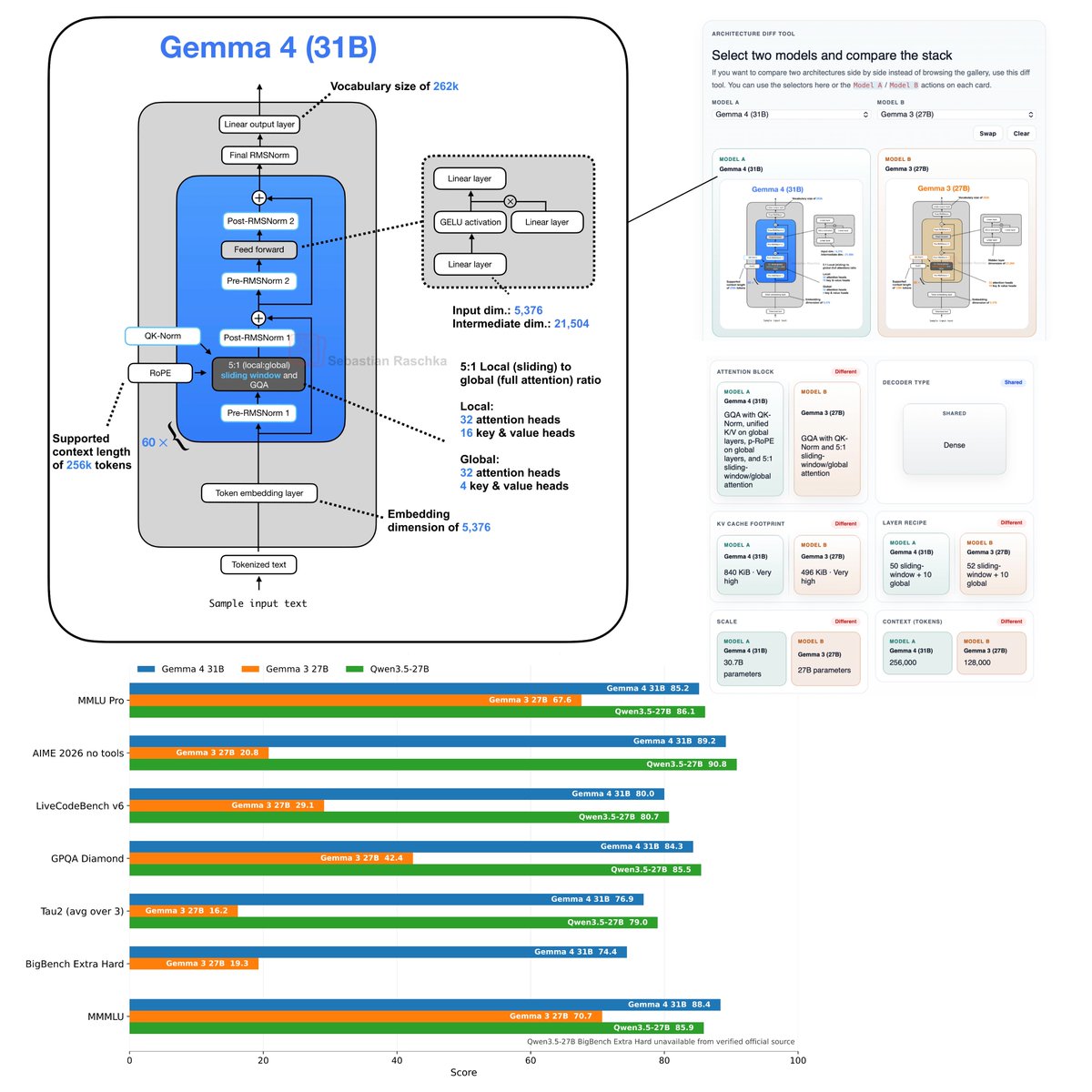
Flagship open-weight release days are always exciting. Was just reading through the Gemma 4 reports, configs, and code, and here are my takeaways: Architecture-wise, besides multi-model support, Gemma 4 (31B) looks pretty much unchanged compared to Gemma 3 (27B). Gemma 4 maintains a relatively unique Pre- and Post-norm setup and remains relatively classic, with a 5:1 hybrid attention mechanism combining a sliding-window (local) layer and a full-attention (global) layer. The attention mechanism itself is also classic Grouped Query Attention (GQA). But let’s not be fooled by the lack of architectural changes. Looking at the benchmarks, Gemma 4 is a huge leap from Gemma 3. This is likely due to the training set and recipe. Interestingly, on the AI Arena Leaderboard, Gemma 4 (31B) ranks similarly to the much larger Qwen3.5-397B-A17B model. But as I discussed in my model evaluation article, arena scores are a bit problematic as they can be gamed and are biased towards human (style) preference. If we look at some other common benchmarks, which I plotted below, we can see that it’s indeed a very clear leap over Gemma 3 and ranks on par with Qwen3.5 27B. Note that there is also a Mixture-of-Experts (MoE) Gemma 4 variant that is slightly smaller (27B with 4 billion parameters active. The benchmarks are only slightly worse compared to Gemma 4 (31B). I omitted the MoE architecture in the figure below because the figure is already very crowded, but you can find it in my LLM Architecture Gallery. Anyways, overall, it's a nice and strong model release and a strong contender for local usage. Also, one aspect that should not be underrated is that (it seems) the model is now released with a standard Apache 2.0 open-source license, which has much friendlier usage terms than the custom Gemma 3 license.
-

Anthropic Research on Emotion Concepts in Large Language Models
By
–
this is very good science comms Anthropic (@AnthropicAI) New Anthropic research: Emotion concepts and their function in a large language model. All LLMs sometimes act like they have emotions. But why? We found internal representations of emotion concepts that can drive Claude’s behavior, sometimes in surprising ways. — https://nitter.net/AnthropicAI/status/2039749628737019925#m
→ View original post on X — @nathanbenaich, 2026-04-02 18:52 UTC
-

Jeremy Howard’s 2016 Paper on Steering Vectors from Synthetic Data
By
–
if it makes you feel better: i also introduced the idea of generating useful steering vectors from contrastive synthetic data in my 2016 paper – a whole section on augmenting inputs with low pass gaussian filter to derive a steering vector that produces less blurry samples. arxiv.org/abs/1609.04468
→ View original post on X — @jeremyphoward, 2026-04-02 18:44 UTC
-
Gemma 4 Models Tested: Pelicans Generated via LM Studio and Gemini API
By
–



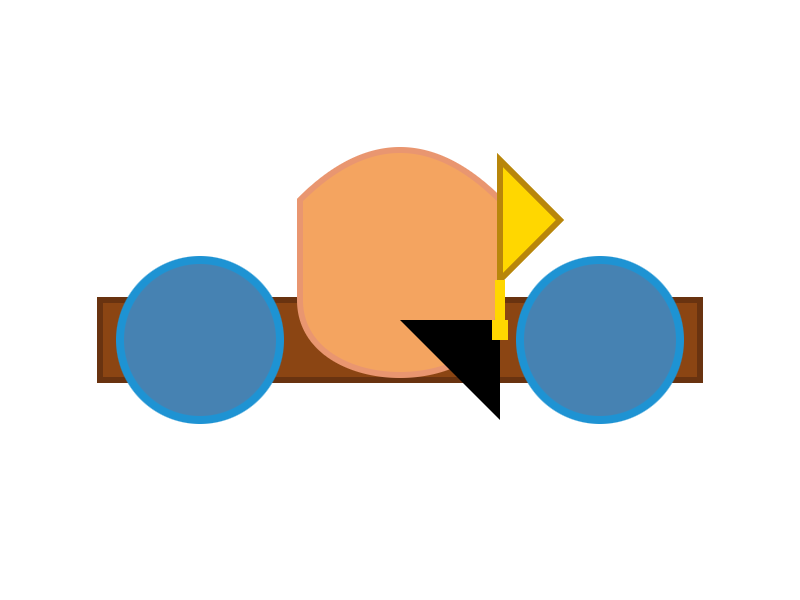
Pelicans for Gemma 4 E2B, E4B, 26B-A4B and 31B – the first three generated on my laptop via LM Studio, the 31B was broken on my laptop so I ran it via the Gemini API instead simonwillison.net/2026/Apr/2…
-
AI Timeline Predictions Shortened by 1.5 Years Due to Agent Progress
By
–
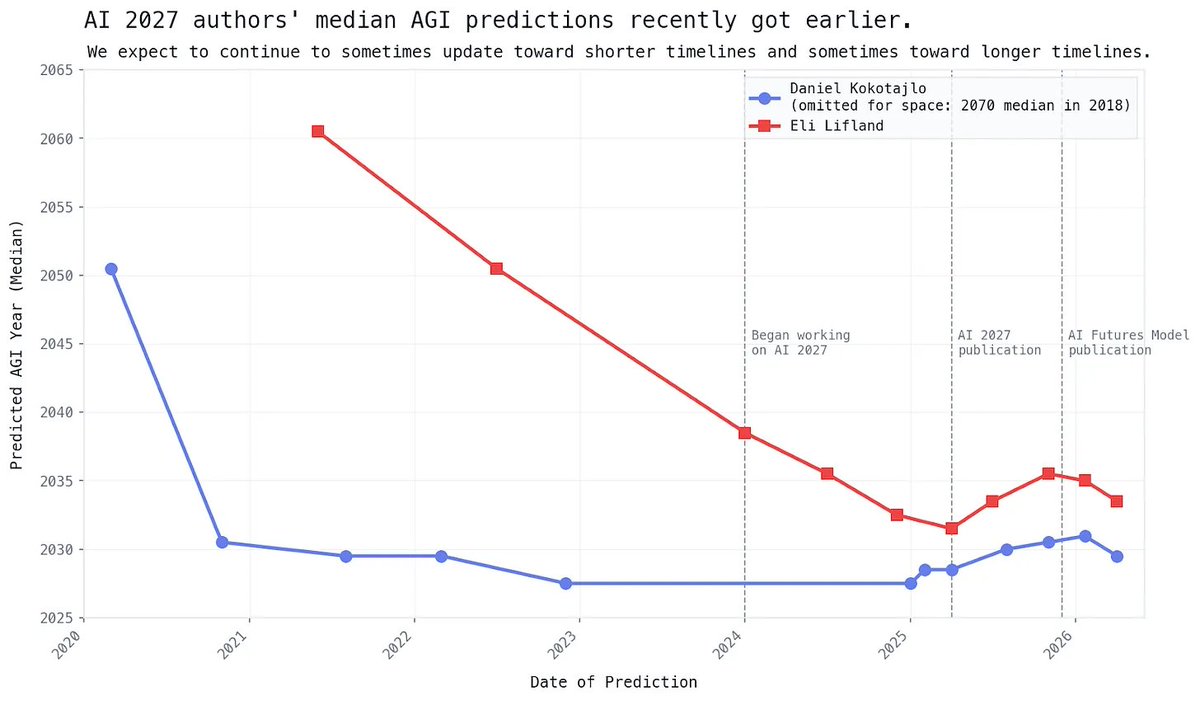
AI timelines update: @DKokotajlo and I have updated our timelines earlier by ~1.5 years over the last 3 months, primarily due to (a) expecting faster time horizon growth, and (b) coding agents impressing in the real world. During 2025, we had updated toward longer timelines.
→ View original post on X — @paulroetzer, 2026-04-02 18:34 UTC
-

Staying in Control During EDA with Coding Agents
By
–
How to stay in control when doing EDA with coding agents buff.ly/aZsp0Or #AI #MachineLearning #DeepLearning #LLMs #DataScience
→ View original post on X — @miketamir, 2026-04-02 18:33 UTC
-
Action-to-Action Flow Matching: Ultra-Fast Robot Control Method
By
–
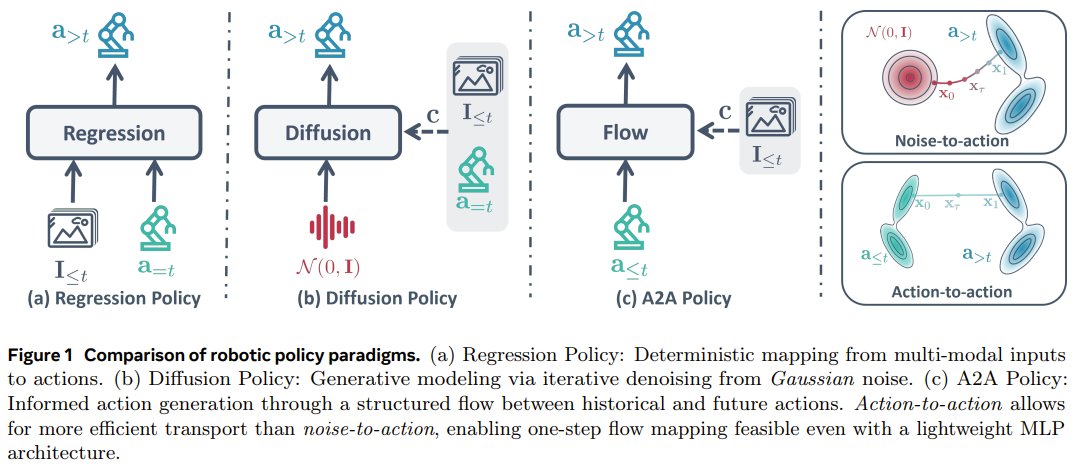
What if real-time robot control didn't have to wait for slow, iterative action generation? MARS Lab at Nanyang Technological University (Jindou Jia et al.) introduces Action-to-Action Flow Matching (A2A). This novel method uses a robot's own historical actions to directly predict the next move, skipping the slow, random noise sampling of traditional diffusion models. A2A enables lightning-fast, single-step action generation (0.56 ms!), vastly outperforming existing methods in speed, training efficiency, robustness to visual noise, and generalization to unseen configurations. It even shows versatility in video generation! Action-to-Action Flow Matching Website: lorenzo-0-0.github.io/A2A_Fl… arXiv: arxiv.org/pdf/2602.07322 Code: github.com/JIAjindou/A2A_Flo… Our report: mp.weixin.qq.com/s/mrSUcVLUA… 📬 #PapersAccepted by Jiqizhixin
→ View original post on X — @jiqizhixin, 2026-04-02 18:30 UTC
-
LLM Trained on Pre-1900 Text Discovers Modern Physics
By
–
I trained an LLM from scratch on pre-1900 text to see if it could come up with quantum mechanics and relativity.
— Michael Hla (@hla_michael) 2 avril 2026
While the model is too small to do meaningful reasoning, it has glimpses of intuition.
When given observations from past landmark experiments, the model can declare… pic.twitter.com/qVjUF6bvtpI trained an LLM from scratch on pre-1900 text to see if it could come up with quantum mechanics and relativity. While the model is too small to do meaningful reasoning, it has glimpses of intuition. When given observations from past landmark experiments, the model can declare that “light is made up of definite quantities of energy” and even suggest that gravity and acceleration are locally equivalent. I’m releasing the dataset + models and leave this as an open problem to the research community. I also include what this project has taught me about intelligence in a mini essay linked below. 🧵(1/n)
→ View original post on X — @thom_wolf, 2026-04-02 18:14 UTC
-
NVIDIA Reaches Major Milestone in AI Inference Era
By
–
"The inflection point for inference has arrived." — Jensen Huang, Founder & CEO of NVIDIA
— NVIDIA (@nvidia) 2 avril 2026
We’ve officially crossed a new milestone in the inference era — where widespread adoption of AI shifts from learning to doing.
The breakthrough: extreme codesign across hardware and… pic.twitter.com/ZZtR1SZa23"The inflection point for inference has arrived." — Jensen Huang, Founder & CEO of NVIDIA We've officially crossed a new milestone in the inference era — where widespread adoption of AI shifts from learning to doing. The breakthrough: extreme codesign across hardware and software driving down cost per token. Lower cost → more inference
More inference → more users and applications
More users and applications → exponential AI revenue growth [Translated from EN to English]